Reefing a furling gib - do I need to tie off the furling line?

Captain Crisp

Well-Known Member
Joined
1 Mar 2015
Messages
414
Visit site
Hi,
if I reef in my gib, do I need to secure the furling line to stop a heavy wind unravelling the sail again?
It's a continuous line on a loop, secured to the base off the pushpit, so I'm not too sure how I would do this!?
Thanks!
Crisp
 
Yes - you must tie it off - sounds like you have a Sailspar gear. I fittrd a Clutch to my Sailspar on my previous boat. Rutgerson and Spinlock can supply a clutch that you can fit onto an endless line. Makes reefing very easy, just pull on the line and that's it - stays nice and secure. Release the clutch to pull the sail out. Rutgerso & Spinlock are the only companies I know that can supply a clutch that you can fit onto an endless line.
 
Normally the line(s) are led aft so that they can be reached from the cockpit, as being able to reef and furl without going forward is one of the advantages of the usual roller system. Also I'm not sure how you unfurl using your arrangement as the usual way to get the jib started is to haul one of the jibsheets and that must be a two-person job if one of you has to be on the foredeck to operate the furling line, instead of a one-person job if you can haul the jib sheet and loose the furling line from the same place..

But yes, I think you need to make the reefing line fast unless you have some unusual geared system. My single line comes aft through a series of blocks attached to the stanchion bases, then through a jammer to a turning block, so I can haul from the cockpit, or surge the line out over a winch with one hand while unfurling using a jibsheet over a winch with the other hand.
 
When your "gib", is fully out, the furling line is not doing anything, you only use it to furl the "gib" by pulling it in, so no need to tie off.
However, if the "gib" is furled, part way or fully, then it needs to be tied or trapped to ensure the size of the "gib" is as required & doesn't inadvertantly deploy fully.
 
Normally the line(s) are led aft so that they can be reached from the cockpit, as being able to reef and furl without going forward is one of the advantages of the usual roller system. Also I'm not sure how you unfurl using your arrangement as the usual way to get the jib started is to haul one of the jibsheets and that must be a two-person job if one of you has to be on the foredeck to operate the furling line, instead of a one-person job if you can haul the jib sheet and loose the furling line from the same place..

But yes, I think you need to make the reefing line fast unless you have some unusual geared system. My single line comes aft through a series of blocks attached to the stanchion bases, then through a jammer to a turning block, so I can haul from the cockpit, or surge the line out over a winch with one hand while unfurling using a jibsheet over a winch with the other hand.
I think you may have read 'pushpit' as 'pulpit'. I admit to having done the same first time round. Tying to the pushpit would do, but I'm sure that a tidier method could be applied. I have a single-line system and make a loop in it and put it over a winch when leaving the boat. I don't regard this as making the jib fully secure and prefer to wind the spinnaker halyard round the furled jib as well, though a well-fitted furling sail sock would do as well.
 
I think you may have read 'pushpit' as 'pulpit'. I admit to having done the same first time round. Tying to the pushpit would do, but I'm sure that a tidier method could be applied. I have a single-line system and make a loop in it and put it over a winch when leaving the boat. I don't regard this as making the jib fully secure and prefer to wind the spinnaker halyard round the furled jib as well, though a well-fitted furling sail sock would do as well.
Yes. Sorry, my mistake. I can see that making fast to the pushpit would work, but how convenient that is will depend on the layout of the cockpit and how clear a lead you can give the line.

If the boat is anything other than very small I would be unhappy with having to release the reefing line under tension unless it can be surged round a winch. The problem isn't at the start of the process but when the wind begins to fill the sail, especially if you want to let out only part of the sail and need to stop the unrolling with a few turns left on the stay.

When leaving the boat I always take a couple of extra turns round the furler so there are some turns of jib sheet wrapped round the sail, then double check that I have secured the furling line. The turns discourage the sail from unwrapping. It's rare to see jibs/genoas unfurled by the wind on unoccupied boats but it happens sometimes and isn't a pretty sight. It could cause expensive damage.
 
I think you may have read 'pushpit' as 'pulpit'. I admit to having done the same first time round. Tying to the pushpit would do, but I'm sure that a tidier method could be applied. I have a single-line system and make a loop in it and put it over a winch when leaving the boat. I don't regard this as making the jib fully secure and prefer to wind the spinnaker halyard round the furled jib as well, though a well-fitted furling sail sock would do as well.
Re securing the headsail when leaving the boat, winding a couple of turns of the sheets around it and tieing sail tie around it as well will prevent any unforseen flogging.
 
Re securing the headsail when leaving the boat, winding a couple of turns of the sheets around it and tieing sail tie around it as well will prevent any unforseen flogging.
That is good advice, but I have seen furled sails after gales where the wind got hold of a weakness in the sail's leach where it may have been flapping, well above where you could reach from the deck, resulting in massive tears (probably from the owner too).
 
Yes - you must tie it off - sounds like you have a Sailspar gear. I fittrd a Clutch to my Sailspar on my previous boat. Rutgerson and Spinlock can supply a clutch that you can fit onto an endless line. Makes reefing very easy, just pull on the line and that's it - stays nice and secure. Release the clutch to pull the sail out. Rutgerso & Spinlock are the only companies I know that can supply a clutch that you can fit onto an endless line.

My furler is also a Sailspar, i just use a cam cleat to stop it unfurling, fitted to the cockpit coaming.
 
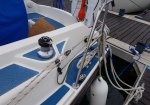
Ive got sailspar too. continuous line goes through a block which is bungeed to the base of the pushpit. the two lines run parallel to the cockpit where i have a jammer deck cleat. I only lock the loaded side of the loop as the bungee keeps it tight on the furling wheel.
Depending on what tack I'm on I will furl to reef in the appropriate direction so the Jib leading edge is always smooth. Not sure it makes any difference but I like to think it does.
When furling the sail away of course the uv protection goes on the outside.
 
mine is good to 40kts with only one side cleated. Ive not tested it above that.

from the sailspar instructions:
31) Fix a deck cleat in a suitable position for the control rope. Only one side of the rope loop is 'live” but both sides of the rope may be cleated. A single block on shock- cord may be fitted to keep the rope loop tensioned.
 
Because if you don't the line can slip and the reefed genoa unreefs itself.

Happened to me more than once before I learned to lock off both sides of the loop.

- W
mine is good to 40kts with only one side cleated. Ive not tested it above that.

from the sailspar instructions:

Similar to Bucks setup, I have a block in the loop (rather than bungy) , which has a line to the pushpit and back to a cam cleat, this allows me to keep the line under a little pressure, making it easier to furl and making it impossible for the line to slip on the furler. Plus, a single cam cleat to stop the genoa unfurling when reefed.

20201002_122534.jpg
 
Last edited:
Top