
vyv_cox
Well-Known Member
The tack and clew are pulled down exactly as required in the correct order. With a single line they are reversed.But why? What's the advantage?

The tack and clew are pulled down exactly as required in the correct order. With a single line they are reversed.But why? What's the advantage?
The number of blocks is exactly the same. Mine are ball blocks in which friction is almost zero.If there was no load being applied to the pullies and cars there would be no friction. Start to apply a load & it stands to reason that friction is created in the working parts as they start to operate.There is a relationship between load & friction at some point in the operation.

What? That's completely against my experience of a lot of sailing with the single line reefing system described above.The tack and clew are pulled down exactly as required in the correct order. With a single line they are reversed.
So what are those wheels inside the boom?The number of blocks is exactly the same. Mine are ball blocks in which friction is almost zero.

Cods wallopThe tack and clew are pulled down exactly as required in the correct order. With a single line they are reversed.
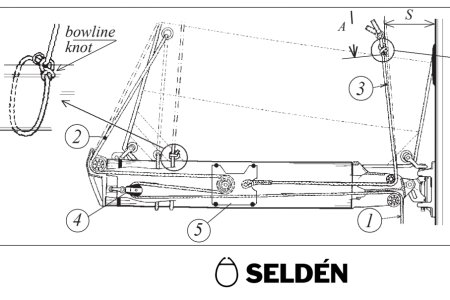
Again, this is completely counter to my experience with that system.I'm with Vyv on this one... and it's the way Selden set up my Moody S38 from new..
With the sliding car within the boom, the clew gets tensioned in perfect unison with the tack..
In a previous boat with a single line, the tack would always get pulled down to the gooseneck first and then the line was often at risk of chafing (the sail) as the reefing line was further pulled to tension the clew end.
The clew was always then more difficult to tension because the line was passing through the tack end of the reef...
Don't agree with that. We used to just bang off the halyard to the mark, then get on with pulling in the reefing line. Don't recall any issues.Cods wallop
One just controls the halyard tension as the sail falls & the clew comes in at whatever speed one wants.
One mistake with any single line car, or otherwise, is to just let the halyard fall in one lump as it can lead to a twist & jam in itself or the sail.
The drop needs to be controlled.
The reef line always passes to the tack end of the sail through a block on the tack (rather than through the cringle which is wrong)on single line, Car or no car.The clew was always then more difficult to tension because the line was passing through the tack end of the reef...
I did have halyards marked... but it was still a bit of a wiggly path for the reefing line to pass up and through the reef eye by the mast, then back into the boom, before exiting at the aft end of the boom.Again, this is completely counter to my experience with that system.
The key thing with it was to mark the halyard, so that you could just ease to that point, and then the block on the luff would be in the right place for a nice clean run.
I always leave a turn round the winch with the clutch open & winch the sail down. It tends to fall on its own but slower If I want a bit more on the clew I shut the clutch for a second. This picks the clew up. I do not have a mark on the halyard as I cannot see it in the dark. I have a reflective band on the mast I can see that at night better ) also I am looking up at the sail anyway ( It just suits me & I can see progress better)& drop the batten to just above the mark, shut the clutch & harden everything up so it stretches the sail with the batten level with the markDon't agree with that. We used to just bang off the halyard to the mark, then get on with pulling in the reefing line. Don't recall any issues.
We had 3 reefs on the single line. resulted in an absurdly long reef 3 though.I did have halyards marked... but it was still a bit of a wiggly path for the reefing line to pass up and through the reef eye by the mast, then back into the boom, before exiting at the aft end of the boom.
Also, as Vyv says.. This works for reefs 1 and 2... The third reef needs a separate line for each end of the reef..
Yes my 3rd reef is a 2 line system as I only need it every few years & it is bullet proof & can be doubled up on any other reef if I get a problem Seems pointless having to put a 3rd reef line away every time I adjust the sailI did have halyards marked... but it was still a bit of a wiggly path for the reefing line to pass up and through the reef eye by the mast, then back into the boom, before exiting at the aft end of the boom.
Also, as Vyv says.. This works for reefs 1 and 2... The third reef needs a separate line for each end of the reef..
If it works for you that is the way to goDon't agree with that. We used to just bang off the halyard to the mark, then get on with pulling in the reefing line. Don't recall any issues.
In general I'm not a fan of systems, especially sail handling systems, that need careful babysitting in order to avoid snags etc. Time spent working out how to de-snag them by design is normally time well spent. Especially reefing systems as when you need them you are already into conditions where performing "out of the ordinary" tasks such as reaching up to untangle a reefing line for example, are putting you at a heightened risk. Better to "design out" such risks if at all possible.If it works for you that is the way to go
Bit like vyv-cox's system really
But not for me

We’ve tried both ways, having the same simple setup. Controlling the drop just takes longer and is harder work for us. But I guess, as you say, it may vary from boat to boat and crew to crew. I can’t see the need for a more complex system though.If it works for you that is the way to go
Bit like vyv-cox's system really
But not for me

Yes ours is set up like that and works absolutely fine. There is a whipping on each reef line (and three on the main halyard) which, when aft of the clutch, represents maximum tension. All colour coded. Makes it easy to see when the reef is in and roughly how it is set.Don't agree with that. We used to just bang off the halyard to the mark, then get on with pulling in the reefing line. Don't recall any issues.
