Red light myth that's not a myth.

Pirates had eyepatches for a reason...
Not just Pirates but also pilots.

My uncle was supplied an RAF ministry approved eye patch for flying atomic V bombers post war.
The theory was if they were blinded by a nuclear flash then just remove eye patch and carry on!
The yanks spent a fortune developing and issuing reactolite lense headsets for protectihg their pilots eyesight.
 
I have read a few posts upon this... an excellent one posted by an ophthalmologist.

Red light (because of cones and rods) allows us to keep our night vision.

BUT does the intensity or brightness of the red light make a difference?

My thinking says "no".

If a red light wavelength maintains night vision, then a really bright red light should make no difference (except let the petson see more) to night vision.

Am I correct or talking rubbish?
Having read all replies, only one touched upon my question, so I am still confused.

If the red light is pure red at the required frequency, can it not be as bright as you like and still not affect night vision?

From what I gather, as long as pure red, it can be as bright as a lighthouse without affecting night vision. Am I wrong?
 
If the red light is pure red at the required frequency, can it not be as bright as you like and still not affect night vision?

Ideally the red needs to be kept dim, but it is nowhere near as critical to have the lighting level as low as possible as it is with other colours.

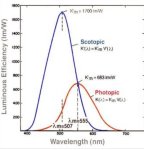
If you look at the photopic and scotopic spectral sensitivity curves if the red light is above 650nm (this is very deep red) it cannot be seen by the scotopic system and therefore cannot effect the dark adapation of this system.

However, dark adaptation has some component of cone function especially under mesopic (between photopic and scotopic) conditions, which are common on yacht. It therefore helpful even with red light to keep it as dull as practical.
FACD726A-28CC-4335-93F1-F446563E9A08.jpeg
 
Last edited:
Ideally the red needs to be kept dim, but it is nowhere near as critical to have the lighting level as low as possible as it is with other colours.

If you look at the photopic and scotopic spectral sensitivity curves if the red light is above 650nm (this is very deep red) it cannot be seen by the scotopic system and therefore cannot effect the dark adapation of this system.

However, dark adaptation has some component of cone function especially under mesopic (between photopic and scotopic) conditions, which are common on yacht. It therefore helpful even with red light to keep it as dull as practical.
View attachment 154160
Thanks
 
In the olden days red light was achieved by placing a red filter in front of white light, screening out much, but not all, of the other wavelengths. A consequence of this was that if the "red" light was bright enough to let you see detail there was enough light of other wavelengths leaking past to affect night vision. Could someone who knows tell us how pure the coloured light from LEDs actually is?
 
Lots of popular theories.

a. The military and aviation no longer use red. They researched it.
b. If you use while light that is sufficiently dim to read the charts with the same effectiveness as red, white will save more night vision (yes, I have been involved in testing). The point so many have missed is that you can use MUCH LESS white light and get the same effective reading ability as red, because the eyes are so much more sensative to shorter wave lengths, because the cones are MUCH better at reading detail, and because you loose a lot of information when everything is converted to a distorted black and white. You must compare them on an equal utility basis, not an equal brightness basis. The correct white light is very, very, very dim, much less than standard products without additional filtering. BTW, nearly all red chart lights are WAY to bright as well.

So yeah, the red light save night vision mantra is not the whole story. Not myth exactly, but not at all the whole story.

----

The best method is to get off your computer, go down in the basement, and test reading maps with very, very dim light, and then compare night vision. But the light must be very dim, just enough to read the chart, after the eyes are addapted for 15 minutes or so, with equal speed and acruracy. Probably with several layers of white tape over the lens to reduce the output.
 
Last edited:
Lots of popular theories.

a. The military and aviation no longer use red. They researched it.
b. If you use while light that is sufficiently dim to read the charts with the same effectiveness as red, white will save more night vision (yes, I have been involved in testing). The point so many have missed is that you can use MUCH LESS white light and get the same effective reading ability as red, because the eyes are so much more sensative to shorter wave lengths, because the cones are MUCH better at reading detail, and because you loose a lot of information when everything is converted to a distorted black and white. You must compare them on an equal utility basis, not an equal brightness basis. The correct white light is very, very, very dim, much less than standard products without additional filtering. BTW, nearly all red chart lights are WAY to bright as well.

So yeah, the red light save night vision mantra is not the whole story. Not myth exactly, but not at all the whole story.

----

The best method is to get off your computer, go down in the basement, and test reading maps with very, very dim light, and then compare night vision. But the light must be very dim, just enough to read the chart, after the eyes are addapted for 15 minutes or so, with equal speed and acruracy. Probably with several layers of white tape over the lens to reduce the output.
Another method is to be in red lighting in a submarine control room and then go to 'black' lighting to return to periscope depth at night. Make sure your torch has a red filter on it if you really need to see something in detail. Or you will get moaned at.
 
The point so many have missed is that you can use MUCH LESS white light and get the same effective reading ability as red, because the eyes are so much more sensative to shorter wave lengths,

This is where many misunderstand the basic physiology. The radiant flux of a red light needs to be much higher than white light. The eye is very insensitive to red light so it needs much more red light energy to be able to see, but dark adaptation is not controlled by the level of energy or radiant flux. It is controlled by the level of luminous flux (the eyes response to that energy).

As an example, we could set up very powerful IR "light" that would appear very bright to a camera that could respond to IR but would be invisible to a human. The IR "light" would have no effect on dark adaption. In this case the IR "light" has high energy. It has high radiant flux but zero luminous flux. It is not the energy in the light that influences dark adaption, rather it is the eye’s response to that energy. The cones of our visual system respond poorly to red light and the rod receptors do not respond at all (they cannot see red beyond about 650nm).

The best method is to get off your computer, go down in the basement, and test reading maps with very, very dim light, and then compare night vision. But the light must be very dim, just enough to read the chart, after the eyes are addapted for 15 minutes or so, with equal speed and acruracy. Probably with several layers of white tape over the lens to reduce the output.

This is not a great test. Trying to use red light to extract very detailed information quickly does not work. It is the wrong application for red light. Red light should be used for reading instruments (speed, depth wind etc) general tasks (getting dressed, making a hot drink, finding where you left the binoculars etc) or for extracting some basic information from a chart, radar or AIS. It is possible to accomplish these tasks and preserve your deepest levels of dark adaptation (using red light). These types of tasks are very common on a night watch, which is why the ability to switch to red light is important in a yacht.

Once you want to extract detailed and complex information from a chart or pilot book, especially quickly, you need to accept losing your deepest levels of dark adaptation in at least one eye. This does not mean that all dark adaption is lost, but all rod function will bleached out. For this task white light is better, keep it dim to preserve some of the dark adaption of your cone system. You need to be aware that after even with a brief exposure to dim white light (if you can resolve any detail) restoration of your deepest levels of dark will take some time, typically around 15-20 minutes. Plan accordingly, for example do a scan of the horizon before doing any detailed chart work.
 
Last edited:
Many military and civilians applications are moving to blue light for night if reading is required; the reason is that you can have much dimmer blue light and still read (maps, charts, medical notes etc) so your night vision is left more able to recover than the brighter red light needed to read in at night.
I'm a little surprised because Admiralty charts (at least, the ones we use) are designed to be clear under red light; the colour pallette was chosen for that (Admiralty charts don't use the 4-colour half-tone process; all the colours are "spot" colours). However, ECDIS and other electronic displays are of course self-luminous so the effectiveness of red lighting is unimportant, and ease of reading black-on-white documents may be more important, and I can imagine blue light to be more effective for that - I know I prefer "cold" (i.e. blue tinged) white lighting for reading.
 
Top