
Rectifier for charging - mercury sail power outboard

simonafloat

New Member
Joined
21 Jan 2018
Messages
14
Visit site
Hi all

i've had a 4hp mercury sailpower 2 stroke outboard on my signet 20 for ages now. I put wiring in for the charging circuit but only just got round to connecting it. Nothing happens, it doesn't charge at all. The battery voltage doesn't even blink. So I put a voltmeter across the output and its showing AC volts only. I'm thinking that my outboard only has the ac lighting coil and needs a rectifier?

Wondering if anyone with a mercury/tohatsu/mariner 4hp 2 stroke could take a photo of their rectifier so that i know what i'm supposed to be looking for. If I do need to buy one i'm wondering what the best source would be.

I know that some will say it's not worth doing given the small output but my mooring is a 40min motor from the open sea and unless the wind's favourable the outboard gets a good workout. Plus the wiring's already there so i may as well do it, unless a rectifier is £gazillion

thanks
 
My friend made me a bridge rectifier to replace the dead (and expensive) one on my yam outboard. It’s just four diodes soldered in a certain configuration, very simple to make. If you google “bridge rectifier” you’ll see what I mean.
 
I shall look into that, thanks
My friend made me a bridge rectifier to replace the dead (and expensive) one on my yam outboard. It’s just four diodes soldered in a certain configuration, very simple to make. If you google “bridge rectifier” you’ll see what I mean.
 
Hi all

i've had a 4hp mercury sailpower 2 stroke outboard on my signet 20 for ages now. I put wiring in for the charging circuit but only just got round to connecting it. Nothing happens, it doesn't charge at all. The battery voltage doesn't even blink. So I put a voltmeter across the output and its showing AC volts only. I'm thinking that my outboard only has the ac lighting coil and needs a rectifier?

Wondering if anyone with a mercury/tohatsu/mariner 4hp 2 stroke could take a photo of their rectifier so that i know what i'm supposed to be looking for. If I do need to buy one i'm wondering what the best source would be.

I know that some will say it's not worth doing given the small output but my mooring is a 40min motor from the open sea and unless the wind's favourable the outboard gets a good workout. Plus the wiring's already there so i may as well do it, unless a rectifier is £gazillion

thanks
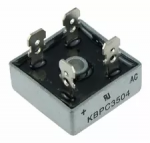
You dont give any model details ( year or serial number ) so cannot ID it specifically but a "Mercury" rectifier for it is likely to be around £60

However as already suggested a bridge rectifier from an electronic component suppiers will be much less, well under £10

This sort of thing with spade terminals ( I used one with a lighting coil for a good few years )

1606649169982.png
 
You can buy potted bridge rectifiers very cheaply. How many amps max are we looking at? I’m going to guess 5 amps max.

Bridge Rectifiers RS Components
Doesn’t matter if it exceeds your voltage and current. eg £2.81 plus p&p plus VAT is worth a punt
Thanks, I'll take a look. I have read that it needs to be a certain type of rectifier that doesn't impede current too much.
 
Thanks, I'll take a look. I have read that it needs to be a certain type of rectifier that doesn't impede current too much.
Further thoughts

I would have expected the Sailpower version of the engine to have a charging coil and rectifier as standard. Not just an AC lighting coil.

If you have connected your battery directly to a lighting coil I would have expected the coil to burn out

I suggest you check out what you have and check on its heath before proceeding
 
Last edited:
Thanks, I'll take a look. I have read that it needs to be a certain type of rectifier that doesn't impede current too much.
All silicon diodes have a forward voltage (ie give voltdrop) of about 0.7v. Germanium diodes and Schottky effect diodes have lower volt drop but are less robust and mostly used for signal not power circuits, and I cannot imagine anyone would use and old style metal oxide plate diode these days for this purpose.

As others have said a standard silicon diode bridge is the way to go to try things out, and specifically designed for power rectification. If it really gives more than about 14.5 volts on the output it could be an issue for the battery long term and its probably then cheaper to buy the Mercury one rather than build a charging limiter
 
Further thoughts

I would have expected the Sailpower version of the engine to have a charging coil and rectifier as standard. Not just an AC lighting coil.

If you have connected your battery directly to a lighting oil I would have expected the coil to burn out

I suggest you check out what you have and check on its heath before proceeding
My old Mercury had 2 coils. One for ignition and one for power. It gave an ac output but being poor 35 years ago I never got around to getting bits to make robust pluggable connection to battery. Diodes and plugs are cheaper and more available these days.
 
When I had a Selva 4hp outboard with an AC lighting coil as propulsion on a small yacht in the 1970s I made up four silicon diodes in a alloy box to connect it to a small car battery on board. It seemed to keep it up adequately with average outboard use. Prior to that I used to park my car on a slope facing downwards, and take the car battery to the boat if I was going off cruising and might want nav lights. Cabin lights and anchor light were paraffin. On return even if the battery was too low to start the car I could easily bump-start it!
 
When I had a Selva 4hp outboard with an AC lighting coil as propulsion on a small yacht in the 1970s I made up four silicon diodes in a alloy box to connect it to a small car battery on board. It seemed to keep it up adequately with average outboard use. Prior to that I used to park my car on a slope facing downwards, and take the car battery to the boat if I was going off cruising and might want nav lights. Cabin lights and anchor light were paraffin. On return even if the battery was too low to start the car I could easily bump-start it!
Those were the days!
 
I once worked with a mercury arc rectifier, seems to suit your requirements.
Ah mercury arc rectifiers. They were the days. Just for those who don't know they are a bit like a vacuuum tube rectifier but with mercury vapour. They are sued for high voltage several Kv and some amps but have a forward volt drop of around 50 volts.
Now re OP question of course he must identify if he has a charging/lighting coil fitted probably under the flywheel and next to ignition coil. The does he have a rectifier fitted. He may be able to follow wiring from charge coil to a box or to an outlet connector. Try a 12v lamp say 10watt on the outlet connector with engine running to confirm it has a good coil. Then use an amp meter to measure any charge into the battery. NB here a digital map meter will probably be useless with numbers dancing all over. Thsi si because the output will be DC but pulsed. A digital volt meter (amp meter also) measures the voltage periodically for a short period of time A few milliseconds. Thsi may or may not coincide with voltage peak of the output. So an analogue needle type meter cam average out the pulses.
Now in my experience with Johnson lighting coil it takes some engine revs to get a voltage from a silicon bridge rectifier to get a charge into a 12v battery. The forward volt drop of the silicon diodes about .7 is significant with 2 diodes in series at all times. So yes a schotky diode bridge gave more charge than silicon diodes but was still only about .3 amp. If like me you like to run o/b at low power or in my case not at all the diode bridge I made sits unused. ol'will
 
You can buy a motorcycle rectifier for less than £10 on ebay if you don't want to be doing any soldering,it also regulates the voltage.
 
You can buy a motorcycle rectifier for less than £10 on ebay if you don't want to be doing any soldering,it also regulates the voltage.
That's a fair call, but I suspect most small outboard charging coils won't throw out enough power for regulation to be an issue, if you have a reasonable sized battery in the system. If you anticipate motoring for many hours at high revs when the battery is already charged, it might be an issue.
I'd just try it with a 10A bridge rectifier and an old car battery.
Be aware that some of these 'lighting coil' malarkeys can put out a lot of volts at high rpm if not loaded.
Reminds me of the moped thread last week. My moped would blow all the bulbs if the headlamp blew, and the headlamps did blow, due to the vibration when ridden flat out as you do at 16..
 
Top