Recommendations for new lines

Lets say weather is getting really bad ... you are on the boat and its taking a beating ... you have choice ... let go from the boat and clear away ... or risk going on pontoon to let go ...
By that time I would have had a line from the bow cleat, around the shore cleat & back to the boat. Never had a situation where bad weather has caught me out before I can set up lines to suit. Sailing SH I rarely go ashore to release lines when casting off.
At my home port I have lines set & never have an issue. There I leave them on the pontoon. But that is a different situation
My loop goes through the middle of the cleat & over the horns so it does not fall off when approaching a docking situation. Then I just loop over the pontoon cleat & back if long enough.. My bow lines are cut so that if they drop in the water they do not quite reach the prop. Useful as I cannot see the foredeck from the helm so would not see if one washed of by a sea.
 
I only double a line back when I am short stay ... I never double back a line if weather expected or long stay ... the rope where it comes round the cleat chafes ...
In any weather / long stay - its even more reason to fig 8 lines on cleats.

A good example was my pal with his Borgstrom 31 ... Baltic Moor here at local marina .... I suggested he not double back his bow lines from the two pontoon cleats ... but he left them as is ... we had a few days of really bad weather and guess what ... one of his doubled lines at bow parted at the cleat ... and he was hanging by one doubled line of bow and the long sternm line to buoy. What saved him was laying up against the HR 42 next to him.

Needless to say - he no longer doubles lines back without first fig8 on shore cleat before passing end back.
 
Its worth thinking that most ropes we use - would pull the cleats out of deck ... and even out of pontoons ...

The main concern is not so much Breaking Strain of the ropes - but the diameter to cater for wear ... of course braided which many prefer has limited capacity for wear due to the outer braid sheath. But for heavy duty and liable to wear - there's always the good old 3 stranded rope. Or use of lengths of garden hose with rope passed through.
I suggest that there is a parameter missing in your post.
Stretchability of the rope.
I agree though that the breaking strain is less important than any wear.

As for doubling up - I am paranoid when I leave the boat.
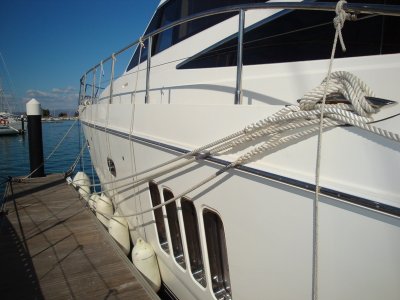
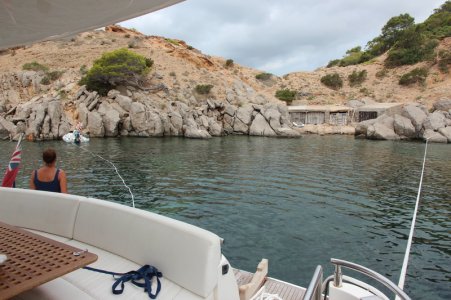
DSC04931.resized.JPG

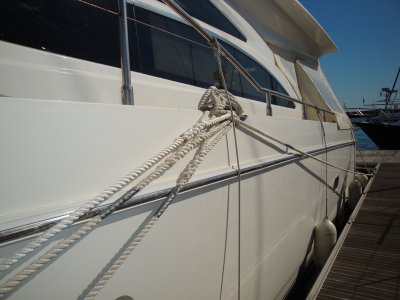
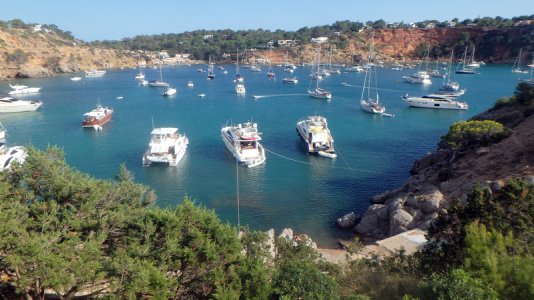
DSC04937.resized.JPG

We may be in the Med but we still get VERY strong winds coming through. The boat is a little under 50 tons.

It is also one of my bugbears - lots of people don't know how to tie their boats up.
IMO, bow and stern lines are intended to keep the bow and stern at set distance from the dock.
Springs do the main job of taking the load - as a spring pulls, the corresponding bow/stern line helps to keep that spring under tension.
Obviously, this all changes for Med style stern to moorings but Sant Carles has UK style pontoons.
You often see boats with loops attached to cleats along the length of the boat - obviously not doing much.
Springs need to be long - often as long as the boat.
Hence my original point stretchability.
Not too stretchy - not too stiff.
IMO, Nylon is no good - too stretchy.
I use good quality Polyester 3 strand (as said above - nice and easy to splice.
We have Braid on Braid lines but we only use them as travelling lines - easier on the hands (ours are 25mm dia).
 
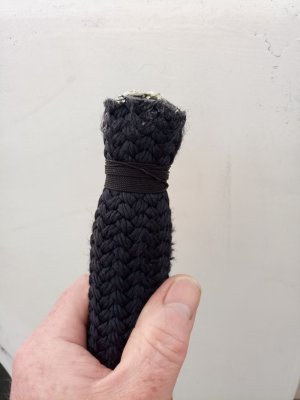
BTW - my nice floating rope has disintegrated.
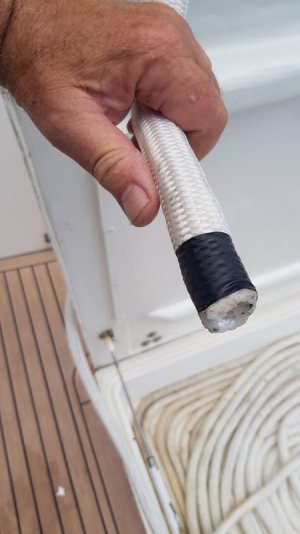
It was a lovely rope nice and strong - until the UV/elements got it.

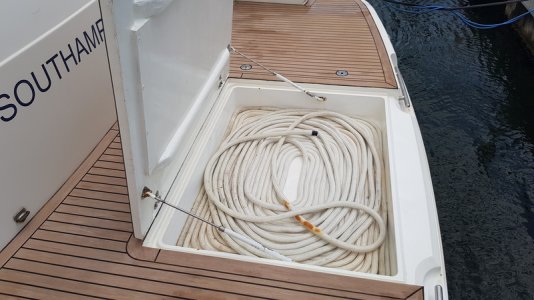
This is it when it was good
I bought 120m of it and cut it in half

20210712_125908.resized.jpg

20210712_125932.resized.jpg

We use it for this kind of thing
Rigging up the boat before a storm.

IMG_0481.resized.JPG

And this is that same spot after the storm - hence lots of boats.

P8100222e.resized.jpg

At the end of last season, I had to throw both (60m) pieces out - they were both, literally, crumbling.
It wasn't that I kept them in that locker because I kept the second half in a separate locker on the flybridge.
I also made a point of washing them out with fresh water and drying them after use.

Anyone know where I can get some more? - it was very nice rope before it disintegrated.
 
OK .. lets discuss what a ropes job is ... there are three main forms of mooring line :

Fore / Aft lines : These of course come from the bow and stern and they ideally should have a good lead forward and aft to the dock. This provides not only alongside but also restrict movement along dock (ranging). Their main job is to prevent bow or stern moving off the dock due external force - may it be tide / stream / other vessel passing etc.
Springs fore and aft : These are the main lines to set position of the boat and to restrict movement along the dock (ranging). They have no part in holding boat alongside the dock. A secondary job is to provide a means of turning / arresting / bring alongside a boat, It is generally accepted that the spring lines should be at least long enough to be effective and as near horizontal as possible. Quote : Springs do the main job of taking the load - as a spring pulls, the corresponding bow/stern line helps to keep that spring under tension. Unquote > Sorry but this is not correct.
Breast lines : These are lines that go at 90 degs or as near as from the boat to the dock - they provide holding alongside - but being usually short - suffer high strain. For many boats due to boat size / limitations - these are often not used. Breast lines have no part in preventing 'ranging'.

To give an example of the above and their relation in terms of holding a ship / boat .... ships will often use a variation of the 3 - 2 - 2 - 3 as minimum (3 head, 2 fwd springs, 2 aft springs, 3 stern) when suitable 3 - 2 - 2 - 2 - 2 - 3 ... being the addition of 2 fwd and 2 aft breast lines ..... In many situations - the number of head and stern lines will be increased.

Ok back to dock lines for a boat !!
 
The main concern is not so much Breaking Strain of the ropes - but the diameter to cater for wear ... of course braided which many prefer has limited capacity for wear due to the outer braid sheath. But for heavy duty and liable to wear - there's always the good old 3 stranded rope. Or use of lengths of garden hose with rope passed through.
I've always considered the outer sheath as the 'protective cover', the strength being in the core, but yes I cover any point where wear can and does happen with a plastic hose. Wear happens with three stranded lines as well.

There is an ancient line on one of my mooring buoys that I am in the process of cutting off. While not under load so far it has taken 15 minutes with a serrated knife to get half way through the core! Three stranded line would have been off in less than a minute!
 
It is also one of my bugbears - lots of people don't know how to tie their boats up.
In my experience most people tie up their boats with bits of wet string. Fine on a nice summers day, but when a blow comes through surprised to see that one or two lines have parted.
 
Quote : Springs do the main job of taking the load - as a spring pulls, the corresponding bow/stern line helps to keep that spring under tension. Unquote > Sorry but this is not correct.
OK - we will have to agree do disagree with this one.
Simple example (for a day without wind and tide etc).
Tie the boat up with just one spring (say the forward one).
Now pull the boat back against that spring and (in this case) the bow will move out away from the dock.
The act of a bow line keeps the bow in thus allowing the spring to do most of the work.
Try it - springs do much more than just stop the boat from going forward and backwards.

But, essentially, you and I agree.
It is a shame that a lot of people don't fit proper (long) springs.
 
OK - we will have to agree do disagree with this one.
Simple example (for a day without wind and tide etc).
Tie the boat up with just one spring (say the forward one).
Now pull the boat back against that spring and (in this case) the bow will move out away from the dock.
The act of a bow line keeps the bow in thus allowing the spring to do most of the work.
Try it - springs do much more than just stop the boat from going forward and backwards.

But, essentially, you and I agree.
It is a shame that a lot of people don't fit proper (long) springs.

Like many composite actions - you can interpret to suit your PoV ....

You are taking the matter of springing to / from a berth and using it to try and justify springs carrying vessels load alongside - not correct. Springs are primarily to reduce a vessels ranging on berth ..

I have spent all my working life with ships and such matters ... putting ships alongside each other ... alongside docks .. floating docks ... even warping ships into / out small harbours / dry-docks and many other instances.
 
I've always considered the outer sheath as the 'protective cover', the strength being in the core, but yes I cover any point where wear can and does happen with a plastic hose. Wear happens with three stranded lines as well.

There is an ancient line on one of my mooring buoys that I am in the process of cutting off. While not under load so far it has taken 15 minutes with a serrated knife to get half way through the core! Three stranded line would have been off in less than a minute!

May I suggest you get a good knife ?

Yes the outer is a protective sheath ... but once that is worn through - the chafe then has a field day on the core... unless it has a composite form. Some braided have a central part that is a composite - multiplying the BS of the rope ... and also making it hard to cut. mIt is common when cutting a multi braid - that sheath and braided inner cut easily - but the central core encompassed by the inner braid can often be very hard to cut.
3 strand can hardly have same ... but the wear characteristic of 3 strand allows a substantial reduction of strand and still retains reasonable strength.
 
We are not talking ships & in most cases large MOBOS.
People go over the top with lines. Most marinas are fairly calm & if they do tend to be rough on a windy day then owners can add lines to suit the situation
Most boat tie up in finger berths where there will be 2 cleats on the main pontoon. One to port & one to Stbd. There will usually be one roughly near the spring cleat & one at the end of the finger- This is often a hoop so best to take any rope back to the boat
So all it needs are 2 at the bow. One to each of the cleats & back to the boat is usually adequate unless there is surging which might cause some friction on the rope- But often unlikely. This lines the bow up on the pontoon & holds it .5 M away.
One from the stern of the boat to the end of the finger. This will almost certainly pull the boat forward as will the 2 bow ones. To stop this take a line from the spring cleat back to the end of the pontoon loop & back to the spring cleat & tension fairly hard.
If the boat wants to drift away from the pontoon a bit , making stepping ashore harder then drop a short line onto the middle cleat. One could use the end of the spring line.
When visiting places, one will be on & off the boat all day long so can keep an eye on the ropes as required.
4 ropes required, sized to suit the boat.
Finally- Do not put any rope through a fairlead. Unless really necessary. Most AWBs have useless ones that just wear through the ropes faster than anything.
 
DB .. my 'novel' was in replay to guys stated :

"We may be in the Med but we still get VERY strong winds coming through. The boat is a little under 50 tons."

Sort of puts it into another league from the run o mill ..

All I can say - is if guy thinks that springs are the main lines for his ~50 ton boat ... then I hope he doesn't moor near me any time !!
 
Top