Recommend me some nice thick copper battery/power lugs

I am very fond of my Klauke kit for crimping cables of various sizes. The K05L crimper has a range of in-built dies to cover most boat cable crimps, and the Klauke support documentation is really good.

180207_buchdokument_katalog2018_de-en.indb (klauke.com)

And here is some of their advice about multiple crimps: see doc on Processing Instructions

Technical Appendix | Klauke

It makes really solid crimps using home made chunks of copper tube without soldering.

Solidly recommended.
 
I am very fond of my Klauke kit for crimping cables of various sizes. The K05L crimper has a range of in-built dies to cover most boat cable crimps, and the Klauke support documentation is really good.

180207_buchdokument_katalog2018_de-en.indb (klauke.com)

And here is some of their advice about multiple crimps: see doc on Processing Instructions

Technical Appendix | Klauke

It makes really solid crimps using home made chunks of copper tube without soldering.

Solidly recommended.

The dies are designed to be used with connectors of particular dimensions, most notably OD and wall thickness. If you reduce either, the crimp is not as well made. The documentation you link to states:

The connections produced according to the assembly instructions with our tools comply with the tensile strength requirements of the standards
IEC 61238-1, DIN EN 60999 and DIN EN 60352-2.

Please note, that crimping solderless cable connections using tools from other manufactures does not guarantee a proper
connection. We recommend only the use of solderless cable connections from Klauke using Klauke tools.

Sorry Tim, but i cannot see any logic in buying a £200 Klauke crimper and using home made terminals of incorrect dimensions. Better to buy a £25 Ebay crimper and some decent terminals. IMO
 
I recently bought some from 12V Planet, absolutely no issues with the quality. However, they are also about twice the price of the ones @PaulRainbow recommended, so I've bookmarked those to try when I next need some more ?
 
Who said anything about incorrect dimensions ? With care, I can measure and make in a way that gives me confidence and satisfaction that it's a proper job.

I have tried pulling my DIY unsoldered connections to pieces using a lever, and cannot do it.

It's the flexibility to use the crimper on boat as well as agricultural stuff that has made it worth buying the crimper 8 years ago.

3EZtKSs.jpg
 
Better to buy a £25 Ebay crimper and some decent terminals. IMO

I have been looking at battery cable crimpers recently. Are the 10T Chinese hydraulic ones that sell for circa £30 any good? Seems to be little point in spending to much for the few cable connections i have to do.
 
I have been looking at battery cable crimpers recently. Are the 10T Chinese hydraulic ones that sell for circa £30 any good? Seems to be little point in spending to much for the few cable connections i have to do.

I'm very happy with mine. Not sure how long it will last, but for non-professional use it ticks the boxes
 
I have been looking at battery cable crimpers recently. Are the 10T Chinese hydraulic ones that sell for circa £30 any good? Seems to be little point in spending to much for the few cable connections i have to do.

Perfectly OK for what you need, i can't see any point in spending big money on tools for occasional use, if the budget ones do the job correctly.
 
Who said anything about incorrect dimensions ? With care, I can measure and make in a way that gives me confidence and satisfaction that it's a proper job.

How does one make the wall thickness of copper tube match that of proper DIN rated terminals Tim ?

The dies in a crimper are designed to apply a given pressure, provided the cable is the correct size and the diameter/wall thickness of the connector is of the dimensions that the die was designed for. If the wall thickness is less than that for which the die was designed the crimp will not be so tight. If you are happy with home made terminals that's entirely your choice, but it makes no sense to me to spend time making a terminal from scrap tube that doesn't conform to the required specifications and isn't even tinned, to save 49p
 
I have been looking at battery cable crimpers recently. Are the 10T Chinese hydraulic ones that sell for circa £30 any good? Seems to be little point in spending to much for the few cable connections i have to do.
Mine are fine too and have done probably 30-40 crimps in a few months.
 
Who said anything about incorrect dimensions ? With care, I can measure and make in a way that gives me confidence and satisfaction that it's a proper job.

I have tried pulling my DIY unsoldered connections to pieces using a lever, and cannot do it.

It's the flexibility to use the crimper on boat as well as agricultural stuff that has made it worth buying the crimper 8 years ago.

3EZtKSs.jpg

My Ebay Chrimper looks almost identical. Makes nice crimps, if the lugs are big/thick enough. Makes a slight mess of the thinner ones. Hence the question.
 
RS Sell most Klauke sized ones, but annoying not 1R10 (6mm2 cable, M10 hole).

Having now received some other sizes they appear to be better than my best ones.

Will take some pictures later to show the different, especially in the smaller sizes (6-6, and 25-10)
 
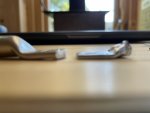
Some photos

Top Picture;
top left 6-6 CEF Engex vs Klauke
top right 6-8 Engex
Bottom left 25-6 Engex vs Klauke
Bottom right 25-10 my favourite from a closed chandlers vs Klauke.

Bottom picture - thickness difference between a CEF engEx and Klauke. Klauke must be double.

E8AA55F7-10D2-4AB1-BB54-4F6D8E3193A0.jpegFFB66262-9678-4A6A-84FD-E195F6B56D07.jpeg
 
Speaking from experience, for professional use these tools would have to be tested each year to ensure the crimp strength is correct. When I was on the tools and fastidious, I used to take my calibrated tools out of my van each night to avoid any large temperature swings - but that's just me.

I worked for a manufacturer where we did annual testing & calibration on our electrical tools, before anyone tries to call me out on this. Part of my apprenticeship was to do the testing. Our QC manager would also do spot testing, especially if we had a new product coming up.

So unless you are testing the tool against a known & calibrated weight, it's all just opinion. Which is fine, but it doesn't mean one brand or type is necessarily better than the other. The point has been well made that the quality of the terminal matters more than the type (hydraulic or box) of tool. I would also add to that the way the tool is used, and how the terminal/wire is terminated & finished will probably make just as much difference in the long-run...

As an aside if anyone is interested, the ABYC has some very good standards and guidance for electrical installations.
 
... and how the terminal/wire is terminated & finished will probably make just as much difference in the long-run...

@Moodysailor Nice post. Can you expand on that bit? Do you mean decent heat-shrink and suitably torqued bolts onto clean terminals?

As a slight aside as I have been replacing/changing some crimped fittings I have been chopping them up in the middle of the crimp. Most seem to be near sold lumps of wire. Ie you have to look hard to see the individual strands they are so tight.

Also when I make them I give them the patented "Jolly good pull test". Force varies due to wire strength. On the 6mm2 and 25mm2 I pull as hard as I can and only the insulation creeps. On the 1.5mm2 I pull less hard as I think I might be able to break the wire :-)
 
@Moodysailor Nice post. Can you expand on that bit? Do you mean decent heat-shrink and suitably torqued bolts onto clean terminals?

As a slight aside as I have been replacing/changing some crimped fittings I have been chopping them up in the middle of the crimp. Most seem to be near sold lumps of wire. Ie you have to look hard to see the individual strands they are so tight.

Also when I make them I give them the patented "Jolly good pull test". Force varies due to wire strength. On the 6mm2 and 25mm2 I pull as hard as I can and only the insulation creeps. On the 1.5mm2 I pull less hard as I think I might be able to break the wire :)

Yes, exactly that. I've also seen cases where the wire is not inserted fully into the terminal before crimping, and where the insulation on the cable has been stripped back too far.

Best is to think of it as a 'system'. I've seen @PaulRainbow allude to this in other threads too, but in essence, you need to ensure every link in the chain is up to the task - otherwise it fails at the weakest link, and the rest is pointless.

So make sure that the terminals are well made, properly connected onto terminal posts that are adequately sized, clean from verdigris, grease or corrosion. You don't want too many terminals sharing the same post (that is what bus bars are for). The cables should be adequately sized (taking into account future degradation/loads) and well routed. Ends should have sufficient 'service length' to be re-made if needed, and in an ideal world the connections would not be in an area that has too much chance of a soaking. For battery connections, good ventilation is a must if using LA batteries as the gasses can be corrosive.

I like you "JGP test", it's what I do myself and now I'm not doing it for a living is perfectly sufficient. That said, I've made so many connections over the years (and enough mistakes too) so I have a reasonable gauge if it's a good crimp just by the way it feels when crimping (this is for the small red/blue/yellow insulated ones - not battery terminals).

The goal of a crimp connection is to squeeze the individual strands together into one cohesive lump, so it's good you observe that. Some still like to solder, but there are several good reasons why the industry has gone away from solder connections for most electrical terminations, so I think it's a bit of a throw-back.
 
I am sitting next to a pile of crimps that did not work. On the smaller "Red" (well more pink for the Adhesive Heat Shrink ones) my hit rate yesterday was around 30% failures.

On the larger ones the large lever crimp I have does a good job if I can align it all and keep the wire pushed in. Sometimes easier said than done.

One area I have failed to crimp is Anderson SB175 connectors. I solder those. This is mostly due to the tool I have been too weak to crush the very heavy gauge Anderson SB175 connectors.

I am careful on the amount of exposed wire (a few mm) and heatshrink goes over the top.

@Moodysailor I like your point on leaving service length - this is something I have omitted in the past and now regret.

Also with my past experience of an LA Battery cooking I am now removing all connections from the batteries and having some buss bars near them for those "Direct to battery" devices (VHF/Bilgepump/Chargers). I am to have the batteries on Anderson connectors.
 
Top
