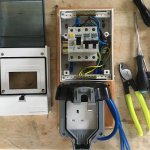
Recommend me a RCD please

More and more new Domestic Customers are expecting or asking for 100% RCBO. We have come through, no RCD, at all: to one for the whole board, to two and now 100% RCBO. Price of RCBO has come down considerably and they are neater and less fiddly to install, plus better understood. Given that getting called back for tripping nuisance is enemy number one, RCBO are winning. In my book it is an extravagance but hey! Regs are also tightening up on non RCD protected circuits, we have travelled from optional, to required on socket circuits, unless risk assessment produced to exempt a circuit. Now, the RA route is closing and lighting circuits are to be covered. With all the extra circuits increasing trip risk, RCBO is the answer more and more.
 
RCBO's are generally to replace the individual MCBs, for instance when you want earth leakage protection on an individual circuit, so tripping the lawnmower doesn't turn the freezer off or something.
I'm talking about the double width main switch/RCD/overload which does the whole box.
The one in my garage has a fuse symbol as well as the RCD symbols.
Not all RCD breakers have the fuse symbol on though....
The RCBO which does the whole box will be a double pole one The ones on individual circuits will normally be be single pole .

What's the significance of the fuse symbol?
 
To save on starting a new thread.
I've bought the RCD that channel sailor recommended with a 6amp and 16amp MCB. the company was 5mins around the corner from me!
After Pauls comment about adding a battery charger I'm looking at a Sterling Power Pro Sport dual 5amp which is fine for my battery needs.
Question I have is will this be ok on the 6 amp MCB, the charger is 2x 5amp so 10amp?
Am I missing something?
 
Am I missing something?
Yes, voltage. The 6 A MCB is on the 240V AC system, it will pass some ≈ 1 400 W. The 2 x 5 A charger is on the 12 V dc system ≈ 120 W. (The power draw of the charger will be greater though, as it will also produce a lot of heat and possibly drive a fan. Maybe 200 W in total?)
 
Yes, voltage. The 6 A MCB is on the 240V AC system, it will pass some ≈ 1 400 W. The 2 x 5 A charger is on the 12 V dc system ≈ 120 W. (The power draw of the charger will be greater though, as it will also produce a lot of heat and possibly drive a fan. Maybe 200 W in total?)

Couldn't find any figures for the 10a Sterling charger, but the 20a Pro Charge Ultra is quoted as being 350w, so your 200w isn't far out.

The 6a MCB will be fine.
 
I know you guys are right but I can't get my head around it.

Is there a good source for me to learn the basic's of Watts, Amps, Volts, the relationship between the three. I've done a google search and found a few videos, etc but is there anyone you would recommend?

thanks
 
I know you guys are right but I can't get my head around it.

Is there a good source for me to learn the basic's of Watts, Amps, Volts, the relationship between the three. I've done a google search and found a few videos, etc but is there anyone you would recommend?

thanks
Yes
The "Boat Electrical Notes" from Tony Brooks' TB-Training website at "Tony Brooks' marine courses and advice" cover the basics of electrical theory well.
 
Thanks for that VicS, at the moment I'm going backwards...

What the hell is a Coulomb! LOL
 
Thanks for that VicS, at the moment I'm going backwards...

What the hell is a Coulomb! LOL

Dunno how you gotito coulombs. Coulombs = amps x seconds but you are not likely to want to know that

The other thing you might want to know is "Ampere hours" (Ah) in relation to battery capacity , Ah= amps x hours
 
Last edited:
Dunno how you got ito coulombs but coulombs = amps x seconds But you are not likely to want to know that

This is the problem with just google searching things you end up not understanding whats important.
I'm currently going though the training on the link you posted, just right for my level.
Thanks again.
 
I just spotted mention of "RCBO"s in the posts above. I would suggest: if Residual Current Circuit Breaker is installed on board as both a main isolator (for maintenance purposes) and as a safety measure to reduce the risk of electric shock, then it should be a double/two pole switching RCD/RCCB. The reason for this is because in a marina supply there could be a voltage differential between the Neutral and and the Earth wires, enough of a difference to cause an electric shock. So if the RCD/RCCB trips off because of a fault then both Neutral and the Live and disconnected.

The reason for explaining this is because if someone decided to install one of the now very commonly available RCBOs (instead of an RCD), they should note that most of the RCBOs available cheaply are single pole switching only. Though there are a few manufacturers now offering double pole RCBOs. Double pole RCBOs have all the electronics of an MCB and and RCD in one tiny module, so typically they are more expensive.

Anyway, on a little family yacht I cannot think of a good reason for having a double pole RCBO on all and every separate circuit on board. Maybe they would have a place on a large live aboard with more than three or four living onboard and/or if you had a large switched mode charger, other multiple significant electronic equipment or as mentioned above even a freezer. But then you are certainly into the realms of a 32A capacity supply, Type A RCDs (not type AC) or even a three phase supply. I am no expert on live aboard electrics but 16A I reckon is not a lot for a shore tethered live aboard multi cabin yacht if you want heat hot water or have any electric heating.

Remember that in a decent UK marina the 16A supply will have a RCD in the pillar protecting the 16A supply to the yacht anyway. This means having a RCD onboard is primarily for when connecting to a shore supply that does not have an RCD, or has a specification of RCD that is not recommended or the RCD on shore is faulty. It just so happens cheap "Garage" Consumer Units (fuse boxes) have an RCD built in anyway at no extra cost.

This shore power and "Garage Consumer Unit" on a little yacht discussion got me thinking:-

If your yacht has onboard an RCD of the same specification (probably 30mA Type AC) as the shore side RCD, then if there is an earth leakage fault onboard then it will be a race of say between 25 to 200 milli seconds between the two RCDs as to which one will trip first. Though it would need some professional design selection of more expensive components, I suggest it would be nice if the trip on your yacht tripped first because it means after you have disconnected the offending faulty item of equipment, you do not need to stumble up the finger pontoon in the dark, find the correct one of the two trips in a pillar, unscrew the cover thumb screw in the dark then flick it back on. In some cases the shore side RCD is not in the adjacent pillar but is elsewhere on the pontoon (Dan Brun pontoon and the New Town Quay pontoons in Lymington for example). In other words if the onboard double pole RCD was specified to trip off at 10 or 20mA of fault leakage and the shore side RCD was set at 30mA leakage, then the on board one would always trip off first. I have seen 10mA trip RCD/RCCBs for sale a while ago.

On a similar train of thought, the socket on the Pontoon is usually rated at 16A maximum. It will have an excess current MCB (probably 16A as well) to protect the socket from taking too much power. On board your yacht you could have a few sockets on a circuit protected in your "Garage Consumer Unit" by a 16A MCB onboard. If you turned on a 2Kw heater and kettle at the same time, this could be enough energy/power draw in excess of 16A for say 5 seconds that it will cause a 16A MCB to trip off. Once more it could be a race between the shore side 16A MCB and the onboard 16A MCB. Again there could be some merit in having an MCB onboard of less than a 16A rating, or faster operating, to ensure it is the one on the yacht that trips first. You can buy 10A MCBs, but you would probably need one 10A MCB for each 13A type socket, unless you do not use high power appliances in the onboard sockets.

Interestingly maybe, if you only had a DIY 13A socket and plug top on the end of your 16A shore power lead, that plug top will a 13A fuse in it. I would guess in an excess (>16A) current situation it is very likely any shore side 16A MCB will trip much quicker a 13A fuse will blow. Maybe it will easier anyway to reset the shore side trip as opposed trying to change a fuse in a 13A plug top.

Conclusion: OK so a cheap garage Consumer Unit for £30 enables you to properly terminate a 16A rated shore supply onto your yacht and it provides a method to fuse down the circuits on board safely for 16A cables, importantly for 13A for socket accessories (or 6A for lighting fittings). But this cheap garage unit MCBs might never actually trip (because the shore side one might trip first) and the RCD in the same box might never trip because again shore side one might trip first.
 
I know you guys are right but I can't get my head around it.

Is there a good source for me to learn the basic's of Watts, Amps, Volts, the relationship between the three. I've done a google search and found a few videos, etc but is there anyone you would recommend?

thanks

Very basically Watt = Amps x Volts so 5 Amps x 12 Volts = 60 Watts

It you take that 60 Watt then current at 240 Volts Amps = Watt / Volts 60 / 240 = 0.25 Amps. This is at 100% efficiency.

This is very basic and apply to DC volts /Amps.

AC as in mains this apply to non inductive loads (resistive) when you talk about mains electric motors which are inductive the may not apply but will still give you a guide wen the motor is running
 
I just spotted mention of "RCBO"s in the posts above. I would suggest: if Residual Current Circuit Breaker is installed on board as both a main isolator (for maintenance purposes) and as a safety measure to reduce the risk of electric shock, then it should be a double/two pole switching RCD/RCCB. The reason for this is because in a marina supply there could be a voltage differential between the Neutral and and the Earth wires, enough of a difference to cause an electric shock. So if the RCD/RCCB trips off because of a fault then both Neutral and the Live and disconnected.

The reason for explaining this is because if someone decided to install one of the now very commonly available RCBOs (instead of an RCD), they should note that most of the RCBOs available cheaply are single pole switching only. Though there are a few manufacturers now offering double pole RCBOs. Double pole RCBOs have all the electronics of an MCB and and RCD in one tiny module, so typically they are more expensive.

Anyway, on a little family yacht I cannot think of a good reason for having a double pole RCBO on all and every separate circuit on board. Maybe they would have a place on a large live aboard with more than three or four living onboard and/or if you had a large switched mode charger, other multiple significant electronic equipment or as mentioned above even a freezer. But then you are certainly into the realms of a 32A capacity supply, Type A RCDs (not type AC) or even a three phase supply. I am no expert on live aboard electrics but 16A I reckon is not a lot for a shore tethered live aboard multi cabin yacht if you want heat hot water or have any electric heating.

Remember that in a decent UK marina the 16A supply will have a RCD in the pillar protecting the 16A supply to the yacht anyway. This means having a RCD onboard is primarily for when connecting to a shore supply that does not have an RCD, or has a specification of RCD that is not recommended or the RCD on shore is faulty. It just so happens cheap "Garage" Consumer Units (fuse boxes) have an RCD built in anyway at no extra cost.

This shore power and "Garage Consumer Unit" on a little yacht discussion got me thinking:-

If your yacht has onboard an RCD of the same specification (probably 30mA Type AC) as the shore side RCD, then if there is an earth leakage fault onboard then it will be a race of say between 25 to 200 milli seconds between the two RCDs as to which one will trip first. Though it would need some professional design selection of more expensive components, I suggest it would be nice if the trip on your yacht tripped first because it means after you have disconnected the offending faulty item of equipment, you do not need to stumble up the finger pontoon in the dark, find the correct one of the two trips in a pillar, unscrew the cover thumb screw in the dark then flick it back on. In some cases the shore side RCD is not in the adjacent pillar but is elsewhere on the pontoon (Dan Brun pontoon and the New Town Quay pontoons in Lymington for example). In other words if the onboard double pole RCD was specified to trip off at 10 or 20mA of fault leakage and the shore side RCD was set at 30mA leakage, then the on board one would always trip off first. I have seen 10mA trip RCD/RCCBs for sale a while ago.

On a similar train of thought, the socket on the Pontoon is usually rated at 16A maximum. It will have an excess current MCB (probably 16A as well) to protect the socket from taking too much power. On board your yacht you could have a few sockets on a circuit protected in your "Garage Consumer Unit" by a 16A MCB onboard. If you turned on a 2Kw heater and kettle at the same time, this could be enough energy/power draw in excess of 16A for say 5 seconds that it will cause a 16A MCB to trip off. Once more it could be a race between the shore side 16A MCB and the onboard 16A MCB. Again there could be some merit in having an MCB onboard of less than a 16A rating, or faster operating, to ensure it is the one on the yacht that trips first. You can buy 10A MCBs, but you would probably need one 10A MCB for each 13A type socket, unless you do not use high power appliances in the onboard sockets.

Interestingly maybe, if you only had a DIY 13A socket and plug top on the end of your 16A shore power lead, that plug top will a 13A fuse in it. I would guess in an excess (>16A) current situation it is very likely any shore side 16A MCB will trip much quicker a 13A fuse will blow. Maybe it will easier anyway to reset the shore side trip as opposed trying to change a fuse in a 13A plug top.

Conclusion: OK so a cheap garage Consumer Unit for £30 enables you to properly terminate a 16A rated shore supply onto your yacht and it provides a method to fuse down the circuits on board safely for 16A cables, importantly for 13A for socket accessories (or 6A for lighting fittings). But this cheap garage unit MCBs might never actually trip (because the shore side one might trip first) and the RCD in the same box might never trip because again shore side one might trip first.
You wouldn’t want to downrate your onboard MCBs if part of the installation is a combi charger inverter with power assist. In that situation the inverter can blend a supply from shorepower and inverted 12v to provide say 20A on the socket circuit - to cope with your scenario of heater and kettle - in which case an MCB rated to protect the 2.5mm would be better - say 20A or so.
 
It's interesting reading through this thread and the things people think or assume they're protected from. Having had two separate incidents with boat power supply I can confidently say it's not as straightforward as you'd think. My first incident (with the TLC unit linked) was when condensation built up over months or weeks inside a 4 gang socket to the point it was full of water. No leaks, just condensation during the winter months. Boat didn't trip, socket didn't trip, pontoon didn't trip, marina did. I'm told it took them several days to troubleshoot and find my boat. Second incident the shore cable parted and dropped into the water. The socket did trip, but only after burning over £5 of electricity in the water, presumably raising the water temperature ever so slightly.
I'm not really making a point here, other than to say you're probably not as protected as you think you are, regardless how many "trip switches" separate you from the supply, so always be careful on boats!
 
In the interest of finishing a thread, this is what I decided to do. When I can get back down the boat I’ll get it fitted. The plug is wired to the 6amp and is just for the charger.

DB3FF8FE-E159-4EBC-83B8-410D91E2E79B.jpeg
 
FWIW I have just had the house electrics (50 years old) upgraded/replaced.

The new metal consumer unit is populated with RCBOs (residual current circuit breaker with overcurrent protection)) and monitors electrical circuits to keep them running safely, disconnecting the circuit if it's unbalanced. These devices are commonly used where there is a need to combine protection against overload, short circuit and earth leakage currents. A great range of curve types, phases and amp ratings are available to suit the usage profile and equipment and wiring to be protected.

I am not sure if the 18th edition applies to yachts, but it would be sensible to follow the latest guidance and standards.
 
FWIW I have just had the house electrics (50 years old) upgraded/replaced.

The new metal consumer unit is populated with RCBOs (residual current circuit breaker with overcurrent protection)) and monitors electrical circuits to keep them running safely, disconnecting the circuit if it's unbalanced. These devices are commonly used where there is a need to combine protection against overload, short circuit and earth leakage currents. A great range of curve types, phases and amp ratings are available to suit the usage profile and equipment and wiring to be protected.

I am not sure if the 18th edition applies to yachts, but it would be sensible to follow the latest guidance and standards.
I’ve read about on these and am considering them for our installation/refit - especially now that more single module versions are available.

I particularly like the idea of double pole, single module RCBOs because, as I understand it, the circuit remains protected in the case of reverse polarity (say in an overseas marina):
40A Double Pole 1 Module B Curve 6kA 30mA Type AC Mini RCBO
 
I’ve read about on these and am considering them for our installation/refit - especially now that more single module versions are available.

I particularly like the idea of double pole, single module RCBOs because, as I understand it, the circuit remains protected in the case of reverse polarity (say in an overseas marina):
40A Double Pole 1 Module B Curve 6kA 30mA Type AC Mini RCBO
The RCBO in your link is not double pole switched The diagram on the side shows it to be single pole switched and the spec describes it as "single pole and neutral".

ITYWF that all the switching; isolator (when applicable), circuit breakers , RCDs and socket switches, should be double pole with a non polarised system ( or if the polarity will be reversed) to avoid the situation where the neutral might be switched off by a single pole switch leaving the circuit or an appliance still live .

A reverse polarity indicator and a reversing adapter might be a better idea.
 
Last edited:
Top