Recommend me a compact consumer unit

mrangry

Well-Known Member
Joined
12 Jun 2007
Messages
993
Location
Clyde
Visit site
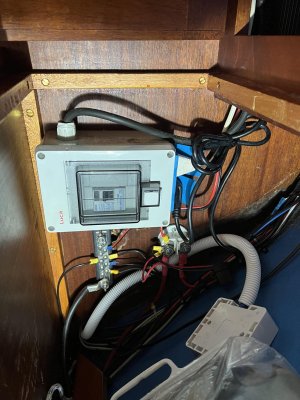
I am looking to replace the ac consumer unit on a friends boat following the fitting of a calorifier (1200w). Currently the boat only has a 230v battery charger and now a 230v water heater, although for future proofing would like to allow for socket outlets at a later date. Has anyone any recommendations on a particular unit that is small in size as space is tight.
 
You are really dictated by the number of circuits you want which is a minimum of 3. If I was redoing my consumer unit I would possibly use double pole RCBO's and not have an RCD plus allow space for a few more circuits.
RCBO's are expensive compared with circuit breakers though.
 
I am looking to replace the ac consumer unit on a friends boat following the fitting of a calorifier (1200w). Currently the boat only has a 230v battery charger and now a 230v water heater, although for future proofing would like to allow for socket outlets at a later date. Has anyone any recommendations on a particular unit that is small in size as space is tight.
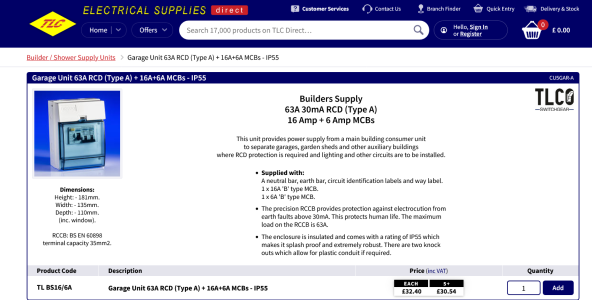
Why not get something similar to these and build with appropriate units. Bear in mind that Double pole units, RCDs, MCBs etc. will be two modules wide.
WCED Consumer Unit Enclosures
 
The problem with current regs is that the CU box has to be metal which isn't the best material on a boat as they are usually made from cheap painted steel. I'd probably search out an older plastic version.
 
There are many different brands like the one in post#5, often called "Garage" units. They are all much the same size as that is controlled by the number of MCBs plus space to fit wires and busbars. Can't see a problem with painted steel if you locate it inside the boat.
 
The problem with current regs is that the CU box has to be metal which isn't the best material on a boat as they are usually made from cheap painted steel. I'd probably search out an older plastic version.
I am unaware of any regs for a leisure boat at sea. Are you meaning best practice?
 
I am looking to replace the ac consumer unit on a friends boat following the fitting of a calorifier (1200w). Currently the boat only has a 230v battery charger and now a 230v water heater, although for future proofing would like to allow for socket outlets at a later date. Has anyone any recommendations on a particular unit that is small in size as space is tight.

The problem with current regs is that the CU box has to be metal which isn't the best material on a boat as they are usually made from cheap painted steel. I'd probably search out an older plastic version.
It is the current IET Wiring Regulations for electrical installations in domestic, commercial and industrial settings that requires metal boxes

Plastic boxes can still be found eg this weatherproof (IP65) one:- 5 Way Garage IP65 Weatherproof Consumer Unit Enclosure 16A 40A 30mA RCD Fuse Box | eBay
 
I am unaware of any regs for a leisure boat at sea. Are you meaning best practice?
There are no current regs stating what material consumer units should be made of on a boat. In fact, there doesn't even have to be a consumer unit.

But with 18th edition regs prohibiting plastic consumer units in most premises, you might find it difficult to find one.

There is a "loophole" that allows garage consumer units to be made from plastic, as long as it is housed in a non combustible enclosure.
 
Last edited:
There are for new boats under the RCD, but not for retrofit. Not sure whether the regs stipulate non metallic casings, but loads of boats, mine included have the metal cased garage units. What is worth following is earthing to water - I used a dedicated button anode but you can use an existing anode if more convenient and fitting a galvanic isolator. Put the sockets on one circuit with one for the heater and the charger on its own circuit.
 
I am by no means an electrician, but the current box only has a "Malmbergs sd62 2 pole 40a" and 2 euro plug outlets. I am now wondering can I just use this box and simply use euro plug adapters to run a circuit for the water heater and the other for a socket or two with the charger plugging into a socket, or am I better just replacing the unit altogether.
 
There are for new boats under the RCD, but not for retrofit. Not sure whether the regs stipulate non metallic casings, but loads of boats, mine included have the metal cased garage units. What is worth following is earthing to water - I used a dedicated button anode but you can use an existing anode if more convenient and fitting a galvanic isolator. Put the sockets on one circuit with one for the heater and the charger on its own circuit.
Thankfully there is already a galvanic isolator, will check the grounding to water.
 
I am by no means an electrician, but the current box only has a "Malmbergs sd62 2 pole 40a" and 2 euro plug outlets. I am now wondering can I just use this box and simply use euro plug adapters to run a circuit for the water heater and the other for a socket or two with the charger plugging into a socket, or am I better just replacing the unit altogether.
All you have is an RCD, no circuit breakers !

You can keep the current consumer unit and fit a coupe of MCBs, one for the existing sockets and a second for the water heater.
 
The problem with current regs is that the CU box has to be metal which isn't the best material on a boat as they are usually made from cheap painted steel. I'd probably search out an older plastic version.
That is for domestic and mainly in escape routes or under stairs.

You can still buy plastic CU's for boats, sheds, etc.

Less common but if you really want compact, you can get single module compact rcbo's.
 
That is for domestic and mainly in escape routes or under stairs.

You can still buy plastic CU's for boats, sheds, etc.

Less common but if you really want compact, you can get single module compact rcbo's.
Double pole compact here:-
Wylex 16A 30mA DP Type B Mini RCBO - Screwfix
You can also get single module DP compact MCBs. Google will reveal suppliers.
As Paul has said you can retain the existing enclosure. You can either keep the RCD and add three additional DP compact single module MCBs. 16 amp for the sockets, 6 amp for the Battery charger and what ever is suitable for the heater.
Or, replace the RCD with a suitable (probably 16amp) DP MCB and fit three compact DP RCBOs current rated as above.
I would personally favour the later, but that is personal choice. I would advise the use of Double pole units. Not single pole and Neutral or two pole as they are sometimes described. You want to switch both Line and Neutral. Just in case of polarity reversal. I am not sure if DP is not mandated for boats?? Expect Paul will fill in on that.
 
Last edited:
Last edited:
4Way Garage Shed Camper Van Caravan Consumer Unit Fuse Box With RCD + 4 X MCB | eBay

Any thoughts on this unit, although no dimensions given does look small. I am just unsure of a non recognised brand for this type of thing
1. The incoming isolation Circuit breaker is 63 amp. Most shore supply outlets in UK, are 16 amp max. You don't need anything more than that on board.
2. You do not want that configuration of MCBs You would need to change the 32 and 20 amp MCBs for for at least one 16( sockets) and what ever is suitable for the heater, again that will be 16 amp max. You will have a spare 6amp left. Do you need it? You will be spending money on kit you wont use.
3. If you have only one RCD and not individual RCBOs any fault on any circuit will trip the whole board. That of course is personal choice.
4. Why not as previously suggested use the existing box you have and just reconfigure?
5. At that price it is either a great bargain buy or utter rubbish. :unsure: ;)
 
Okay so if I use the existing board and remove the rcd and fit-
16a rcbo for sockets
10a rcbo for water heater (1200w)
6a rcbo for battery charger
I can buy these three rcbos for £53 from Screwfix.
 
Need to be careful on size of the rcbo's and cb's as they do vary a bit and won't necessarily fit a box well. I would still fit a double pole switch, though it could be argued that your supply cable can be unplugged on the boat which would be like a switch.
I'm a bit out of touch with electrical regs, having in the past work colleagues who were chartered electrical engineers specialising in hazardous spaces who gave me great advice.
 
Top