Recommend a Bridle Chain Hook

There are two of you who dislike my posts - reading is voluntary - a lesson you need to learn.
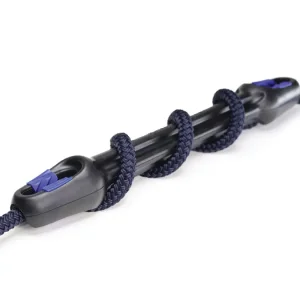
I'll learn that when you learn how to tie a soft shackle rather than that dog's dinner of a knot in the Dyneema at your bow. You could have tied one in the time it took to write one of your posts. I'll refrain from commenting on the advisability of using a stanchion to take anchoring loads in case it promotes another ream of guff.
 
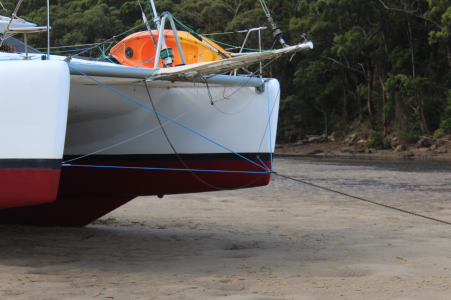
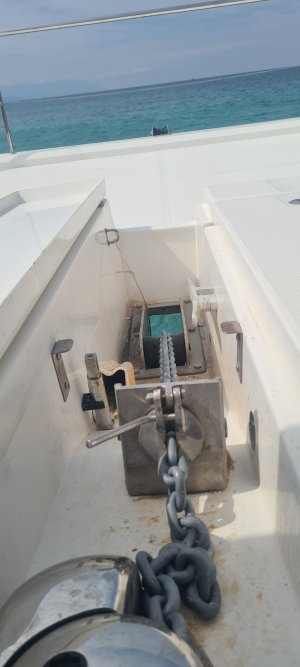
This is the setup on my powercat from a photo taken last week on the land.

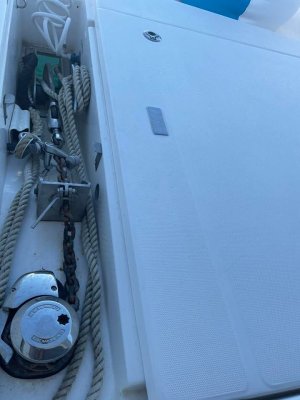
As will be obvious the bridle is relatively short. The next photo was taken just now anchored in shallow water in calm conditions. If there was wind and the chain was extended the chain hook connects no more than 2 metres forward of the bow.

The roller you see in the photo is a secondary one intended for deploying a second or emergency anchor.
I'm in the Aegean, where severe winds are rare and always well forecasted. We're never more than an hour or so from good shelter - my cat will make 24kts although my usual speed is 7/8. My draft is less than 1M and I usually anchor in no more than 4/5M with 30+M of chain out overnight.
I don't feel the need for the type of elaborate setup you describe, but perhaps I'm being naive.
Yes, it is clear that what you are looking for is a solution to attach your short bridle - which is presumably intended to take the anchor load off the windlass and connect to the two bows to reduce swinging. A perfectly reasonable and sensible requirement.

Neaves extensive and lengthy posts are all about something different - creating a long and stretchy snubber, for extreme conditions - something which you have made clear is not your requirement.

Does seem an unhelpful boat design for regular anchoring - which is what charter boats do a lot of in the Med. Presumably in charter life crews simply hoped for the best and rode to the windlass !
 
Neaves extensive and lengthy posts are all about something different - creating a long and stretchy snubber, for extreme conditions - something which you have made clear is not your requirement.
A far easier less Heath Robinson solution that doesn't result in torturing your aft stanchion posts is to have part chain and part warp anchoring cable. When the conditions are difficult, and you'll have a long anchor cable out anyway, stretchiness is built in to the warp part. Then a bridle on a multi to reduce swinging around.

Confucius had this to say about anchoring: "Simple easy to use solutions are the solutions most likely to be used when conditions are tough."
 
Last edited:
Some hooks are better than others. Show us your hook.

Your short snubber is magic for taking the tension off the windlass but unless its actually elastic it will not 'snub'. If your chain is heavy you have less need for a snubber. The elasticity of a snubber replaces or augments the catenary effect of the chain (and the heavier the chain the better, for snubbing).

Peo[le have used chain for years, centuries. It obviously works.

The best chain is heavy but carrying lots of heavy chain in the bow does nothing for sailing performance. An alternative is to use smaller, light, high tensile chain, but then you lose some of the catenary for snubbing. Another option is to use an elastic snubber - which smooths out the snatch loads. Or mix and match. Heavy chain is not such an issue with an older, heavier and larger yacht but modern plastic fantastics are better with weight centralised and minimum weight in the first place.

There is no one answer suits all.


This was our solutions:

Changed the 8mm chain for high tensile 6mm, saves weight - important for multihulls. We replaced 50m of 8mm with 75 m of 6mm and still saved weight. Both the 8mm chain and the windlass were tired.

We routed the snubber from the transom using a big block attached to the last stanchion. We want length, for extra elasticity and carried the extra length by using the sheet winches and storing the excess in a bag attached to the lifelines. The snubber, half of a bridle, then was routed up the side decks. Our stanchions 'feet' were hollow and we could run lines through the stanchion feet to the bow (but you can buy devices that will do the same thing or use soft shackles - it keeps the snubbers out of the way).

We originally use 12mm kermantle, the black rope with the yellow fleck, for the snubbers but this was not sufficiently elastic and we down sizes to the 10mm blue, same rope construction
View attachment 208176

At the bow I used a turning block, I had to add reinforcing inside the bow
View attachment 208177

From the turning block the snubber was routed to the bridle plate

View attachment 208179

And then to a pad eye at the bow waterline. The pad eyes are for the kicker wires for the prodder, I reinforced the location of the pad eyes 150mm square plates of 5mm aluminium.View attachment 208180

We now have 10.5m along the side decks, and two length from the hulls at the waterline and the bow turning blocks + the extra in the sheet bags.

It is possible to release more snubber or take retrieve in the comfort and safety of the cockpit. The tensions are surprisingly low and you can retrieve, even in arduous conditions, by hand. But when you are at anchor on a sailing yacht the sheet winches are redundant - dual use seems a good idea - and allows your wife to work one winch as you work the other.

You can devise something very similar for a mono hull.

I made my original bridle plates and when I was happy I had it made professionally. Its quite easy to make your own. I used custom made threaded, 316 stainless 2 part LFRs, you can buy the same from Allan Brothers in 7075 aluminium or 2205 stainless. I think Allan Bros calls them deck bushes. My original bridle plates had a wire gate - but I dispensed with that and the chain never felt out of the slot. I made my plates from 800 MPa steel (which I had galvanised, I was gifted a piece for some work I did, 2205 stainless or 7075 aluminium which I home anodised. The profesionally made plates were 2205 stainless or 7075 anodised aluminium.

But the OP was interested in chain hooks, I'll cover that next but its time consuming digging out the images, resizing them to post so it might be tomorrow.

Jonathan
I’ll try to remember to take a picture of our hook when I raise the anchor in a few minutes time. We use 10mm chain but I think the elasticity of the catenary was debunked a while ago. In severe conditions the catenary all but disappears. I agree our three metres of nylon rope doesn’t have much elasticity but 99% of the time we don’t need anti snubbing. The boat just lies quietly to her anchor. If we do need to add anti snubbing we’ve got 25 metres of climbing rope we can add. We’ve also got a couple of rubber snubber things we could add.
IMG_0007.webp

I also appreciate all this isn’t relevant to the OP. Our boat is 12 tonnes and doesn’t skit about on her anchor like some cats do. Most of the time all our hook and bit of nylon warp is doing is taking the load off the windless.
 
Last edited:
I’ll try to remember to take a picture of our hook when I raise the anchor in a few minutes time. We use 10mm chain but I think the elasticity of the catenary was debunked a while ago. In severe conditions the catenary all but disappears. I agree our three metres of nylon rope doesn’t have much elasticity but 99% of the time we don’t need anti snubbing. The boat just lies quietly to her anchor. If we do need to add anti snubbing we’ve got 25 metres of climbing rope we can add. We’ve also got a couple of rubber snubber things we could add.
View attachment 208183

I also appreciate all this isn’t relevant to the OP. Our boat is 12 tonnes and doesn’t skit about on her anchor like some cats do. Most of the time all our hook and bit of nylon warp is doing is taking the load off the windless.
Like you we use a shortish 4m snubber with a simple hook - but the snubber includes a rubber compensator of exactly the type you show in your picture. Works for us (plus our secondary short one in case anything fails)
 
Like you we use a shortish 4m snubber with a simple hook - but the snubber includes a rubber compensator of exactly the type you show in your picture. Works for us (plus our secondary short one in case anything fails)
Interesting to hear.

The reason our rubber thing isn’t permanently fitted is that our hook and nylon warp is lead through the second bow roller and when we recover the anchor, the hook is jiggled off the chain (often takes a bit of jiggling to get it to come off!) and then the hook and nylon warp can be pulled through the roller without me having to undo the gate mechanism. Keep it simple etc.
 
...the hook is jiggled off the chain (often takes a bit of jiggling to get it to come off!)
If I don't fasten the retaining strap on my hook it falls off the moment it touches the seabed. On retrieving the anchor, once I have undone the strap to remove the hook from the chain...will the bastard thing come off? Sod's law at its best.
 
If I don't fasten the retaining strap on my hook it falls off the moment it touches the seabed. On retrieving the anchor, once I have undone the strap to remove the hook from the chain...will the bastard thing come off? Sod's law at its best.
We’ve just upped anchor so for fun I got Mrs M to video me taking the chain hook off!


It often comes off when I jiggle it, but sods law says that it stuck fast for a video and I had to bend over the bow and get the wretched thing off. I can say it’s never fallen off when the chain has been deployed correctly.

For anyone interested, we were anchored off Gordon’s bar at the bottom end of Long Island in the Bahamas. Gordon’s bar do a mean rum punch.
 
Our boat is 12 tonnes and doesn’t skit about on her anchor like some cats do
My cat is up on16 tonnes with tanks half full, chain etc and 2/3 on board. There's a lot of windage, given the size, flybridge etc so it definitely swings with wind direction, but it certainly doesn't skit about.
 
My cat is up on16 tonnes with tanks half full, chain etc and 2/3 on board. There's a lot of windage, given the size, flybridge etc so it definitely swings with wind direction, but it certainly doesn't skit about.
Nice cat. No insinuation of your cat’s manners by me but I was assuming the fixation of elasticity of a snubber (rather than a chain hook just to take the load off the windless) by some was about how some lightweight cats dance about on their anchor?
 
Last edited:
Nice cat. No insinuation of your cat by me but I was assuming the fixation of elasticity of a snubber (rather than a chain hook just to take the load off the windless) was about how some lightweight cats dance about on their anchor?

The bridle from the outer hulls reduces the sideways movement at anchor. That's separate from a snubber which is to reduce snatch loads in a not so smooth anchorage. Chain catenary works doing the latter, until is doesn't any more, like in Peter Smith's photo. I have an 8m beam so each bridle leg is 6m, which is why my chain hook is often dragging on the sea bed encouraging it to detach itself from the chain. The 6m bridle produces some elasticity, but not much. If I need more I let out more anchor cable until there's some warp deployed.
 
The bridle from the outer hulls reduces the sideways movement at anchor. That's separate from a snubber which is to reduce snatch loads in a not so smooth anchorage. Chain catenary works doing the latter, until is doesn't any more, like in Peter Smith's photo. I have an 8m beam so each bridle leg is 6m, which is why my chain hook is often dragging on the sea bed encouraging it to detach itself from the chain. The 6m bridle produces some elasticity, but not much. If I need more I let out more anchor cable until there's some warp deployed.
Perfectly understood. It’s all horses for courses I guess.
 
Interesting to hear.

The reason our rubber thing isn’t permanently fitted is that our hook and nylon warp is lead through the second bow roller and when we recover the anchor, the hook is jiggled off the chain (often takes a bit of jiggling to get it to come off!) and then the hook and nylon warp can be pulled through the roller without me having to undo the gate mechanism. Keep it simple etc.
Our bow roller is wide enough that the rubber snubber fits through easily enough.
Our anchor lifting process includes always taking the boathook to the bows before lifting - as often some weed to be cleared, and once every now and again anchor needs encouragement to line up into the roller (happens much less after removed the swivel).
But the other role of the boat hook is to give the snubber hook a tap if it is being uncooperative - which is usually only when windy enough that anchor chain is taut.
 
Ooooh. An anchoring thread.

This is one place where cats and monos are very different.
  • The windage on multihulls is just "different" because they have more than one hull. It's not about weight or inherent skittishness; many are less "skittish" than light monos. But with a bridle, they are rock steady, more so than most monos. Common sense is to use a bridle, and nearly all do.
  • The ergonomics for deploying the rode and bridle is different from monos. Unlike monos, it also varies a great deal between multies. The solutions are often boat-specific.
  • 1774273190491.png
I think the best we can do is give the PO some choices. I've used many methods, and sometimes I switch between them, because frankly, there are many good methods.
 
Nice cat. No insinuation of your cat’s manners by me but I was assuming the fixation of elasticity of a snubber (rather than a chain hook just to take the load off the windless) by some was about how some lightweight cats dance about on their anchor?
As Angus says the main purpose of the bridle is to keep the nose into the wind and stop it wandering. Without the bridle the hulls can drift across the chain and if there's a pull the chain scrapes along the hull. As was probably evident from an earlier pic (below again) I have a chain stopper which protects the windlass. I'd like to fit a longer bridle but stowing it in the very limited space is sn issue. Something like a Medium Mantus Bridle would be ideal but I think retrieving it through the roller opening and stowing it in that space would be a huge pain. I'm more inclined to rig a temporary bridle snubber tailed back to the deck cleats when needed, but that's also a pain as I have to go fishing for the chain over the bow.20260322_131025.jpg
 
Further to my earlier post I just got this pic from a guy in the US who's using a Mantus Medium on the same boat as mine. For someone like me who uses my boat probably 300 days in the year and always anchors this looks like it's a real pain in the arse
FB_IMG_1774275136228.jpg
 
Further to my earlier post I just got this pic from a guy in the US who's using a Mantus Medium on the same boat as mine. For someone like me who uses my boat probably 300 days in the year and always anchors this looks like it's a real pain in the arse
View attachment 208192

What is a pain? The Mantus hook doesn't need to be on the chain.

  • Release chain stopper.
  • Power down anchor and chain
  • Attach shackle and lower more chain.
  • Re-attach stopper, if you want.
  • Reverse to recover.
That said, the shackle, IMO, is way too big and will try to jam. Perhaps that is the PITA. Probably. Use a soft shackle or Prusik when it needs to go over a roller, like that. Much smoother. Then it would be slick. Forget the hardware. looks nifty, but does not work best in this situation IMO. I've done this.
 
What is a pain? The Mantus hook doesn't need to be on the chain.

  • Release chain stopper.
  • Power down anchor and chain
  • Attach shackle and lower more chain.
  • Re-attach stopper, if you want.
  • Reverse to recover.
That said, the shackle, IMO, is way too big and will try to jam. Perhaps that is the PITA. Probably. Use a soft shackle or Prusik when it needs to go over a roller, like that. Much smoother. Then it would be slick. Forget the hardware. looks nifty, but does not work best in this situation IMO. I've done this.
I think you misunderstood my post which is in relation to a Mantus Medium Bridle as pictured.
Mantus Bridle
 
Top