Recommend a Bridle Chain Hook

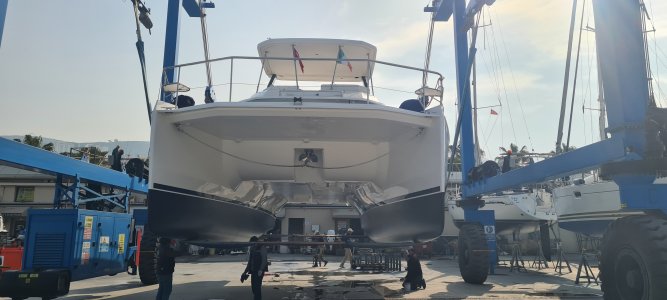
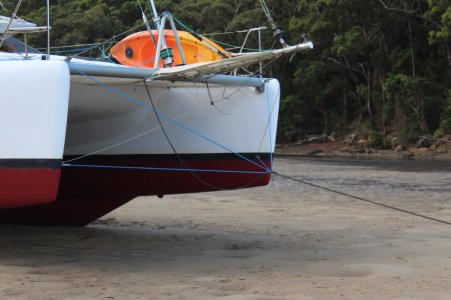
As I'm sure most of you will appreciate deploying a bridle or a snubber on a catamaran is a bit different and more tricky than on a monohull with a bow roller. The anchor chain roller on mine is below deck and a full 3M aft of the bow. I took this photo just now.
That makes it harder but a chain hook is still a good solution.

Chain hook with a single line you can feed out your chain fairlead, but with a big loop in it you can fish out with a boathook and add two bridle lines to each hull?

+1 for Dunedin's second hook - I have just added this to my set up.
 
As I'm sure most of you will appreciate deploying a bridle or a snubber on a catamaran is a bit different and more tricky than on a monohull with a bow roller. The anchor chain roller on mine is below deck and a full 3M aft of the bow. I took this photo just now.
View attachment 208121
Try a spliced Dyneema loop with a Prusik hitch. It will roll right over the roller like it's not there. Easy peasy, the simplest way with a bridle and a roller. Dyneema webbing is easiest to handle, but an 8 mm Amsteel loop is easy to splice and would be strong enough for a bridle on 10 mm chain.
 
Of course on a chain.

Looking at the photo, I don't see why would there be any difficulty putting a rolling hitch on to the chain
Possible, but the bridle comes up from under with 2 spliced eyes. I think a Prusik hitch is easier to tie in that awkward position. Like a luggage tag, nothing much to remember.

Additionally, a rolling hitch will slowly slip starting at about 50% WLL unless it is backed up with a second hitch. I have tested this on rigs many times, and cruisers have reported this. A Prusik hitch will not slip.

Yes, I have a cat.
 
Possible, but the bridle comes up from under with 2 spliced eyes. I think a Prusik hitch is easier to tie in that awkward position. Like a luggage tag, nothing much to remember.

Additionally, a rolling hitch will slowly slip starting at about 50% WLL unless it is backed up with a second hitch. I have tested this on rigs many times, and cruisers have reported this. A Prusik hitch will not slip.

Yes, I have a cat.
That's a better suggestion than mine.

I was thinking of a Y bridle with the tail hitched to the chain.
 
Thank you all for the help, advice and information. I've fitted the regular chain hook for now, but I also broke out and ordered a Mantus M3 from Jimmy Green - not available in Türkiye so hopefully be delivered to my son before he comes out for Easter. I think it will be easiest for my wife to manage, but if not I'll flog it here and try something else.
 
The problem is that if your snubber/bridle is attached at the bow then in order to have elasticity you use a long bridle that extends a long way in front of the cat's bow. You cannot use a short bridle, which would keep the rode in tension even in shallow water as there is then no elasticity or the bridle is simply not beefy enough.

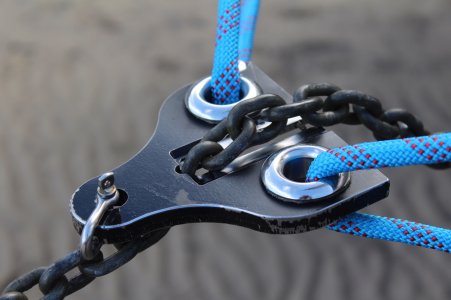
You need to find a way of starting the bridle at the transom, run up the side decks to a turning block on the bow and then to the chain hook. You can attach the turning block to the bow horn cleats. You can route the single arms of the bridle, one on each sidedeck, through those devices you use to tidy up furling lines (or use soft shackles attached to the stanchions.). You leave the snubbers in this arrangement permanently deployed, take them in at the end of the season. I used this arrangement on our cat with a slight modification. I started the bridle at a pad eye at each bow, water line, the snubber then ran to a low friction ring in a bridle plate (to which the chain would be inserted and secured), and then to the turning block at the bow, deck level, then down the side decks to the transom where I had an extra 10m of snubber (kept in a bag attached to the life lines, as you do with sheets). My snubber was then deck length, + 2 times half the beam of the cat - but I had a 10m tail so I could extend each arm a further 10m if needed - but the final securement point was the transom located horn cleats (or sheet winches)

You then end up with a deck length bridle + the distance from the turning block to the chain hook which will give you the required elasticity, snubbing effect. You can vary the length of the single arms of the bridle the amount of spare snubber you have at the transom. It works really well on a sail cat as you can take the tails and wrap them round the deck winches - and vary the length extended beyond the bow. You can do something similar with horn cleats - but its not quite so neat.

So..... you run the snubbers down the side decks to turning blocks then to the common chain hook. You can make the snubbers as short as you want, the whole arrangement can be such that you have minimal slack, the bridles are not tight but loosely tight, slack enough to manipulate the chain hook. The chain will be tight on the hook, the weight of the chain will keep the chain on the hook. Now if the wind gets up - extend the snubbers, at the transom, to give you more snubbing. If you have used a bridle plate with LFRs the snubber will 'slide' through the LFRs as you extend, or retrieve.

I used a bridle plate, but have used a clevis chain hook. Do NOT use a Witchard hook - the little pins bends and then you cannot release the chain. I tested a wire chain hook, available from Oscalutti - like Vyv's the whole device bent and the chain slips out. The original Mantus hook bent, the chain falls off. Claws seem a good idea but need to be aligned perfectly to release the chain - its almost impossible to get the correct alignment, do not use a claw.

You can source a bridle plate with low friction rings from Viking made to my design, I make no money on this - its an altruistic service to multihull owners and helps keep food on the table for Ukraineians - its my attempt at doing something positive - talk is cheap. But this is PBO and you can easily make your own bridle plate, or have one made.


If this all sounds very complicated, its not, and you give me some time - I'll sort out the pictures so make it easier to understand.

I'll also include a picture of a modified clevis chain hook, like the stainless one in this thread, with a little securement gate to hold the chain in the slot of the hook. Its breakfast time here and I may not add pictures till tonight - just be patient.


Jonathan
 
As introduction to catamaran brides aka 2 snubbers.

Most of the multihulls I see, especially at boat shows have bridles that are too beefy, too large a diameter, and they will not exhibit much or any, noticeable, elasticity. Your snubbers, also true for monohulls should noticeably stretch. Working on a 10m snubber it will stretch to 40% at failure so thinking of a 4:1 safety margins and assuming linear elasticity then at the extreme you should be looking for a 1m stretch.

Some bridles are so beefy I suspect they might be actually used for lifting the hulls. Don't laugh. Seawind cats are now made in Vietnam and they do lift the completed hulls using the horn cleats when they ship as deck cargo which also tests the integrity of the bow horn cleats.

Snubber and bridles are consummables, like sails. They wear out and when they fail its with a sound like a single gun shot. There is commonly no sign to indicate the snubber will fail, the damage can be internal. But ropes that stretch, nylon, have a finite lifespan dictated by a number of factors (abrasion being the obvious) but their life span is constantly reducing based on the number and intensity of the stretch cycles. The more you demand of your snubbers the shorter the life - so carry spares. Thicker, beefier, snubbers will last longer but will be less value as snubbers - there is a balance (commonly found by trial and error)


Avid readers of my threads will recall I am constantly criticised for repetitive threads. I hope the complainants will appreciate repetition can be useful.

Jonathan
 
As introduction to catamaran brides aka 2 snubbers.

Most of the multihulls I see, especially at boat shows have bridles that are too beefy, too large a diameter, and they will not exhibit much or any, noticeable, elasticity. Your snubbers, also true for monohulls should noticeably stretch. Working on a 10m snubber it will stretch to 40% at failure so thinking of a 4:1 safety margins and assuming linear elasticity then at the extreme you should be looking for a 1m stretch.

Some bridles are so beefy I suspect they might be actually used for lifting the hulls. Don't laugh. Seawind cats are now made in Vietnam and they do lift the completed hulls using the horn cleats when they ship as deck cargo which also tests the integrity of the bow horn cleats.

Snubber and bridles are consummables, like sails. They wear out and when they fail its with a sound like a single gun shot. There is commonly no sign to indicate the snubber will fail, the damage can be internal. But ropes that stretch, nylon, have a finite lifespan dictated by a number of factors (abrasion being the obvious) but their life span is constantly reducing based on the number and intensity of the stretch cycles. The more you demand of your snubbers the shorter the life - so carry spares. Thicker, beefier, snubbers will last longer but will be less value as snubbers - there is a balance (commonly found by trial and error)


Avid readers of my threads will recall I am constantly criticised for repetitive threads. I hope the complainants will appreciate repetition can be useful.

Jonathan
It’s certainly one opinion.

Our snubber is only three metres long (or thereabouts) and as we’re anchored in less that three metres of water with twenty metres of chain deployed. (Contrary to some people’s suggestions the hook doesn’t fall off.)
 
It’s certainly one opinion.

Our snubber is only three metres long (or thereabouts) and as we’re anchored in less that three metres of water with twenty metres of chain deployed. (Contrary to some people’s suggestions the hook doesn’t fall off.)
If you have an 6m bridle and anchor in 1m of water, it does, but you haven't and don't. The OP has a multihull, as have I. With an unsecured chain hook falling off every time it touched bottom when the tide turned or the wind dropped I got a better one, as has the OP now.
 
Last edited:
The problem is that if your snubber/bridle is attached at the bow then in order to have elasticity you use a long bridle that extends a long way in front of the cat's bow. You cannot use a short bridle, which would keep the rode in tension even in shallow water as there is then no elasticity or the bridle is simply not beefy enough.
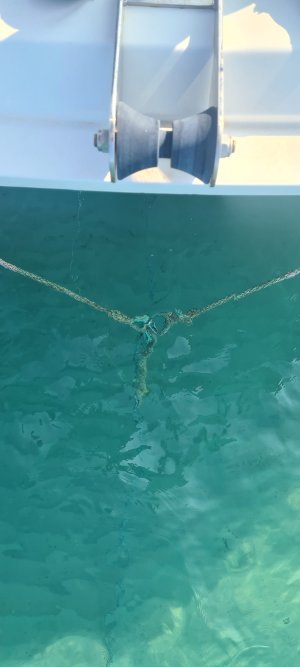
This is the setup on my powercat from a photo taken last week on the land.
20260318_102617.jpg
As will be obvious the bridle is relatively short. The next photo was taken just now anchored in shallow water in calm conditions. If there was wind and the chain was extended the chain hook connects no more than 2 metres forward of the bow.
20260323_103840.jpg
The roller you see in the photo is a secondary one intended for deploying a second or emergency anchor.
I'm in the Aegean, where severe winds are rare and always well forecasted. We're never more than an hour or so from good shelter - my cat will make 24kts although my usual speed is 7/8. My draft is less than 1M and I usually anchor in no more than 4/5M with 30+M of chain out overnight.
I don't feel the need for the type of elaborate setup you describe, but perhaps I'm being naive.
 
It’s certainly one opinion.

Our snubber is only three metres long (or thereabouts) and as we’re anchored in less that three metres of water with twenty metres of chain deployed. (Contrary to some people’s suggestions the hook doesn’t fall off.)

Some hooks are better than others. Show us your hook.

Your short snubber is magic for taking the tension off the windlass but unless its actually elastic it will not 'snub'. If your chain is heavy you have less need for a snubber. The elasticity of a snubber replaces or augments the catenary effect of the chain (and the heavier the chain the better, for snubbing).

Peo[le have used chain for years, centuries. It obviously works.

The best chain is heavy but carrying lots of heavy chain in the bow does nothing for sailing performance. An alternative is to use smaller, light, high tensile chain, but then you lose some of the catenary for snubbing. Another option is to use an elastic snubber - which smooths out the snatch loads. Or mix and match. Heavy chain is not such an issue with an older, heavier and larger yacht but modern plastic fantastics are better with weight centralised and minimum weight in the first place.

There is no one answer suits all.


This was our solutions:

Changed the 8mm chain for high tensile 6mm, saves weight - important for multihulls. We replaced 50m of 8mm with 75 m of 6mm and still saved weight. Both the 8mm chain and the windlass were tired.

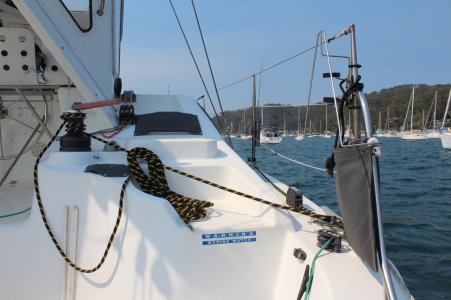
We routed the snubber from the transom using a big block attached to the last stanchion. We want length, for extra elasticity and carried the extra length by using the sheet winches and storing the excess in a bag attached to the lifelines. The snubber, half of a bridle, then was routed up the side decks. Our stanchions 'feet' were hollow and we could run lines through the stanchion feet to the bow (but you can buy devices that will do the same thing or use soft shackles - it keeps the snubbers out of the way).

We originally use 12mm kermantle, the black rope with the yellow fleck, for the snubbers but this was not sufficiently elastic and we down sizes to the 10mm blue, same rope construction
IMG_9992.jpeg

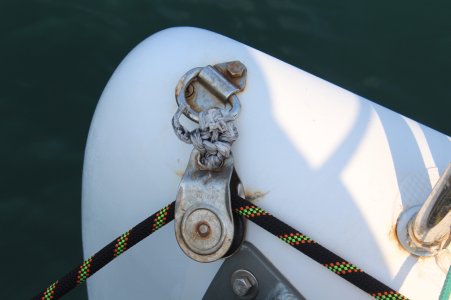
At the bow I used a turning block, I had to add reinforcing inside the bow
IMG_9998.jpeg

From the turning block the snubber was routed to the bridle plate

IMG_4759.jpeg

And then to a pad eye at the bow waterline. The pad eyes are for the kicker wires for the prodder, I reinforced the location of the pad eyes 150mm square plates of 5mm aluminium.IMG_4749.jpeg

We now have 10.5m along the side decks, and two length from the hulls at the waterline and the bow turning blocks + the extra in the sheet bags.

It is possible to release more snubber or take retrieve in the comfort and safety of the cockpit. The tensions are surprisingly low and you can retrieve, even in arduous conditions, by hand. But when you are at anchor on a sailing yacht the sheet winches are redundant - dual use seems a good idea - and allows your wife to work one winch as you work the other.

You can devise something very similar for a mono hull.

I made my original bridle plates and when I was happy I had it made professionally. Its quite easy to make your own. I used custom made threaded, 316 stainless 2 part LFRs, you can buy the same from Allan Brothers in 7075 aluminium or 2205 stainless. I think Allan Bros calls them deck bushes. My original bridle plates had a wire gate - but I dispensed with that and the chain never felt out of the slot. I made my plates from 800 MPa steel (which I had galvanised, I was gifted a piece for some work I did, 2205 stainless or 7075 aluminium which I home anodised. The profesionally made plates were 2205 stainless or 7075 anodised aluminium.

But the OP was interested in chain hooks, I'll cover that next but its time consuming digging out the images, resizing them to post so it might be tomorrow.

Jonathan
 
But the OP was interested in chain hooks, I'll cover that next but its time consuming digging out the images, resizing them to post so it might be tomorrow.
If you read the thread rather than writing reams of guff describing in intimate detail your Heath Robinson solutions looking for a problem you'll soon discover that the OP has bought one already.
 
Last edited:
I promised to post on chain hooks. I hope the OP bought the correct hook.

There are two sorts of lifting hooks,

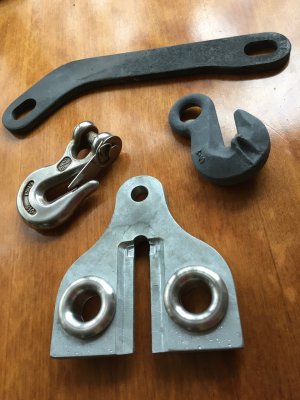
Clevis pin and Eye hooks - the eye hooks are meant for cordage the clevis pin hooks are meant for chain or shackles. For a bridle the Clevis Pin hook is the better choice.

However the stainless hook is really a poor choice as it edge loads the chain held in the slot, the saddle hook spreads the load over the length of the chain link and also does not point load the links on either side of the slots.

The lifting industry has better, slightly more sophisticated hooks now - but they are painted or powder coated, no galvanising. So you either buy two saddle hooks and retire one when it gets grotty or talk nicely to your local galvaniser, a slab of beer works well.

I have made a little stainless gate for the stainless hook, the chain is then retained. I have not discovered a way to secure the chain in an eye hook. You may need to buy a longer clevis pin to accomodate the thickness of the little plate/gate. You do not need to use stainless for the gate, thin fibreglass works well. The saddle eye hook can be bought as a saddle clevis hook from you local lifting chain retailer. You can flick the gate open, or closed with your thumb, single handed.

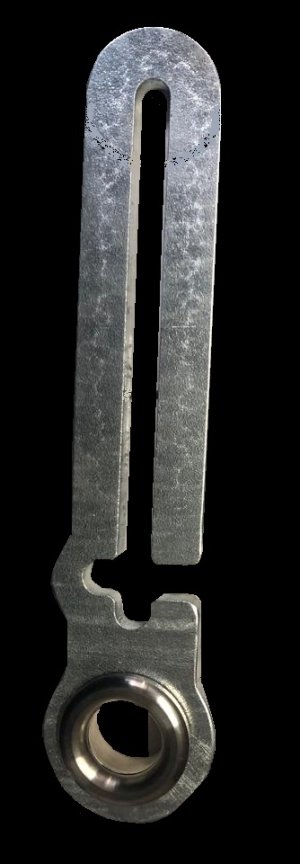
The bridle plate is one made by Viking Anchor in Kiev, they are sold galvanised. the boomerang is made in Australia and galvanised using Thermal Diffusion Galvanising aka TDG (Sherardising was the original technique). TDG operates at lower temperatures than HDG, it allows the gal thickness to be defined.

Jonathan

IMG_1811 2.jpeg

This is the Viking Anchor chain hook. The slot is long and it is difficult fr there chain to fall out, it could enjoy some rounding of the slot to avoid point loading. Bridle plates and chain hooks are made for specific chain sizes, 6mm, 8mm, 10mm and 12mm. If you are buying you need to source devices that are sized for your chain.
There are two of you who dislike my posts - reading is voluntary - a lesson you need to learn.


chain lock 10mm.jpg
 
A soft shackle has many advantages for the chain to bridle/snubber connection:


It never undoes despite any slack in the system.
It never jams.
There is nothing to bend or break.
It is very kind on the galvanising of the chain.
There is no point load on the chain causing a reduction in the chain strength.
It can be cut in an emergency and therefore released under severe load or if somehow jammed.
It will pass over the bow roller without damage.
Cheap.
An easily replaceable DIY solution.
Can be used elsewhere if you do not think it is the best option.

The best bridle/snubber to chain attachment depends on your particular vessel, but a soft shackle is worth investigating before you spend money on other options. It is the best solution we have found. If this is not the ideal option for your vessel, the cost is not high and the soft shackle can be utilised in many other applications. It will not be wasted.
 
Last edited:
This is the setup on my powercat from a photo taken last week on the land.
View attachment 208170
As will be obvious the bridle is relatively short. The next photo was taken just now anchored in shallow water in calm conditions. If there was wind and the chain was extended the chain hook connects no more than 2 metres forward of the bow.
View attachment 208171
The roller you see in the photo is a secondary one intended for deploying a second or emergency anchor.
I'm in the Aegean, where severe winds are rare and always well forecasted. We're never more than an hour or so from good shelter - my cat will make 24kts although my usual speed is 7/8. My draft is less than 1M and I usually anchor in no more than 4/5M with 30+M of chain out overnight.
I don't feel the need for the type of elaborate setup you describe, but perhaps I'm being naive.

I would not say you are being naive, your snubber seems perfect for the environment. We cruised in Tasmania and we had one Storm warning every month in the summer and presumably more frequently out of the summer, when we would be back in Sydney. Your bridle is fairly typical of the bridles I see on charter sailing catamarans. Your specific motor cat allows you to find shelter quickly and in plenty of time given your good forecasts.

This makes good reading and might interest Angus.

Slammed in the Med: How We Survived 70-Knot Winds and Chaos at Anchor

Jonathan

There was a similar event in the Scillies a couple of years ago, but not so well summarised anywhere I have seen
 
A soft shackle has many advantages for the chain to bridle/snubber connection:


It never undoes despite any slack in the system.
It never jams.
There is nothing to bend or break.
It is very kind on the galvanising of the chain.
There is no point load on the chain causing a reduction in the chain strength.
It can be cut in an emergency and therefore released under severe load or if somehow jammed.
It will pass over the bow roller without damage.
Cheap.
An easily replaceable DIY solution.
Can be used elsewhere if you do not think it is the best option.

The best bridle/snubber to chain attachment depends on your particular vessel, but a soft shackle is worth investigating before you spend money on other options. It is the best solution we have found. If this is not the ideal option for your vessel, the cost is not high and the soft shackle can be utilised in many other applications. It will not be wasted.
Very true

Soft shackles are not easy to feed through small chain links, especially in the dark with rain as a distraction.
 
Top