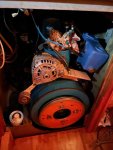
Rebuilding a 1968 Sabb model GG

Hi Marcel, I'm not sure what you mean by slack? Do you mean in the control cable? Either way I doubt you have ruined anything, those gearboxes are fairly bomb proof. Are you saying that when you have engaged reverse ( you could do this by moving the gear lever backwards by hand) you are able to turn the prop shaft/engine by hand whilst it is not decompressed? And what happens when you run the engine and engage astern? Can you turn it by hand whilst gearbox is in forward position?

Kieran
 
Sorry marcel, I just re read you post and realised my reply was not very helpful. Yes it sounds like the cones are slipping. I have another piece of advice for you but it may be easier to explain by phone. Basically there are shims to adjust the cone BUT also shims to adjust the bearing clearance. It is easy to mix them up.

Kieran
 
Richard, the rods are the same length but the lifters are driven by a fore and aft cam, so the rods crossover to port and starboard valve and I crossed them the wrong way.
Norman, yes, I should have had the water off then I would have seen the smoke without the hydro lock. Stupid mistake.
Hi Nick, yes I knew the engine before and it's not as well balanced as before. I did not explain well earlier, there are no mounts, engine bolts direct to bearers. The two cylinder Sabb is supposed to be much rougher running and from what I have read and my experience the GG is supposedly very smooth for a single cylinder.
The vibration damper is set by placing the fly wheel onto the crank shaft whilst at TDC, then gears on the wheel mesh with two counter weights. There are inspection holes to look at the weights to check the position and the timing. They appear to be correct. However, could it make a difference depending on which TDC it was set to. I.e. There are two TDC positions within the four strokes. Surely not? It takes two full revolutions of the fly wheel to complete a full revolution of the cam shaft, so the damper weights are just counter acting the rotation of the crank shaft webs. It is possible that the vibration damper gears meshed just one tooth the wrong way. It's relatively easy to whip the fly wheel off and have another look.

Once again, thank you to all the contributions on this thread. I'm off to France for a few weeks work tomorrow so any adjustments will have to wait. Please keep the comments coming and good luck with all your spring time projects.

Just a wee thought... may be well wide of the mark so take with a large pinch of salt.
As you say, there is piston TDC twice on each full cycle. Could it be that the counterweights need to be set up along with the firing TDC as opposed to the exhaust TDC? Like there would be more force on the firing TDC as opposed to the exhaust which isn't pushing against compression. I'm struggling to visualise the set up tbh...
 
Sorry marcel, I just re read you post and realised my reply was not very helpful. Yes it sounds like the cones are slipping. I have another piece of advice for you but it may be easier to explain by phone. Basically there are shims to adjust the cone BUT also shims to adjust the bearing clearance. It is easy to mix them up.

Kieran
thanks, I received it, much appreciated! as soon as I start dismantling the engine and are in need of help I know who to call :)
 
Thanks Stevie, I was thinking along the same lines but discounted it because the fly wheel completes two full revolutions for each cycle, in other words, the fly wheel and damper weights will be in the same position for both tdc positions regardless. I will check the fuel timing when I return to the boat, and see if that helps the smoothness of things. Another thought, the engine is leaning over towards port by possibly as much as 10 degrees. Is it possible that an engine, especially a single cylinder could be thrown out of balance by leaning over too much. The flanges are well aligned but maybe that is the problem? I couldnt say if it was like that before because this is the first time i have had the saloon table out so I am able to step back and look at it.
 
I agree that the "timing" of the damper weights wrt. to either the firing or the induction stroke is not an issue.
The engine itself shouldn't be thrown out of balance due to the lean, but there are vertical and horizontal imbalances, the vertical being the larger I should think.
Are you suggesting that your re-installation has introduced the lean?
If it has, there will now be a component of the engine "vertical" vibration which is now at an angle to the boat's vertical centre line, this might magnify the effect that you're feeling.
 
I'm back on the boat, on my return I wanted to double check the vibration damper timing. I removed the gasket from the rocker cover which in turn lowers the decompressor bolt, with this done the movement is much easier to see when the piston passes TDC. And surprise surprise the damper is not timed correctly, thankfully an easy fix. I've whipped the fly wheel off and will adjust. With the fly wheel off I can also remove the starter motor and scrape some paint off to restore the earth correctly. Also, I can repair a stripped thread on the solenoid, the question is how do I remove the insulated bakerlite end of the solenoid? Is it possible? Screwed in?
Final thing, when I got back to boat there was a massive amount of clean engine oil in the drip pan under the engine. I couldn't believe it, on closer inspection my oil can in the cockpit locker had spilt and the oil ran down the hull and under the engine, phew!

Kieran
 

Attachments

  • IMG_0879.jpg
    IMG_0879.jpg
    92.9 KB · Views: 4
Welcome back Kieran. :)

Good news about the balancing.

The solenoid looks like it's flared over the bakelite to me so I don't think it will come out that end. It internals might slide out of the other end if there is any sign of a fixing bolt. However, bakelite tends to go brittle with age and heat so dismantling the thing might lead to more pain.

Two suggestions you could try ...... using a new nyloc nut on the terminal as this will cut a new thread in the nylon part and might well grip fine for electrical purposes and/or combine the nyloc with more nuts or washers to move the nyloc nut to a better part of the thread away from where it was tighenend previously.

I would also suggest running a die down the terminal to sharpen it up but I don't think you have enough access.

Good luck. :)

Richard
 
Cheers Richard,
The other thought I've had is to cut off the damaged thread and weld a nut onto the head of a bolt to act as a new stud. But I agree the nylock nut would probably do the trick.
 
Okay, vibration sorted! Engine running nice and smoothly. But, I have noticed thick black oil leaking from the exhaust flange gasket on the side of the cylinder head. How is oil getting there? Is it because the rings are not yet bedded in and oil is Passing through and mixing with the combusted fuel? Is that possible until I have properly completed the break in?

Kieran
 
A very interesting read, though I hope I don't ever need to know most of this. I was interested to note that the gearbox only featured in a couple of posts, so was presumably straight forward.

We have a Sabb GG with H-1965 gearbox in our Springer narrowboat in London UK. Its 48 years old and the gearbox needs some substantial work. It still works both forwards and reverse, so nothing is broken, but it isn’t transmitting much power and some worn parts need replacing and everything adjusting. I’ve got a comprehensive maintenance manual and know where to get spare parts, but its beyond my capabilities and I need to find a mechanic who can do the job. I think that some of the adjustment must be done attached to the engine, so they need to be willing to travel to London. I don’t think they specifically need to be a Sabb expert, but do need to be comfortable working with old engines. Any suggestions for a mechanic gratefully received.
 
Hi Mick,
The gearbox is fairly straight forward. When you say it is not transmitting much power, I presume this is because the cones are slipping. Hopefully you will just need to adjust the shims and all will be good. However if the linings in the cones are worn too far they will need to be replaced, they are called ferodo linings and will need to be glued in and then machined true. Also you are correct that when the shims are adjusted you need to be able to check it whilst it's on the engine. Have you downloaded the additional notes from the Sleeman website? dont forget to make the special 4 inch long 36mm socket/box spanner because I doubt any mechanic would be carrying anything like that, especially if they have to travel.
Good luck.

Kieran
 
Hi Kieran,
Thanks for very useful information, particularly the confirmation that the adjustment needs to be done on the engine. If I can't find a local mechanic, would it make any sense for me to remove the gearbox (that looks within my capabilities, ship it to the mechanic, them do the bulk of the work on their site at their convenience. Then the mechanic would only need to make one visit. Or does that not work because of the need to assess how many shims and whether the clutch cones need relining with it attached to the engine?

I think things are quite seriously worn. The gear lever movement at the top is about 130mm forwards and 150 mm reverse (where the manual say 70mm and the additional notes 83mm). At least I have identified someone who can reline the clutch cones if needed. With hindsight, I realise that the gearbox has needed adjusting since before we got the boat, but just assumed it was normal!

Mick
 
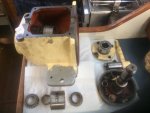
Mick, have you got enough room to slide the gearbox back (about 4 inches needed) without moving the engine? If so, then I would definitely suggest you remove the gearbox. It's just 4 or 5 bolts and pull it off. Then you can inspect the cone linings, if they are shot then it will have to be sent off anyhow. My linings were about 4 to 5 mm thick, seen in the photo below. It sounds like you have been running the engine whilst they have been slipping for some time which in turn will have worn the linings down quite considerably I would guess. Once you get the liners sorted I would have the bearings replaced and then ask the mechanic to show you all the parts laid out and how they assemble and where to put the shims forward and astern, it's really quite simple once you understand how it works and then you would be able to refit it yourself. Don't forget the long 36mm socket you will need too. I will message my email and phone number, I really don't mind talking you through any problems should you need some help.

Kieran
 

Attachments

  • IMG_0821.jpg
    IMG_0821.jpg
    90.9 KB · Views: 18
Thanks for this. I can slide the prop shaft back far enough to remove the gearbox. I made a lot of progress today, A 36mm socket will arrive tomorrow and I have lined someone up to cut and weld it to make a long socket. I've also identified an engineer to service the gearbox and will take it to him next week. He'll be happy to refit and do the adjustment. Useful to know what thickness your linings are. I wonder what they are new? Thanks for the contact details and I'll certainly be in touch if I get stuck.
Mick
 
Hi folks, I have been super busy with lots of other boat jobs that needed to be completed before we left the marina. So here is the final update on the rebuild.
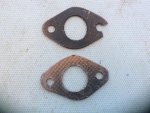
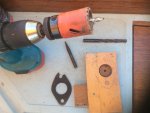
The engine was running slightly hotter after the rebuild which was a bit of a puzzle, I have replaced the small plastic valves and springs in the pump but hadn't got round to refacing the valve seats. Once I had completed the refacing I refitted the pump but still had the slightly higher running temperature. I remembered that the new springs were now of the same strength, originally the inlet spring was weaker, so I put the original inlet spring back in and sure enough temperatures were back to normal. I think the design change was introduced to help stop the valve getting jammed with grains of sand but I have decided to keep the original spring as I have never had a problem. Next up was a new exhaust gasket, the old one was leaking and I broke a piece off it. I eventually sourced some gasket material and made a new one by sandwiching it in between two pieces of ply. The hand starting handle arrangement needed a little attention and now works well. I wasn't able to hand start the engine on my own before, one person had to flip the decompressor whilst I narrowly escaped cardiac arrest spinning the flywheel. The engine now starts so easily I can get enough speed on the flywheel using just one hand and flip the decompressor with the other, see video.
https://youtu.be/-Fl6jxXkykU
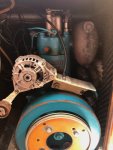
I have put the pulley and alternator back on, adjusted the throttle cable and checked and adjusted the fuel timing, which was miles out, not that it appears to matter much.
We have taken the boat out around the bay and everything seems to be pretty good. I still feel that there is something that is a little out of balance but I have removed the flywheel and realigned the vibration damper so many times without any improvement. The only thing I can think that may have this effect is the removal of the old oil filter ring. This ring was bolted to the crank shaft web and contained a paper filter strip. The manual suggested removing it during a major overhaul because it was made redundant by the development of modern oils. It was also suggested to retain the clamping bar to ensure balance, which I did. The ring was circular and made from thin steel so I doubt it would have any impact. Unfortunately I can not put it back because I threw it away plus I would have to remove the crankshaft. I may try some experiments with magnets at a later stage or learn to live with it.
The rebuild has cost approximately £1500, money well spent I think. It's a lovely feeling to know your engine intimately but also the satisfaction of fixing something that has been designed to be repaired. A 49 year old 10HP donk does have its limitations but good design and quality manufacturing are sadly missing all to often in an increasingly "throw away" world.
Once again, a massive thank you to everybody who has contributed to this thread and especially to those of you who have been actively involved at every stage, you know who you are!

Regards

Kieran
 

Attachments

  • IMG_0896.jpg
    IMG_0896.jpg
    95.3 KB · Views: 6
  • IMG_0895.jpg
    IMG_0895.jpg
    92.4 KB · Views: 6
Hi Kieran,

thank you so much for this thread!

I bought a 9m steel yacht for 3500 euros in autumn of 2020 with a not running SABB 10 GG (I believe it’s the same model as yours).

IMG_2503.jpg

The previous owner told me that engine did start before, but because the exhaust mount of the silencer broke off, it does not anymore.
After inspecting the boat - if you can even call it inspecting, as I had 0 experience regarding boat so far - I decided to go for it.

IMG_2302.jpeg

Again 0 experience with boats, 0 experience with engines, so please bear with me if I don't use the right vocabulary :)

Anyway I ordered a new silencer for 800 euros from the UK, only to find out a few weeks later that I could have bought one off of ebay for around 150...
Btw I feel your pain ordering from the UK. So far I had to order 4 times because I keep finding new stuff I need, each time paying around 30 euros for shipping.

As soon as I had time to drive back down to Croatia (I live in Austria) I installed the silencer and after a few (probably 20) cranks with the starter motor it was running!

Yay I thought. Great purchase. I'm such a great mechanic. Swapping out a silencer like it was nothing - well it is nothing, I know now ;)

I was sure I will be out in the ocean in no time. Little did I know that this was the last time the engine ran so far.

Another boat owner came over to me and told me that I should check the valve clearance as something does not sound too well.
Oh boy was he right. I was not able to restart the engine anymore so I asked him if he could help me have a look at the valve clearance and the how to get the engine started at all.

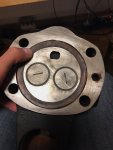
Long story short, he removed the cylinder head and we found this:

IMG_2583.jpeg

A cracked cylinder head. After searching online for ages, I found a small company in Germany specialising on repairing cast iron engines.
Another 750 Euros, but hopefully well spent.

Anyway today I was finally able to get back to Croatia and reassembled the engine.
I was surprised how fast I was able to put it back together. I also bleed a fuel system for the first time in my life.

First I was turning it over by hand what must have been 50 times to see if everything feels and sounds right (what else can I go by?).
I'm the only one in the marina at the moment, so I also don't really have anyone to ask.

So I finally worked up the courage to crank the engine with the starter. It turns a few times and then bank. a loud metallic knock and the engine stopped.
F**k.
In disbelieve I tried turning the engine again by hand, which worked for about half a turn of the flywheel and then it locked up. I was not able to turn it again by hand.
F**k.

Anyway I quickly removed the cylinder head again to find the burn chamber full of water! How did it get there? I just couldn't figure it out until I found your thread just now.

I removed the all the water and also opened up the plate that houses the oil dipstick and oil plug to have a look inside of the cylinder block.
The engine seems to be turning over fine again now. I also just removed all the old oil and will let it sit like this overnight to maybe get more of water to evaporate.

So I'm hoping big time that I had the same problem as you and if I align the push rods correctly the engine will start again.

The plan for tomorrow would be:
  • Buy and cut a new gasket for the oil cover plate
  • Clean the magnet in the engine block (Any idea how todo that?)
  • Fill engine with new oil
  • Reassemble
  • Make sure if I turn the engine by hand I can feel air coming out of the exhaust opening of the cylinder head
  • Start the engine
Does that sound like a sensible plan?
How can I make sure I have the push rods connected to the right valves?
Is there any other reason why the burn chamber could have filled with water so quickly?

IMG_3159.jpegIMG_3158.jpeg


All the best, Philipp
 
Top