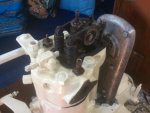
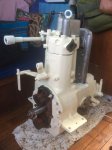
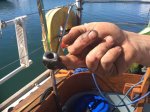
Rebuilding a 1968 Sabb model GG

I read somewhere about setting up the top compression ring at a specific position in relation to the gudgeon pin. Is there any truth or common practice to this?

I've never heard that before .... but that doesn't mean that there's nothing in it 'cos there are always things to learn. :)

Thinking about it logically, I can't see why it would matter. The small end/gudgeon pin has its own lubrication through splash or oil-way and I can't see why the compression ring orientation would make any difference to the rings as the lubrication of the bore where the compression rings are operating is being controlled by the oil ring which sits between them and the gudgeon pin.

Richard
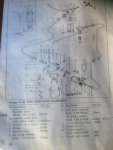
 
Thanks again Richard.
Now some retrospective diagnosis.
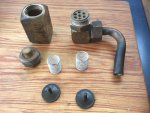
Initially I thought the demise to my engine was from incorrect alignment of prop shaft after refitting the engine two years ago having removed it to replace the front oil seal and paint both the engine and the engine room. After that work the engine ran roughly but it was really difficult to be sure because I had only had the boat for six months prior to the removal. It sounded worse in gear but the change was subtle the engine is pretty noisy and I couldn't be sure that I wasn't just going mad. So, we left Portugal and continued our travels with the view to keeping any eye/ear on the motor. The engine slowly started to sound worse and worse, by the time we got to Sardinia we had a big oil leak around the gear housing (crank shaft oil seal) and you could clearly hear grinding bearings whilst turning the fly wheel by hand. Hence the rebuild. Having now stripped the engine I would say the gearbox and gear housing bearings were probably ok for a few more years service, the main bearings definitely shot and the piston rings/cylinder liner/ valve guides on the cusp of major compression issues (even though she never failed to start easily). So I'm now thinking that it was more likely that the crankcase was getting pressurised by piston blow-by and caused the oil seals to fail. Is it feasible that blow-by could also accelerate wear to the main bearings? Especially considering it is all splash lubricated? Finally, I read something in the manual that's got me thinking......it comes from the section on fuel injection and is highlighted in italics "Never undo pressure valve (4) when loosening suction pipe or pressure pipe. " It is referring to the high pressure pump. I seem to remember that I accidentally loosened the nut on the pressure valve holder two years ago when I initially removed engine. Could the subsequent rough running engine have been caused by incorrect fuel distribution? What does this valve do? Maybe I messed up the fuel system carried on running engine, accelerated piston wear, created lots of blow-by etc etc etc what do we think people?
I will go and get the HP pump calibrated regardless. Excuse the epic post. Thanks for reading.

Kieran
 

Attachments

  • IMG_0846.jpg
    IMG_0846.jpg
    92.3 KB · Views: 9
You may be overthinking it now Kieran :) Mains are likely to have failed due to age. Incorrect alignment of the prop would not have caused front seal failure, that's more likely to be due to some movement in the mains bearings, probably made worse by the crankcase compression.
 
You are probably right Paul. I must be getting nervous now that I'm close to putting the engine back and firing it up. Plus none of it really matters now with all new parts. Fingers crossed.
 
You are probably right Paul. I must be getting nervous now that I'm close to putting the engine back and firing it up. Plus none of it really matters now with all new parts. Fingers crossed.

I agree with Paul about ageing or perhaps a previous owner/s was not so fastidious about oil changes. Once the bearings have worn to a certain point, the process continues at an enhanced pace even if a later owner is very careful about maintenance.

I doubt whether piston blow-by would have much effect on the bearings, particularly if the engine relieves the pressure through a breather, but it certainly isn't going to help. What blow-by will do is act to force oil past the seals which, along with the dodgy bearings, will shorten their life.

If you think there is any mis-adjustment with the pressure pump it's certainly worth getting it checked whilst the engine is out. I'm not a diesel expert but I doubt whether such a mis-adjustment would unduly affect the bearings.

Hope this gives some re-assurance. :)

Richard
 
Last edited:
Just a quickie. Grease, oil or clean diesel for the injector body before fitting back into the cylinder head?
 
Many thanks as usual for your feedback Richard. I read somewhere about setting up the top compression ring at a specific position in relation to the gudgeon pin. Is there any truth or common practice to this?
They actually move around in use, thats why 2 strokes have pegs to stop them moving and the ends catching on a port in the cylinder wall.
The idea of staggering them initially is to make sure of compression on the first fire up.
Stu
 
On this engine there is a short pipe from the rocker cover to the top of the inlet valve, this allows several squirts of oil to be administered to the cylinder to raise compression to aid cold starting. Would it be a good idea to do this prior to first firing?

Thanks

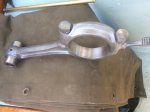
Ps parts arrived today, so the con rod is at the machinists to have the new small end bush pressed in and reamed to fit the new gudgeon pin. I am picking it up tomorrow afternoon.
 
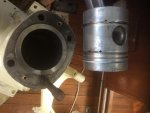
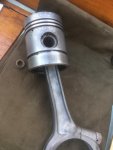
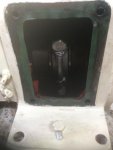
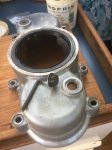
The small end bush has been replaced and reamed to fit the new gudgeon pin. The injector has had its washer annealed and refitted. I have fitted the piston back onto the con rod an installed the rings. The piston is back in the block and bolted on with new self locking nuts and has been seized with Monel wire. Everything has been rust eaten, primed and 3 to 4 coats of enamel paint, I have had to hand paint everything because the motor is inside the boat and I would be a single man if I had tried to spray it.
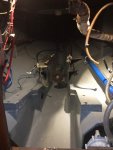
The water pump has new springs and valves but I am going to use the old valves just for now as the valve housing needs to be machined to seat the new valves properly. The head gasket has been annealed and the head is back on with the extension for the hand start gear. Valve clearances are sorted, the vibration damper housing has a new gasket and the inspection holes to check the timing have new o-rings and is all back together. The engine room has been degreased and touched up, ready to go.
So tomorrow is the big day, I have requisitioned some muscle and all looks good to go.
I shall report back tomorrow or Sunday. One way or another I shall be crying. Hopefully tears of joy, not dejection.

Kieran
 

Attachments

  • IMG_0851.jpg
    IMG_0851.jpg
    89 KB · Views: 13
  • IMG_0849.jpg
    IMG_0849.jpg
    97.1 KB · Views: 12
  • IMG_0850.jpg
    IMG_0850.jpg
    100 KB · Views: 11
  • IMG_0852.jpg
    IMG_0852.jpg
    86.7 KB · Views: 17
  • IMG_0857.jpg
    IMG_0857.jpg
    91.8 KB · Views: 15
  • IMG_0860.jpg
    IMG_0860.jpg
    90 KB · Views: 12
  • IMG_0858.jpg
    IMG_0858.jpg
    95.4 KB · Views: 13
  • IMG_0859.jpg
    IMG_0859.jpg
    95.9 KB · Views: 11
  • IMG_0856.jpg
    IMG_0856.jpg
    89.3 KB · Views: 13
  • IMG_0855.jpg
    IMG_0855.jpg
    90.8 KB · Views: 13
  • IMG_0854.jpg
    IMG_0854.jpg
    92.1 KB · Views: 13
Eventually I got the engine running today, but not without issues. After all the hard work I managed to make a ridiculous f**k up. I am so annoyed with myself I can't begin to describe. However, before I share my stupidity with you kind folk I shall explain what I've been up to the last couple of days.
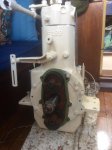
Getting the engine back in went really well, with the hired muscle, a lump of oak and some fairy liquid we slid the engine aft onto its bearers with no drama. The alignment is an absolute pig of a job. Just trying to get the nuts on the aft bolts through small gaps under the bearers whilst lying on the cockpit floor and supporting your body weight with you head on the gearbox to allow you use of both hands. Hard work. Next up was putting the flywheel back on and timing it correctly with the vibration damper, more about this later. Water pump, electrics, fuel and exhaust all reconnected next. Bled the fuel system. Then final checks of oil and double checking everything before first attempted firing.
So, deep breath and turned the key, solenoid clicked but nothing from the starter motor. After much head scratching, bypassing solenoid and checking all electrical connections I decided I may have a problem with the grounding of the starter to the engine because of the new paint. I backed off one of its fixing bolts and put a temporary earth cable on, sure enough it sparked into life. So I will either make the temporary cable permanent or remove some paint to establish proper grounding. Time to try starting again.
Another deep breath, turned key engine tried to fire then hydrolocked and a big puff of black smoke came out the air intake. I don't know how it happened but I knew immediately what I had done, as I'm sure you lot do too! Somehow the pushrods got crossed when I put the head on. What a complete numpty. Water was drawn through the exhaust creating the lock and lots of dirty oily water sprayed all around my lovely clean, freshly built engine. Absolutely gutted. I removed the rocker arms and the plug on the head where the starting cigarettes go and turned the engine over by hand a tiny bit of water was present but everything was running smoothly and sounded ok, so I decided to swap the push rods around to their correct valves and hope for the best. A squirt of fresh oil into the cylinder and she fired up after 5 seconds of cranking. It looks like I may have got away with it, but if anyone thinks differently please don't hold back.
There are a few issues though. The most worrying is the vibration, the whole boat is resonating/vibrating but the actual engine sounds beautiful the loudest noise is the tappets clicking away. No oil leaks and really smooth. The vibration, for want of a better word is constant through the rev range (only 50%) both in neutral and in gear. Any ideas people? It sounds/feels more like the mounts but maybe I have got the vibration damper timing wrong? The only other issue is the engine is running a few degrees hotter than before. I will check the water pump first, I have made a few changes there with new springs, I will check the flow rate.
So, it's running but a few issues.
I will also change the oil straight away but any other thoughts most welcome. It's such a shame I made such a stupid mistake.

Here is vid of running. The clank at the end is me knocking over a floor board.

https://youtu.be/88CpMvj82QI

Kieran
 

Attachments

  • IMG_0865.jpg
    IMG_0865.jpg
    91.6 KB · Views: 12
She sounds good to me Kieran although I can't really help with the vibration thing. Is the vibration damper a counter-balance weight of some kind ..... if so perhaps it can be mis-timed in relation to the crankshaft throw.

I don't understand the pushrod mix-up. Surely all the pushrods are the same length and interchangeable and the exhaust cam is always lined up vertically below the exhaust rocker and the same for the inlet? How can the rocker be operated by the wrong cam? :confused:

Richard
 
Did you know the engine before the re-con? (ie is it different?)
I think Sabbs are meant to shake your fillings out... The single I ran as a safety boat had no mounts though, just bolted to the bearers.
 
Richard, the rods are the same length but the lifters are driven by a fore and aft cam, so the rods crossover to port and starboard valve and I crossed them the wrong way.
Norman, yes, I should have had the water off then I would have seen the smoke without the hydro lock. Stupid mistake.
Hi Nick, yes I knew the engine before and it's not as well balanced as before. I did not explain well earlier, there are no mounts, engine bolts direct to bearers. The two cylinder Sabb is supposed to be much rougher running and from what I have read and my experience the GG is supposedly very smooth for a single cylinder.
The vibration damper is set by placing the fly wheel onto the crank shaft whilst at TDC, then gears on the wheel mesh with two counter weights. There are inspection holes to look at the weights to check the position and the timing. They appear to be correct. However, could it make a difference depending on which TDC it was set to. I.e. There are two TDC positions within the four strokes. Surely not? It takes two full revolutions of the fly wheel to complete a full revolution of the cam shaft, so the damper weights are just counter acting the rotation of the crank shaft webs. It is possible that the vibration damper gears meshed just one tooth the wrong way. It's relatively easy to whip the fly wheel off and have another look.

Once again, thank you to all the contributions on this thread. I'm off to France for a few weeks work tomorrow so any adjustments will have to wait. Please keep the comments coming and good luck with all your spring time projects.
 
Richard, the rods are the same length but the lifters are driven by a fore and aft cam, so the rods crossover to port and starboard valve and I crossed them the wrong way.

Thanks for coming back on that one. Crossover pushrods are something I've never seen before although I don't have a huge amount of experience with single cylinder engines. I live and learn! :encouragement:

Richard
 
I registered today just to read your rebuild :)
Great job! I'm in for adjusting my gearbox and have to get the engine out to be able to take out between engine and shaft.

Can you tell me how many bolds are used to connect the gearbox to the engine? (is it only the 2 on top, or are there also 2 at the bottom (invisible when build in)) and how many clearance do I need between the propellor shaft and the engine to get the gearbox enough aft to take it out.

Thanks, and sorry for my dutch english :) (in holland we call it dunglish)

Marcel
 
Hi marcel,

It depends which gear box you have either the 1965 or 1971 There are 4 bolts on mine holding the gear box on and you need about 12cm of room to slide it backwards off of the cam/drive shaft. One thing you must do first (if you wish to adjust the astern cone) is undo the nut that holds the drive flange. It is 36mm across the flats on the 1965 gearbox. The nut can be very tight so you must put the engine in gear and stop the fly wheel turning with a piece of wood.
Follow this link and you can download a brilliant set of notes on gearbox maintenance and the water pump, fuel system etc.
Please don't hesitate to ask further questions if you need any help. Also don't forget to measure the distance your gear lever moves before you take it apart. good luck.
http://www.sleeman-hawken.co.uk/suppliers/sabb.html

Kieran
 
Hi Kieran,

thanks for your response!
I've the 1965 version and yes, need to adjust the astern cone.
I think I ruined it due to some slack in the controller cable there was approx 1 cm of slack in the reverse. I'm able to turn the shaft when engine is off and gearbox is in reverse. however I feel some torque when trying to turn the shaft.

It's a hell of a job taking the engine off its base in a 22 feet hurley :)
 
Top