Rebuilding a 1968 Sabb model GG

Nice one Norman. That is a great link. It makes a lot of sense, based on that information, to use an adhesive with my bearing carrier considering its usage, particularly as that part is subjected to axial loading until the thrust of the propellor takes over.
 
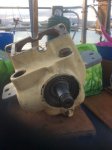
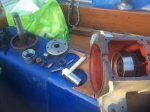
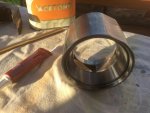
The new races have been fitted into the bearing carrier and bedded with loctite 638 retaining compound. I hope the way I have done it will be ok, because I have no press and need to drift the races in, I wanted to make sure the bearing carrier was hot. It removed it from the oven and the races from the fridge and quickly but carefully drifted them in within about 2mm of fully seating, I then squeezed in the loctite and made sure it ran round the two mating surfaces then drove the races home. The bearing carrier was not super hot but probably not an ideal temperature to apply the loctite.
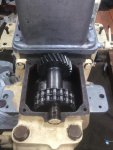
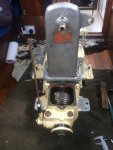
I then fully cleaned up the rest of the components and oiled everything with fresh engine oil (the reverse gear uses the same oil as the engine) and reassembled. I can't test it all until tomorrow because I can't do up the drive flange nut until the box is back on the engine with the ahead cone engaged and the crank shaft spiked. Hopefully all will be good and the gear lever movement within spec, if not, it will all have to come apart again to add or remove shims.
I am not looking forward to tomorrow because I have to go swimming. I have had some misalignment issues which I think contributed and accelerated the original demise of the engine so I want to check the prop shaft for straightness and the lift out costs here in Olbia are astronomical! So wetsuit on, prop off underwater and out with the shaft, what could possibly go wrong.......and yes correct size bung at the ready.
 

Attachments

  • IMG_0839.jpg
    IMG_0839.jpg
    89.1 KB · Views: 8
  • IMG_0837.jpg
    IMG_0837.jpg
    90.7 KB · Views: 8
  • IMG_0835.jpg
    IMG_0835.jpg
    92.8 KB · Views: 9
Sorry - the loctite should be applied to the outside (cylindrical) surface of the bearing or the housing mating surface. If I am reading you correctly, It seems you are suggesting that you applied it either on the end face of the outer race of the bearing or inside the housing (in the 2 mm gap) before pressing the bearing home.

A bit late now but thought I should speak up.

Was there no where local you could have taken the bits to have the bearing pressed in? Drifting bearings in is not the best way of doing it.

Sorry.
 
Last edited:
Sorry - the loctite should be applied to the outside (cylindrical) surface of the bearing or the housing mating surface. If I am reading you correctly, It seems you are suggesting that you applied it either on the end face of the outer race of the bearing or inside the housing (in the 2 mm gap) before pressing the bearing home.

A bit late now but thought I should speak up.

Was there no where local you could have taken the bits to have the bearing pressed in? Drifting bearings in is not the best way of doing it.

Sorry.

It sounds like the Loctite wasn't needed as the races were plenty tight enough. However, applying it to the final part of the race outer surface before it was driven into the housing should be fine as it will then be squashed between the race and the housing.

I wouldn't have bothered to use it though. If the race actually needs to be pressed in or drifted in with a mallet then there is zero chance of the race spinning rather than the rollers unless the bearing completely seizes up when the condition of the housing will be the least of your worries. :ambivalence:

Richard
 
Thanks Norman, Richard,
The fit between the cylindrical surfaces of the carrier and races was spot on perfectly smooth and a perfect interference fit so the fact I have put the loctite in the wrong place shouldn't be an issue. I thought it could be used to bed the races into the carrier, never mind, you live and learn. I appreciate drifting the races is not ideal but with the carrier hot and the races cold I was able to tap them in fairly gently first with a wooden block then a 1/4 inch brass drift. Like you said, too late now!

Please keep the feedback coming, I really appreciate it.

Kieran
 
It sounds like the Loctite wasn't needed as the races were plenty tight enough. However, applying it to the final part of the race outer surface before it was driven into the housing should be fine as it will then be squashed between the race and the housing.

I wouldn't have bothered to use it though. If the race actually needs to be pressed in or drifted in with a mallet then there is zero chance of the race spinning rather than the rollers unless the bearing completely seizes up when the condition of the housing will be the least of your worries. :ambivalence:

Richard

Richard - even with an interference fit the contact area is about 30% of the total surface area and the purpose of the loctite as an 'adhesive' is to improve on that so there is effectively 100% contact, so as to prevent 'fretting'. I accept that this may all be academic now and that the loading on this bearing may be relatively low.
 
Richard - even with an interference fit the contact area is about 30% of the total surface area and the purpose of the loctite as an 'adhesive' is to improve on that so there is effectively 100% contact, so as to prevent 'fretting'.

Understood Norman. Don't forget that I was the person who suggested using Loctite if the bearing was not a tight fit. :)

Richard
 
Understood Norman. Don't forget that I was the person who suggested using Loctite if the bearing was not a tight fit. :)

Richard

I will try and remember that Richard. Don't forget that I was indicating that you should use Loctite 600 series if the bearing is a tight fit.:)
 
Hi Richard. I'm not getting into an argument with you. If you can tell a good bearing from a duff one from a picture, good on you.

I'm sorry Chris but you really need to man-up and stand by your statement. I thought that Kieran had decided to keep the bearings so agreed with him that they also looked OK to me from the photo, as they do, as it seemed the supportive thing to do.

You're now trying to take the mickey because I said the bearings looked OK .... but you refuse to say what you think about their condition from the photo, exactly as I predicted.

In my opinion, a very sad way for you to undermine a very interesting thread by Kieran. :(

Richard
 
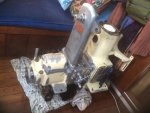
The reverse gear box, for want of a better description; as there are no gears, is back on. I had the usual faff assembling and disassembling to adjust the shims for both the bearings and the throw of the cones. Everything is feeling really good and within spec. I refitted the lay shaft and connecting chain. I will get everything painted over the next couple of days by which time the replacement gudgeon pin should have arrived. I didn't get chance to go swimming yet, adjusting the gear box took longer than expected plus it's blowing a hoolie at the moment.
So question time.
The documentation that I got with my piston rings says nothing about how to orientate the ring gaps and neither does my manual. I understand the principal of offsetting the gaps but any further advice greatly appreciated.
Secondly, advice regarding the best way to break the engine in would be great. The info with the piston rings stated that the engine should be run in neutral for 15 mins then gradually increase revs under load. From what I have read there are differing views regarding a gentle or hard break in. It seems to me that a compromise to allow the new bearings to settle but without glazing the cylinder yet pushing hard enough to bed the rings in would be prudent. Advice and suggestions most welcome. Also, is it necessary to complete the initial break in in one go? In other words can I run the engine for 5 odd mins checking for oil leaks and general listening then stop make a few adjustments and then continue?

Thanks in advance.
 

Attachments

  • IMG_0844.jpg
    IMG_0844.jpg
    92.6 KB · Views: 9
  • IMG_0842.jpg
    IMG_0842.jpg
    92.2 KB · Views: 9
  • IMG_0841.jpg
    IMG_0841.jpg
    89.8 KB · Views: 9
You're certainly cracking on well with this rebuild Keiran.

Piston rings gaps: I would check the ring gap by pushing the ring into the bore and levelling it off with the piston just to check that the gap is in spec, then install the rings with the gaps as far apart as possible. 2 rings would need gaps at 180 degrees, 3 rings would need gaps at 120 degrees.

For breaking in, I would go for the gentle break-in with no load at first, 15 minutes sounds good, but gradually increasing the revs to say 50% for a couple of minutes after that just to check that everything is OK. Then I would start with the load based running in. This is actually the "real" part of the running-in so a gradual increase in revs to 50% with the prop spinning over another 15 minutes. After that, start to use the engine to power the boat but probably best to keep below 50% revs under load for the first hour or two.

I can't see any problem in stopping the engine to check things but best not to let it go cold. If you have to stop for an hour or two to sort something out during the no-load period, then I would be inclined to start again.

None of it is that critical, it's more about listening to the engine whilst it's running-in for any strange noises and checking that nothing is overheating or sticking.

Good luck

Richard
 
Many thanks as usual for your feedback Richard. I read somewhere about setting up the top compression ring at a specific position in relation to the gudgeon pin. Is there any truth or common practice to this?
 
Top