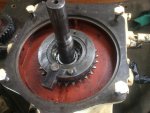
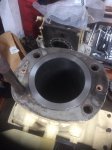
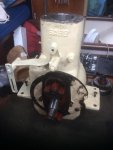
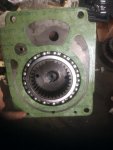
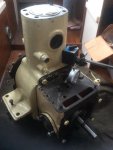
Rebuilding a 1968 Sabb model GG

Thread drift I know but I must say that the DTI is/was the tool of choice for making definitive measurements, thats what it was invented for!
Stu

Yes, but not how the OP is using it.

Although i acknowledge your later advice on how he should do it, i still think there are better ways to do this job.
 
Stu, I thought I might be able to measure the end play using the DTI as well but this is what I have experienced so far. With one 0.2 shim in place and the engine laying down I was able to pull/lift the crankshaft with the DTI attached to engine block and get a constant reading of 0.2 clearance. I then added three 0.05 shims trying to get the desired 0.05 end play but I was unable to apply enough pressure by hand to get any movement to show on the DTI. i presume that as the bearings start to tighten up the resistance overcomes the pressure I can exert. So, as an experiment I set the DTI up again and without rotating the shaft, lifted the engine gently up then back down so the crankshaft pinion was resting on a block of wood thus applying a weight of around 100kg. The DTI didn't so much as flicker. Then stand the engine back up and the end play is clearly way too much, the rollers are rattling, there is way to much radial play and the shaft does not run smoothly. I know it all sounds a bit crazy but that's what happened and yes I definitely had the DTI set up correctly. Anyhow today I followed Richards advice, starting from scratch. I kept adding shims to a total of 0.65 at which point the shaft ran smoothly, no more rattling of bearings but it is much stiffer, I can easily turn it by hand but can't spin it. I then removed 0.05 shim and it feels good and sounds good, still can't really spin it though. I telephoned a very experienced friend who has worked for Renault and as an aviation mechanic for 30 years and he said shim it up and as long as you can turn it be hand it will be fine. So that's where I'm at. It sounds good and feels good and as I have said before if the flywheel gets a bit hot I will have to take a shim out.

Kieran
 
Anyhow today I followed Richards advice, starting from scratch. I kept adding shims to a total of 0.65 at which point the shaft ran smoothly, no more rattling of bearings but it is much stiffer, I can easily turn it by hand but can't spin it. I then removed 0.05 shim and it feels good and sounds good, still can't really spin it though. I telephoned a very experienced friend who has worked for Renault and as an aviation mechanic for 30 years and he said shim it up and as long as you can turn it be hand it will be fine. So that's where I'm at. It sounds good and feels good and as I have said before if the flywheel gets a bit hot I will have to take a shim out.

Kieran

I think that you will be within spec Kieran. If the shaft turns freely by hand using the end of the shaft, rather than a spanner or something, that sounds good. I would have hoped that if you try and jiggle the shaft along its length you would hear/feel a tiny bit of movement. However, this would need perfectly flat and smooth shims as the slightest distortion on the shims will easily take up that play and you won't be able to feel anything. However, this is still the correct clearance and the distorted shims will have no impact on the engine when it's actually running as the clearance is there ..... it's just that you can't feel it.

Richard
 
Crankshaft is in and I am happy with it, sounds good and I have the tiniest of play if I knock it with my hand. The vibration damper weights are back on and the front flange has had its gasket greased up and the bolts torqued. The cylinder liner is in and the starting sprocket has new ball bearings and refitted.
Now I have some real fun and games getting the correct gear clearance between the gear housing and crankshaft pinion.
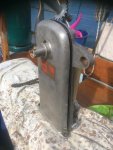
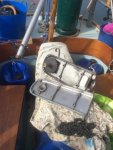
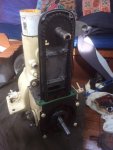
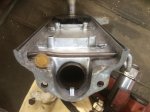
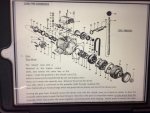
I appreciate that most, if not all of the contributors to this thread are not familiar with this engine but I would still like to hear suggestions and ideas for this next task. Please look at the photographs including the extracts from the manual about adjusting gear clearance and the paragraph above that talks about the dowels.
Questions:
where to position the DTI
How to "lift" the housing using the dowels
Should the gears only just mesh say 5mm or put the housing on all the way as I have it in the pictures

I have had a little play with it this afternoon and the housing tends to move more left and right than up and down.

Many thanks

Kieran
 

Attachments

  • IMG_0806.jpg
    IMG_0806.jpg
    94.8 KB · Views: 15
  • IMG_0805.jpg
    IMG_0805.jpg
    91 KB · Views: 11
  • IMG_0804.jpg
    IMG_0804.jpg
    84.8 KB · Views: 12
  • IMG_0807.jpg
    IMG_0807.jpg
    91.7 KB · Views: 13
  • IMG_0808.jpg
    IMG_0808.jpg
    91.4 KB · Views: 13
  • IMG_0809.jpg
    IMG_0809.jpg
    93 KB · Views: 13
  • IMG_0810.jpg
    IMG_0810.jpg
    91.1 KB · Views: 12
  • IMG_0811.jpg
    IMG_0811.jpg
    94.6 KB · Views: 13
Last edited:
The gears need to be in full mesh.
I'd mount the magnetic base on the flat machined surface of the gear housing, with the DTI plunger on the ledge at the bottom of the cylinder.
Probably a bit more rigid than having the base on a curved surface, as shown in the picture.
A bit of ingenuity with a thin wedge or lever seems to be called for to lift the gear housing an extra few thou from its highest point as the gears are rotated.
I don't think that the sideways movement on the dowels is too critical. It's the vertical gear-tooth clearance that matters.
 
Thanks earlybird, I like the idea of swapping the position of DTI.
I too thought full mesh but the manual wording made me wonder.
 
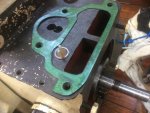
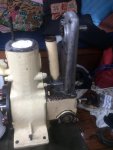
The gear housing is on, it was quite straight forward in the end. I had to put the needle of the DTI onto the housing so that it had a smooth machined surface to sit on, I tried it resting on the block but the uneven surface and the movement of the gear housing gave inaccurate measurements. I was able to set up a few blocks of wood under the housing and tap one of them sideways which in turn lifted another block and thus the housing. I was able to move it in 0.01 increments to reach the desired 0.05. I was then able to rotate the crank shaft two full revolutions and feel the clearance with my hand on the cam shaft. All good. Today I cleaned up the hand starting assembly, put a new o-ring between the two halves, a new gasket at the base and made a small repair to two of the fixing holes that had worn through from the chain rubbing. There are some lovely features on this little engine and one of my favourites is this little dice valve on top of the gear housing that is operated with a simple cam lever, when operated it pressurises the crank case and pumps all the oil out of the sump to a brass spigot on the engine block and through a plastic tube to be placed into your receptical of choice when doing an oil change, simple and clever. Is this common on other engines?

I have also adjusted the ahead cone from the reverse gear by adding an extra shim onto the drive shaft, the gear lever movement is now back to spec. The astern cone does not need adjusting but I do need to remove it from the housing to get to the two bearings in there for replacement. All was going well until I tried to remove the nut that holds on the rear drive flange, it will not budge. I will have another crack at it tomorrow.
 

Attachments

  • IMG_0818.jpg
    IMG_0818.jpg
    95.3 KB · Views: 10
  • IMG_0813.jpg
    IMG_0813.jpg
    93.4 KB · Views: 10
  • IMG_0812.jpg
    IMG_0812.jpg
    93.3 KB · Views: 10
  • IMG_0816.jpg
    IMG_0816.jpg
    88.4 KB · Views: 9
  • IMG_0815.jpg
    IMG_0815.jpg
    91.9 KB · Views: 10
  • IMG_0814.jpg
    IMG_0814.jpg
    92.3 KB · Views: 9
  • IMG_0819.jpg
    IMG_0819.jpg
    90.2 KB · Views: 9
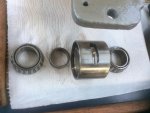
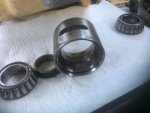
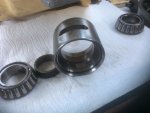
Eventually removed the nut holding the drive flange on, more heat, a bigger lever and I had to make a jig to hold the flange. I was then able to slide the drive cone out forwards and the bearings and bearing carrier out aftwards. I was pleased to discover that my gearbox has had a modification made to the bearing carrier so that it now holds stronger/larger taper bearings as opposed to the normal bearings used in a straight sleeve.
This is great as they were a known weakness but any suggestions of how to remove the races from the sleeve/carrier much appreciated. There is nowhere to get a puller in or drift them out. It seems to me my options are:

1. Heat the sleeve with a cold wet rag inside and see if they will drop out.
2. Weld a nut or piece of bar to the races being extremely careful of splatter and then use that material to drift them out.

Any other ideas most welcome.

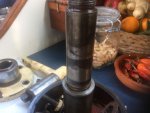
The shaft and the internal race of the bearing is a little rusty, is it a case of just cleaning the shaft with some 400 grit wet and dry? I presume some water has got in there in the past. Obviously I will be using all new oil seals and gaskets to ensure no water gets in in future.

Now I know what parts I need for the reverse gear i am ready to put in a final order to Sleeman Hawken which will include the new piston gudgeon pin. So fingers crossed once I receive the order, hopefully end of the week, I should be close to getting the motor back in its hole!
 

Attachments

  • IMG_0823.jpg
    IMG_0823.jpg
    91 KB · Views: 7
  • IMG_0822.jpg
    IMG_0822.jpg
    88.3 KB · Views: 7
  • IMG_0821.jpg
    IMG_0821.jpg
    90.9 KB · Views: 7
  • IMG_0825.jpg
    IMG_0825.jpg
    89.3 KB · Views: 7
The tapered bearings look OK from the photos so I assume that your'e not changing them? If so, I'm not sure why you want to remove the races from the carrier? Just wash out the bearings with white spirit or diesel and clean races and shaft up with the fine wet and dry, then re-grease and re-assemble and set the loading.

Richard
 
So the bearing manufacturer spend many beer tokens with Taylor Hobson to define roundness (talyrond) and surface finish (talysurfh) However you presume to assume that a quick rub with a bit of wet an dry around your fingers will solve any probs you are mistaken. If any doubt replace
 
As with several decisions on this rebuild, you get to a certain point and think.......well I've come this far.....so let's keep replacing stuff. However, it does all start to mount up cost wise and if I were more experienced I would be in a better position to decide what to spend my spondoolies on, but I'm not experienced.
Richard I think you are probably correct that the bearings are serviceable but the rust on the inner race made the decision easier. However removing those races from the sleeve is proving to be tricky.
Once again, thank you all for the input and keep the comments coming.

Kieran
 
As with several decisions on this rebuild, you get to a certain point and think.......well I've come this far.....so let's keep replacing stuff. However, it does all start to mount up cost wise and if I were more experienced I would be in a better position to decide what to spend my spondoolies on, but I'm not experienced.
Richard I think you are probably correct that the bearings are serviceable but the rust on the inner race made the decision easier. However removing those races from the sleeve is proving to be tricky.
Once again, thank you all for the input and keep the comments coming.

Kieran

Apologies Kieran ..... I thought that you had decided to re-use the bearings as you said "I will be using all new oil seals and gaskets........"

The bearings do indeed look OK in the photos but I would not presume to second-guess you on whether they are OK just from a photo. The crunch test if the de-greased bearing surfaces look smooth and non-pitted after a clean-up is to push them together by hand and spin them slowly whilst exerting hand pressure. If the bearing feels absolutely smooth with no graunching, grinding or sticking, then they are fine.

However, you've clearly decided that it's better to replace them so sorry for missing the point of the question so I'll address that now. The usual way to remove the races is to press them out with a former. I don't have a press here so I usually have to use a socket from a socket set which just fits inside the carrier and drift them out with a club hammer. You will need to heat the carrier using boiling water as a minimum but a torch ideally. Cooling the race will help but the carrier will expand more than the races with just heat. You will probably ruin the race getting it out but the new one will be much easier to drift/press in as it will not be corroded and you can leave it in the freezer overnight and heat the carrier and that really will help. However, you do need a socket or former which is a very close fit into the carrier to ensure that the taper is left untouched by the drifting process.

Having said all that, a hydraulic press or large vice is really the best way to go if you can ask a local machine shop. I should also add that I've never actually worked on your model of engine, of course.

Good luck

Richard
 
Last edited:
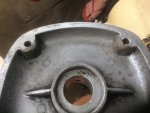
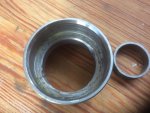
Unfortunately Richard, with this particular situation the two bearings are in a bearing carrier and it it a modification to the original design, therefore there is no way to get either a puller onto the race or any form of drift or press. The races are back to back in the sleeve. What I have started to do today is not pretty but I have been using a drill bit and small file to try to make a recess in the centre of the carrier between the two races so I can get a small punch in there to drift the races out, this area is not a bearing surface and will not effect the actual bearings. . I have managed to shift one of them by a few millimetres so far. Once I get them out I can create some kind of proper rebate to allow for future removal. It is a shame whoever made the modification couldn't be bothered to do it first time round. I hope this makes sense.
 

Attachments

  • IMG_0825.jpg
    IMG_0825.jpg
    89.3 KB · Views: 5
Unfortunately Richard, with this particular situation the two bearings are in a bearing carrier and it it a modification to the original design, therefore there is no way to get either a puller onto the race or any form of drift or press. The races are back to back in the sleeve. What I have started to do today is not pretty but I have been using a drill bit and small file to try to make a recess in the centre of the carrier between the two races so I can get a small punch in there to drift the races out, this area is not a bearing surface and will not effect the actual bearings. . I have managed to shift one of them by a few millimetres so far. Once I get them out I can create some kind of proper rebate to allow for future removal. It is a shame whoever made the modification couldn't be bothered to do it first time round. I hope this makes sense.

I understand. I had assumed that the central "land" was part of one of the races or a separate collar. I have never seen races installed where they are pressed against a solid rebate without the rebate being a slightly smaller diameter so that a lip is formed by the race which can be used to drift out the race. That is a really poor design as you say.

Once you have the races out could you have that central land turned or ground down so that it is just a low ridge across the middle? This would give more options next time.

You could use a reciprocating hacksaw (a hand saw would take a long time!) to cut right through both races? You would end up with a slot in the land but that shouldn't matter.

Richard
 
Last edited:
Kieron. A while back one of my jobs involved the refurbishment of machines from the local steelworks, almost all of the bearing runners where recessed and impossible to push out, just like yours. We made a simple tool out of a small iron rod to get under the race and lever it out. You could also use a cold chisel,a few taps should shatter the race. Wear goggles..Good luck.
 
Thanks for the advice Richard and Chrishelen.
I have managed to remove the races by fairly crude means, hack saw, drill, file and punch. I was not helped by the fact that they were glued in as well!
Anyhow, now I would like to have the surfaces on the central land machined flat so the races sit nice and square, that will remove any glue and the burrs left from my butchery. Would it be reasonable to ask a machinist to remove 0.25mm? I ask because this is the size of the thinnest shims of which I would have to remove one to compensate for the removal of material. I hope this all makes sense.
 

Attachments

  • IMG_0829.jpg
    IMG_0829.jpg
    91.1 KB · Views: 5
  • IMG_0827.jpg
    IMG_0827.jpg
    92 KB · Views: 6
  • IMG_0831.jpg
    IMG_0831.jpg
    94.5 KB · Views: 7
Well done....yes you could get them reamed out if you really wanted to and there is a lot of damage to the Base. Add shims to take up the slack in the bearing.
 
Yes .... well done getting them out. I wonder whether the glue (perhaps epoxy?) was used because the races are actually not a very tight fit? They should obviously be tight to ensure that the race doesn't spin in the holder rather than the bearing. You will need to check the fit of the new races before deciding whether you need to Loctite them in.

To be honest, I think I would just clean up the housing with some heat/solvent/wet and dry just remove the glue and take off the burrs. The odd gouge isn't going to affect the alignment of the races. If I was going get a machinist involved I would be inclined to consider whether the height of the land could be reduced without causing any other issues. This would then leave an inside lip which would enable the races to be removed a lot more easily in the future, just in case.

Richard
 
Exactly the conclusion I reached Richard. Going to clean up the glue and burrs and they will be good to go. I also wondered if the races may be a loose fit so I cleaned up one of the old ones and the carrier with a bit of wet and dry and refitted. It was really tight as you would hope and expect. I will double check tomorrow with the new races. I've no idea what the person who did the mod was thinking.
 
Top