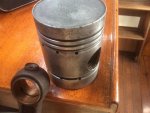
Rebuilding a 1968 Sabb model GG

2. The oil feed normally is from the crankshaft pin through into the large end bearing And then up the connecting rod into the small end bush.
3. Sometimes there is a further drilling on the top of the conrod to allow oil to be squirted up into the underside of the piston crown for cooling purposes.
4. So to explain the 3 hole bush:
(I) this is the one I would place at 12 o clock to align with the drilling for piston cooling.
(ii) I would refer to this one as the 5 o clock position this will allow oil from the gallery in the small end of the conrod into the bush when it is not under load ( the load area moves through each rev).
(iii) I would refer to this hole as the 7 o clock position and the same comments from ii then apply.

This is all incorrect for this and most engines, sorry. The hole in the top of the conrod is where the oil comes in, not goes out.
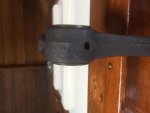
 
I will check with Sleeman Hawken that I have the correct bush, Sabb made this engine for 47 years so there are some changes along the way and Sleeman managed to send me the wrong big end connecting bolts so there are definitely differing con rods. Just for those that aren't familiar with this engine, the main bearing and the big end bearing are splash lubricated and it appears to me that the small end bush would be lubricated from the 12 o'clock hole as there is a "cup" Molded into the Conrod at this position, presumably to collect oil that drips through the piston oil holes. Also if you look carefully at the con rod the additional holes look to have been retro drilled at some point.
 

Attachments

  • IMG_0798.jpg
    IMG_0798.jpg
    95.8 KB · Views: 7
  • IMG_0797.jpg
    IMG_0797.jpg
    93.5 KB · Views: 7
I will check with Sleeman Hawken that I have the correct bush, Sabb made this engine for 47 years so there are some changes along the way and Sleeman managed to send me the wrong big end connecting bolts so there are definitely differing con rods. Just for those that aren't familiar with this engine, the main bearing and the big end bearing are splash lubricated and it appears to me that the small end bush would be lubricated from the 12 o'clock hole as there is a "cup" Molded into the Conrod at this position, presumably to collect oil that drips through the piston oil holes. Also if you look carefully at the con rod the additional holes look to have been retro drilled at some point.

Small end is clearly splash fed into the cup and down onto the bearing. The lower holes look to be drilled into pre-cast lands to me and therefore are presumably part of the design. It looks as if the lower holes are designed to give an oil flow from the cup, round the bearing and out through the lower holes which probably means that once the sleeve is pressed into the conrod the holes in the sleeve are drilled through from the lower holes with a smaller drill.

Whether this is strictly necessary to supplement the natural bleed out of the oil sideways along the gudgeon pin from the cup is a moot point ..... but if the original sleeve is drilled at those lower holes I would recommend sticking with that design if possible.

Richard
 
Whoah.

I am not at all familiar with this engine type so take all I say with that in mind.

1. I would be wary you that you have the correct small end bush.
2. The oil feed normally is from the crankshaft pin through into the large end bearing And then up the connecting rod into the small end bush.
3. Sometimes there is a further drilling on the top of the conrod to allow oil to be squirted up into the underside of the piston crown for cooling purposes.
4. So to explain the 3 hole bush:
(I) this is the one I would place at 12 o clock to align with the drilling for piston cooling.
(ii) I would refer to this one as the 5 o clock position this will allow oil from the gallery in the small end of the conrod into the bush when it is not under load ( the load area moves through each rev).
(iii) I would refer to this hole as the 7 o clock position and the same comments from ii then apply.

I think you have the wrong small end bush because your current pin does not fit AND it only has one oil feed hole.

A previous post suggested fitting at 12 o clock - I do not think you would get any oil into the small end bush if you did this for the reasons posted above.

If you had access to a machine shop you could sort both issues out in 30 minutes but I would hold fire fitting this small end bush and do more research or seek more expert advice.

Sorry.
Some engines have drilled rods as you describe, some have splash lube as this one is. The gudgeon pin needs replacing. Given that you have got this far dont even think about bodging a local sourced one.
Stu
 
please could somebody confirm that it is normal for the cage on the taper roller bearings to move about slightly. It makes a funny rattling noise which is disconcerting. So I have removed the crankshaft and placed a race onto the bearing and applied pressure, sure enough, with the other hand I can replicate the noise by jiggling the roller cage. I presume this is ok and I can carry on? Secondly, the only way to remove the race in order to add or subtract shims is to drift it out with a 1/4 inch brass drift. Now my shims are dinged, considering the tiny margains I am working with I am thinking these are now useless. Do you think trying to flatten them clamped betweeen pieces of metal will help? Or will the force of the bearing flange being bolted down flatten them surficely?

Kieran
 
Hi folks,
Here is an audio clip of the sound of the crankshaft bearings whilst rotating the shaft by hand. It does not sound good to me. It sounds like the rollers are dropping onto one another within the bearing. It sounds like I have managed to distort the bearings whilst fitting. Drat. I heated the bearings up in the oven then very carefully tapped them into place with a brass drift only making contact with the inner bearing race. They appeared to go on fairly easily, I didn't feel like I was smashing them with excessive force but the sound seems to say otherwise. Tell it how it is please gentleman, have I knackered them?

https://drive.google.com/open?id=0B2Kmt17Atit9SllGTTQtMjBsRjA

Kieran
 
Difficult question really based on a sound clip. They do sound a bit rattly, but taper rollers can, esp. if the end play is a bit excessive. How much oil is on them? If they're dry then they will sound worse. Give them a squirt of engine oil and listen again.
Based on your description, I doubt if you've damaged them, although a piece of tubing would be better for drifting them on.
I assume no dirt has got into them.
Did they arrive nicely wrapped in the manufacturer's packing?
Keep smiling!
 
please could somebody confirm that it is normal for the cage on the taper roller bearings to move about slightly. It makes a funny rattling noise which is disconcerting. So I have removed the crankshaft and placed a race onto the bearing and applied pressure, sure enough, with the other hand I can replicate the noise by jiggling the roller cage. I presume this is ok and I can carry on? Secondly, the only way to remove the race in order to add or subtract shims is to drift it out with a 1/4 inch brass drift. Now my shims are dinged, considering the tiny margains I am working with I am thinking these are now useless. Do you think trying to flatten them clamped betweeen pieces of metal will help? Or will the force of the bearing flange being bolted down flatten them surficely?

Kieran

Taper roller bearings will always sound rattley until the correct pre-load is exerted by shims or a nut depending upon design but they do need to be well-greased or oiled before the loading process starts. Having to drift out the bearing each time to alter the shims sounds a bit unconventional. Are you sure that you are putting the shims in the right place?

Unless the shims are really dented, you should be able to flatten them in a vice to make them usable. As you say, they will flatten when you tighen the bearing housing so you just need to allow for the flattening process. I replaced a king pin a couple of weeks ago and that was shimmed and the only way to do it was to tighten up the king-pin housing and measure the stiffness of the hub and then strip down and rebuild with more or less shims. However, those are not as critical as your bearing so I got them close enough on the second attempt. The wheel bearings in that case were tapered rollers but the loading was done with a large nut on the shaft and that's a lot easier to execute.

Richard
 
Thanks again gents.
The bearings are fairly dry at the moment so I will squirt some oil tomorrow and listen again. I have been careful to keep the bearings as clean as possible, a little dust at worst. The bearings came well lubricated and perfectly packaged. I'm definitely putting the shims in the correct place.
I appreciate that asking for advice about clearances is almost impossible, to make a proper judgement one has to hear and feel things themselves. However, as that is not possible I will have to describe the problem.
With the engine laying down and crank shaft pointing upwards, I can lift the crankshaft and measure the clearance with the DTI. Once I add shims and get to the target end play of 0.05, stand the engine up and test it is very rattley, shaft runs unevenly (feel and sound) and also too much radial play. Simple, all the symptoms of excessive end play, so this means my method of using the DTI doesn't work. So, now, I add more shims and I can get it so it sounds much better and runs smoothly but with no apparent end play measured by the DTI. I used to change the bearings on bicycle bottom brackets all the time as a kid, although no where near the same level of accuracy needed or loads being applied. Do I trust my instincts or find another way to measure the play? Also, when I get it to a point I feel is about right and then hit the end of the shaft with the heel of my hand I can just detect a tiny bit of radial play which feels spot on. Surely if there is a small end play there will also be a small radial movement is this correct?
Finally, the manual says "if you have too little end play clearance the fly wheel will be hotter than normal" so maybe do my best, get it running and worst case scenario, whip off the fly wheel and bearing flange and remove a shim.........
 
I did say the DTi method would be too inaccurate for this task. Your target clearance is only two thousands of an inch, very delicate clearance to be measuring using this method.
 
Paul is right in that 2 thou is at the limit of detection by hand. If you jiggle the crank to and fro you will feel/hear the tiniest chink. To be honest, I doubt whether there is any problem in settting it up this way.

As I mentioned before, the only way to do it accurately without specialised equipment and a rig is to shim the shaft until there is no discernable play whatsoever but also the shaft is not binding due to the friction caused by being tight .... then remove a 0.05 shim or whichever one is nearest to the middle of the acceptable range.

Richard
 
Last edited:
Cheers Paul, Richard.
I really appreciate your advice and I am listening, just working my way through things. Apologies if you guys are having to repeat yourselves. I'm hopeful I'll be able to get that shaft sorted tomorrow and move on to the next stage.

Enjoy the rest of your weekend.
 
I did say the DTi method would be too inaccurate for this task. Your target clearance is only two thousands of an inch, very delicate clearance to be measuring using this method.
Thread drift I know but I must say that the DTI is/was the tool of choice for making definitive measurements, thats what it was invented for!
Stu
 
Thanks again gents.
The bearings are fairly dry at the moment so I will squirt some oil tomorrow and listen again. I have been careful to keep the bearings as clean as possible, a little dust at worst. The bearings came well lubricated and perfectly packaged. I'm definitely putting the shims in the correct place.
I appreciate that asking for advice about clearances is almost impossible, to make a proper judgement one has to hear and feel things themselves. However, as that is not possible I will have to describe the problem.
With the engine laying down and crank shaft pointing upwards, I can lift the crankshaft and measure the clearance with the DTI. Once I add shims and get to the target end play of 0.05, stand the engine up and test it is very rattley, shaft runs unevenly (feel and sound) and also too much radial play. Simple, all the symptoms of excessive end play, so this means my method of using the DTI doesn't work. So, now, I add more shims and I can get it so it sounds much better and runs smoothly but with no apparent end play measured by the DTI. I used to change the bearings on bicycle bottom brackets all the time as a kid, although no where near the same level of accuracy needed or loads being applied. Do I trust my instincts or find another way to measure the play? Also, when I get it to a point I feel is about right and then hit the end of the shaft with the heel of my hand I can just detect a tiny bit of radial play which feels spot on. Surely if there is a small end play there will also be a small radial movement is this correct?
Finally, the manual says "if you have too little end play clearance the fly wheel will be hotter than normal" so maybe do my best, get it running and worst case scenario, whip off the fly wheel and bearing flange and remove a shim.........

As I inderstand it you are using taper roller bearings, the cages that hold the rollers in position are loose., that is normal. They can rattle in dry bearings, they have no function as such in the bearing role, they are there to separate the balls or rollers, to keep them apart. I cannot see that you have damaged them doing what you are doing. If you are really concerned, take them off and put them in the cone with some oil on. Spin them etc to confirm they are ok. Make sure there is no roughness etc, light finger pressure is enough to align them. The shims? As long as they are not really damaged then when the bearings are pushed against them properly they should be ok. The "dents" should come out. I still say that you should be able to assemble the crank cases with the shaft in, cases toghtened up and with the DTI on ( with enough movement in the stroke of the DTI) "bump" the shaft to see what play you have or havent. The DTI has been used in scenarios like this by engineers for decades. They can and will detect a "couple of thou" movement, thats what they were invented for!
Stu
 
Thread drift I know but I must say that the DTI is/was the tool of choice for making definitive measurements, thats what it was invented for!
Stu

I think the problem is going to be that without a proper bolt down rig to hold the engine and gauge absolutely rigid, it's going to be impossible to measure 2 thou. The tiniest movement of the engine or gauge when the OP moves the crankshaft will be more than the end-float he is trying to measure. :(

Richard
 
I think the problem is going to be that without a proper bolt down rig to hold the engine and gauge absolutely rigid, it's going to be impossible to measure 2 thou. The tiniest movement of the engine or gauge when the OP moves the crankshaft will be more than the end-float he is trying to measure. :(

Richard
My advice as above, we crossed as we were posting, is, bolt the lot together, then use the DTI properly, clamp the base to the crank case with the sensor on the shaft. Doesnt matter that the engine is loose then the important bit, the DTI is rigid.
Stu
 
My advice as above, we crossed as we were posting, is, bolt the lot together, then use the DTI properly, clamp the base to the crank case with the sensor on the shaft. Doesnt matter that the engine is loose then the important bit, the DTI is rigid.
Stu
I used to use them on the coal face, measuring the alignment in the flexible couplings, 3ft diameter, on the "fluid flywheels" that coupled them. We could get them spot on or within a couple of thou and that was with big 100hp electric motors, shims on the motor feet and "bumping" them around with a wood chock!
Stu
 
I used to use them on the coal face, measuring the alignment in the flexible couplings, 3ft diameter, on the "fluid flywheels" that coupled them. We could get them spot on or within a couple of thou and that was with big 100hp electric motors, shims on the motor feet and "bumping" them around with a wood chock!
Stu
The motors were coupled to Radicon gearboxes, they turned the drive through 90 degs, worm drive in with taper bearings through out, as I came to the end of my apprenticeship, I could shim those in my sleep! All using a DTI.
Stu
 
Top