Rebuilding a 1968 Sabb model GG

What I don't get at the moment is why there doesn't seem to be any end play on the crankshaft. I checked it before I took the engine apart by trying to gently lever in between the fly wheel and engine block and yesterday when I could feel the aft bearing with my finger tips the rollers and cage were loose yet I couldn't feel any end play. It's like the shaft is being held firm but not in the correct position. I have plenty of time to look closer whilst waiting for the shims to arrive. Also there is nowhere to get feeler gauges in so it will have to be measured either by the DTI or by the shims themselves that are 0.2 and 0.05mm.
Not going to do much today other than drink a few beers and watch the rugby. Enjoy!

Kieran
 
What I don't get at the moment is why there doesn't seem to be any end play on the crankshaft. I checked it before I took the engine apart by trying to gently lever in between the fly wheel and engine block and yesterday when I could feel the aft bearing with my finger tips the rollers and cage were loose yet I couldn't feel any end play. It's like the shaft is being held firm but not in the correct position. I have plenty of time to look closer whilst waiting for the shims to arrive. Also there is nowhere to get feeler gauges in so it will have to be measured either by the DTI or by the shims themselves that are 0.2 and 0.05mm.
Not going to do much today other than drink a few beers and watch the rugby. Enjoy!

Kieran

Drop a 0.05 shim in the crank. Put a thin strip of Plasticine on the shim, followed by another shim. Fit and tighten the end cover. Remove the end cover, remove the two shims and Plasticine as one assembly. Measure the assembly with a digital vernier gauge. Deduct the desired clearance from that measurement and what you are left with is the size of shim/s that you need.

Rather than Plasticine you could use very soft solder. In fact, you may be able to use solder on its own, without the shims. You'd need to tap the end cover down to squash the solder, as you gently tighten the bolts.

A tried and tested method of measuring squish :)
 
Thanks Paul, the problem is, the shims go under the front bearing race which is on the inside of the bearing flange (see 1st pic on post #34) It's a pretty tight fit and the race needs to be drifted in. So, I'm not sure the race would be pushed into the solder/plastercine when bolting up the front flange. Definitely worth a try though. I hope that makes sense.
 
Thanks Paul, the problem is, the shims go under the front bearing race which is on the inside of the bearing flange (see 1st pic on post #34) It's a pretty tight fit and the race needs to be drifted in. So, I'm not sure the race would be pushed into the solder/plastercine when bolting up the front flange. Definitely worth a try though. I hope that makes sense.

Yes, that makes sense. Not an easy job.
 
Drop a 0.05 shim in the crank. Put a thin strip of Plasticine on the shim, followed by another shim. Fit and tighten the end cover. Remove the end cover, remove the two shims and Plasticine as one assembly. Measure the assembly with a digital vernier gauge. Deduct the desired clearance from that measurement and what you are left with is the size of shim/s that you need.

Rather than Plasticine you could use very soft solder. In fact, you may be able to use solder on its own, without the shims. You'd need to tap the end cover down to squash the solder, as you gently tighten the bolts.

A tried and tested method of measuring squish :)
Hes got a DTI, Id rather use that, the idea of layering it down would work but if he applies enough "push" with the crank case upright he should be able to get a reading.
Stu
 
Just got back from the local bearing shop where I had hoped to purchase 34 1/4 inch ball bearings to fit in the sprocket for the hand starting gear. As I have said before, my Italian is not very good, so I don't know what the ball bearings were made of but at €5 each and a grand total of €170.......needless to say I politely said thanks but no thanks! Just bought a pack of 50 from simplybearings.co.uk for £6 inc vat and 1st class postage. I'm sure it's simply down to my inability to communicate, but nobody ever said this would be easy.
Just waiting on parts now.

Kieran
 
I'm loving this thread. My old Nova had a Sabb gg 9hp i think. Loved that thumper. I believe they were designed to be repaired and rebuilt by the average sailor using no special tools. Mine run like a dream and would start on the coldest days first turn, a few drops of oil down the pipe into the cylinder helped. It would tick over at really low revs. Loved that lump.
 
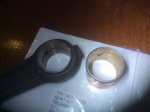
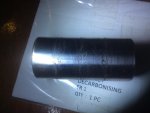
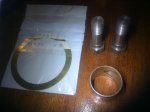
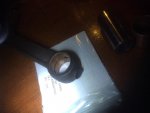
Ok, the parts have arrived. New big end bolts, main bearing shims (still no idea where I put the old ones for safe keeping) and small end bush. Tomorrow I will get the crankshaft end play sorted and see if I can find someone to fit the new bush. I tried to make up a puller today using spares on board and various sockets but I just don't have anything the correct diameter. Looking closely at the new bush and taking some measurements it appears that the bush will need reaming after it has been fitted to get proper clearance with the gudgeon pin. Does this sound correct? Normal practice? Also, I hope I haven't made an error by not ordering a new gudgeon pin, the old one is a little pitted. Does it look like it is still serviceable? And finally the original bush had three oil holes and the new one has one, does it matter which hole I line it up with on the con rod.

Many thanks

Kieran
 

Attachments

  • IMG_0790.jpg
    IMG_0790.jpg
    94.9 KB · Views: 13
  • IMG_0791.jpg
    IMG_0791.jpg
    92.4 KB · Views: 13
  • IMG_0789.jpg
    IMG_0789.jpg
    93.2 KB · Views: 12
  • IMG_0793.jpg
    IMG_0793.jpg
    92.7 KB · Views: 13
Not unheard of to ream bearings, especially on older stuff.

The hole in the shell needs to be at 12-o-clock.

Sorry to say, that gudgeon pin needs renewing.
 
Last edited:
Cheers Paul, am I right in thinking that the gudgeon pin is made from forged steel? Is it the sort of thing One should be able to get machined In most places?
 
Cheers Paul, am I right in thinking that the gudgeon pin is made from forged steel? Is it the sort of thing One should be able to get machined In most places?

Yes, usually forged steel. The surface finish of the pin is critical, i doubt machining would be good enough.

You might be able to locate a pin of the same OD, perhaps longer and have it shortened.
 
Last edited:
Bloody shims, bloody clearances, bloody end play, bloody gudgeon pins, bloody engines, bloody boats!
Thanks, feel better already.
Will try again tomorrow.
:rolleyes:
 
The gudgeon pin will, as said, be ground to a very fine surface finish and highly accurate on diameter. It will be high strength steel and almost certainly surface hardened.. Not a task for the local jobbing shop.
I think that I'd send for the correct component.
When assembled, it should be tighter in the piston than on the con. rod bush, otherwise the bearing movement will be between the piston and the pin, leading to wear of the aluminium piston.
Heating the piston to assemble can be good, but the bush might well need reaming, not too easy a job to do accurately.
It's possible that oil holes in your original bush were drilled after pressing in, saving any problem of aligning pre-existing holes.
Perhaps the agents can advise.
Good luck!
 
Stick with it. It is time consuming (especially where you are) but at least you are identifying the potential pitfalls and resolving them rather than cutting corners and having to start again. :encouragement:
 
Cheers fellas,
Yes definitely need a new gudgeon pin, I can get it from the uk if needs must, on an off chance, it is 35mm external diameter and 74mm in length. If anybody knows of a more common engine that uses a 35mm pin even if it is longer please let me know. As for the crankshaft end play, I shall report back tomorrow after further efforts.
Have a good weekend.

Kieran
 
snipped And finally the original bush had three oil holes and the new one has one, does it matter which hole I line it up with on the con rod.

Many thanks

Kieran

Whoah.

I am not at all familiar with this engine type so take all I say with that in mind.

1. I would be wary you that you have the correct small end bush.
2. The oil feed normally is from the crankshaft pin through into the large end bearing And then up the connecting rod into the small end bush.
3. Sometimes there is a further drilling on the top of the conrod to allow oil to be squirted up into the underside of the piston crown for cooling purposes.
4. So to explain the 3 hole bush:
(I) this is the one I would place at 12 o clock to align with the drilling for piston cooling.
(ii) I would refer to this one as the 5 o clock position this will allow oil from the gallery in the small end of the conrod into the bush when it is not under load ( the load area moves through each rev).
(iii) I would refer to this hole as the 7 o clock position and the same comments from ii then apply.

I think you have the wrong small end bush because your current pin does not fit AND it only has one oil feed hole.

A previous post suggested fitting at 12 o clock - I do not think you would get any oil into the small end bush if you did this for the reasons posted above.

If you had access to a machine shop you could sort both issues out in 30 minutes but I would hold fire fitting this small end bush and do more research or seek more expert advice.

Sorry.
 
Top