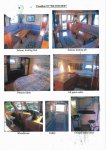
Re engine 16M trawler yacht

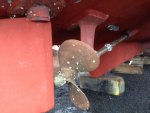
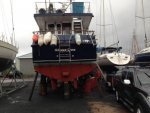
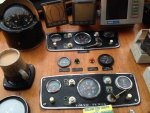
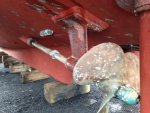
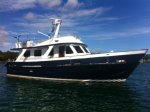
Attached are a few photographs from the sales particulars (probably the last time the boat was tidy!) from around about January 03 when we bought her, and there’s plan there with the layout of the cabins to answer various questions about how to jam that number of loos/beds into a 52 ft hull. With the exception of the master cabin, the heads are all pretty modest in size but do the job. To get 3 showers, a bath and 4 loos in so that every cabin is en suite, is really nice for guests. To be honest the amount of accommodation packed in (obviously you get more with an aft cabin) is one of the reasons we’ve hung on to the boat thus far. There aren’t many even 60 to 70 footers that would tick all the boxes we want (and that we could afford) that would have the accommodation. I also particularly like separate wheelhouse with door where you can shut out the light and chatter from the saloon when cruising at night and separate galley (modest in size but at least you can work in you know sea way that’s not too far to fall).

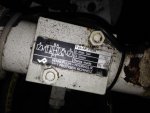
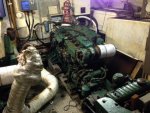
I’ve also attached a bit of detail on the 6068AFM John Deeres that we’ve settled on (just need to wait the 3 months now).

Picking up a few comments from other posters.

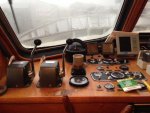
MapisM – the throttles have been like that since I had the boat and to be honest I’m just going to leave them that way, but yes I wonder if one of them should be turned round so that you can use the throttles with one hand. The way they’re set up it’s either one engine at once or reach over with both hand, (how very boatyard). At the start of the process, I thought I wanted the electronic throttles that you see on a lot of modern boats which would allow me to have either a wireless or a wired system on the aft deck to control gears/throttles, but I think I would be up somewhere around £15,000 plus fitting and I just can’t justify the expense. For a displacement boat, frankly once you leave the harbour you just set them. I will try in this refit though to get a set of bow and stern thruster controls wired on the aft deck as that should be a way of getting a bit of partial control if you just need to flick the stern or something whilst mooring stern to Med style. I already have a camera that looks aft so I just need a monitor for that on the fly bridge to maybe help in judging the distance when backing up.

Being what looks like the least technical person on this forum, I can’t add much to the interesting stability debate. All I can say is that before she had the ballast she would literally blow over in strong winds to an uncomfortable angle and then you had to go and shut the fuel stops on whichever side tank was upwind to stop it draining through the keel tank to the other side and accentuating the angle further. The water tanks which work on a similar system don’t have any method of stopping water flowing through over a period of time. From memory they are 600 gallons or so it’s not too much of a problem, but there occasions “pre ballast” where we’ve come into a Marina out of a heavy wind and have to shift all the dive cylinders and weight belts right over to one side of the boat and get a couple of people to stand on that side whilst the fuel and water evened out and then we could hang the fenders at the right height and moor up without looking too shambolic. Also pre ballast, she would kind of hang (would be the description I’d use) at one side of the roll for more than one kind of wave cycle, that’s why I wanted her to stay more vertical or get back to vertical more quickly.

It’s a particular issue when you’re hanging around with divers kitting up when of course the Vosper mini fins are doing nothing for you and you having to manoeuvre around and not always head to sea to get your divers dropping in to a shot line, perhaps up tide, perhaps beam onto the sea or whatever, and then once you’ve dropped the divers you’ve got to sometimes reverse away quite sharply (the divers go over the front not the back in our setup which I much prefer), and then she could be quite unstable pre ballast. The cabin is cascover and the fly bridge roof is a load of wood faced with plywood so as well as her being not that long a boat and nearly as tall as a block of flats (and some say a little uglier) she’s really got quite a lot of weight up top (not to mention the dive compressor but it has to go somewhere) so all in all the ballast will be staying in.

I’m not aware whether you could get bigger stabiliser fins on the same system. She could certainly do with them and I will make an enquiry with Vospers, but the Vosper mini fins are now pre ark and I’m not sure there is anybody at Vospers anymore who know much about them.

I will try and find the clip of the video from the first year we had the boat (when we used it pre ballast) when we were off Northern Ireland on a choppy but by no means horrific day, looking for a diver lost from another boat. It might give some idea of how bad things were pre ballast (just before dark we found the diver by the way and got him on board and onto a rescue helicopter and so like anyone would, we do our bit to help the RNLI but we don’t profess to be as tough as those guys and girls). After that we went into Portrush absolutely cream crackered with the Portrush and the Arranmore Severns who had also been on the search (along with the Tyne Severns from Loch Swilly). The Portrush bistro had to find 20 portions of steak and chips pretty quickly.

Right, moving on to things that are still a bit undecided in the refit project, maybe “the panel” can offer opinions on the following:

1. Air Conditioning. There are some original vintage air con units on the boat, one at the front in a big locker in the wheelhouse and one under the seats in the saloon that cool or heat (reverse cycle) those areas and then through air ducting go down to the cabins. I have never used them in the 10 or 11 years we’ve had the boat. Unfortunately, the one in the saloon is ripped out to make space for the engine lifting in and out job and obviously the boat’s out of the water now, but from memory when we tried them on many years ago, one of them seemed to work ok (at heating, we were in Scotland) and one wasn’t working and I can’t remember whether it was the sea water pump that was seized or not. Anyway, after phoning one air con supplier, their real suggestion rather than buying new units was that I’d try and get those working and they could be re-gassed if necessary and sorted out fairly cheaply. Do people think I am mad going down that route in that presumably, when I’m in France (with my 2 words of French), if anything goes wrong, it will be hard work and would people suggest just going for new stuff now and if so, views on makes on a postcard please.

2. Passerelle. To be honest, I’m thinking of going for an old fashioned one with the rope and pulleys type job instead of hydraulic. The hydraulic one seemed to give a fair bit of trouble?? and I don’t much like the look of the price of them. If I went for a manual one, I’d probably get it folding in the middle so I could take it off and stow it if we were out of sea a long time or whatever. The thing I like most about the hydraulic one is the fact that you can put it right up when you leave the boat to fly home. What do people do with the old fashioned one in terms of security in terms of stopping people being able to get on their boat when they’re away??

3. The vexed topic of marine loos. My 4 all use sea water to flush and pump straight out at the moment, so obviously I’m having a black water tank system fashioned for the Med. I understand that a lot of the smell one gets with boat loos is in fact because of the sea water in them when you leave them for a week or two and come back to them. In UK waters that’s never really bothered me, I just flush a bit of loo cleaner down when I get back to the boat and flush plenty of water through and get it all clean and it’s been fine. I don’t have a water maker and I tend to do a reasonable amount of cruising away from Marinas (i.e. anchoring overnights) obviously I will have to see how that goes in the Med, but that’s a likely method of cruising for me. So at this stage I’m thinking of keeping the sea water flushing. Am I mad, what is the opinion of the learned Med boaters on this forum.

4. Tek-deck or similar. If I can afford it, I’m going to do the fly bridge in this I think and the bow area which currently has Treadmaster and a little bit of steel near the bow. Does Tek-deck get too hot for comfort in the Mediterranean sun? or do people think it is worth the money?

5. Bimini. I’m thinking of having a fixed one, I can’t see that I’d ever want to fold it up and I want it to be pretty tough and affordable. I’m going to cover all the seating area on the fly bridge and the new table I’m going to fit on the fly bridge, at the aft end of the fly bridge there will be a bit of sunbathing space without a Bimini cover (I’ll make the dinghy chocks removable so there will be room for a couple of sunbeds there. What are the views, fixed versus fold up? A hard top would be nice but I’m not minded to spend the money, but again opinions always welcome.

Thanks in anticipation guys and girls.

Silver Dee
ps just figuring out how to upload scanned images be back shortly
 
Hiya
Daft to be discussing this online but actually it's a good think because others can chip in :)

You need a p'bucket account for pictures. I'll talk you through it if you need?

You know my views on ballast: in a pertec world the boat (built by GL Watson, no less) should have had bigger fins, then you would not have the problem where cross winds tip the boat sideways. The fins would just correct it. But no-one makes the fins for your actuators any more, so you have to work with what you have.

By adding ballast you have on the plus side added righting moment of course, but on the negative side you have (together with the compressor) materially increased the hull's angular momentum which increase the boat's roll period (time to self right) by perhaps more than 1 second AND you have slowed down the boat 1 knot which makes the fins even smaller (in effect). The way to deal with cross winds (if ever you experience them in the Med, say 1 day per year) in a high sided boat with too-small fins is to dump the ballast and SPEED UP, and let the fins do the work.

So I'm firmly of the view that with your new engines that will do say 15kts unballasted (admittedly with big fuel burn, but who cares in a storm) you should lose the ballast, save yourself fuel on general cruising, then when a big cross wind comes speed up to 12-14 knots not 7 and your (too small) fins will effectively double in size and cure the leaning over.

Ref MapisM's question above "Do you work for the RNLI?" you should post that vid and that would answer his question! :). I think you emailed it to me - I'll take a look
 
2. Passerelle. To be honest, I’m thinking of going for an old fashioned one with the rope and pulleys type job instead of hydraulic. The hydraulic one seemed to give a fair bit of trouble?? and I don’t much like the look of the price of them. If I went for a manual one, I’d probably get it folding in the middle so I could take it off and stow it if we were out of sea a long time or whatever. The thing I like most about the hydraulic one is the fact that you can put it right up when you leave the boat to fly home. What do people do with the old fashioned one in terms of security in terms of stopping people being able to get on their boat when they’re away??

When I was upgrading my T40 for the Med, I decided against fitting a hydraulic letterbox passerelle on terms of cost (about £7k). Instead, I bought a folding teak/ally one for about £500, and then spent another £300 getting different deck fittings fabricated for it.

To be completely honest, I think I made the wrong call on this one. It is a proper pita arsing about with getting the passerelle out every time you're in and out of the port; you have to leave it out overnight which I'd prefer not to do, and when I'm away from the boat I stow it away - which means a slightly risky passerelle-free scramble/leap off the boat, and ditto when I return. It also makes it pretty nigh impossible for others to get on the boat when I'm not there (eg guardiannage, or the helpful other forumites that keep an eye on things for each other down there). If I was doing this again, I'd pay the money, get the hydraulic passerelle, and make sure that one of the remotes lived on someone else's boat like jfm's for example, in case access was needed in my absence.

3. The vexed topic of marine loos. My 4 all use sea water to flush and pump straight out at the moment, so obviously I’m having a black water tank system fashioned for the Med. I understand that a lot of the smell one gets with boat loos is in fact because of the sea water in them when you leave them for a week or two and come back to them. In UK waters that’s never really bothered me, I just flush a bit of loo cleaner down when I get back to the boat and flush plenty of water through and get it all clean and it’s been fine. I don’t have a water maker and I tend to do a reasonable amount of cruising away from Marinas (i.e. anchoring overnights) obviously I will have to see how that goes in the Med, but that’s a likely method of cruising for me. So at this stage I’m thinking of keeping the sea water flushing. Am I mad, what is the opinion of the learned Med boaters on this forum.

I think I might be a voice in the wilderness on this one, but I also have a seawater head that flushes to a black tank, and for me it is the best solution. You (or your guests....) don't use up all the fresh water flushing the loo, and in the season when you are on board a lot and the loo is getting flushed regularly, the inlet water doesn't get a chance to decay and pong.
 
View attachment 39623 Run out of space for more--off to teach myself photobucket before can load more.

Remember this one too - from a custom boat brochure that used the same hull. Note they say 2x210hp so your new 2x250 feel a nice choice
poseidon52.png
 
I think I might be a voice in the wilderness on this one, but I also have a seawater head that flushes to a black tank, and for me it is the best solution. You (or your guests....) don't use up all the fresh water flushing the loo, and in the season when you are on board a lot and the loo is getting flushed regularly, the inlet water doesn't get a chance to decay and pong.

I agree with the sea water flush, in fact I never understood why anyone would want freshwater flush, especially on boats without a watermaker. Pongy flush water is much less of an issue in the med, and if it does bother you, there are treatment systems you can fit.
 
Out of curiosity, what material is the current ballast?
Lead ingots, made in small bread-making tins. They are sprayed in gold paint and so when you lift the floor hatches it looks like SilverDee is smuggling about 20million quid's worth of gold ingots :D
 
And JFM - But I doubt I am prepared to try without the ballast.
But you cannot ignore the science. At say 14 knots your fins could tip the boat 25 degrees sideways even with all that lead. If the boat is fast enough, fins will beat lead every time. So you're better without the lead, relying on the fins and your new higher top speed
Ultimately though, you can just leave the ballast in there and pay a bit more in fuel to haul it around. You might even like the longer roll period when you're at anchor. It will still be the fins that stabilise the boat underway, not the lead
 
I agree with the sea water flush, in fact I never understood why anyone would want freshwater flush, especially on boats without a watermaker. Pongy flush water is much less of an issue in the med, and if it does bother you, there are treatment systems you can fit.
A typical freshwater toilet uses about 2 litres of water per flush which means about 400 flushes per tank of water on my boat. Unless you've got very incontinent guests on board or a miniscule water tank, I don't think freshwater flushing of toilets is a big issue in terms of water consumption. What uses water quickly are showers, at least on my boat. My guests get a full on induction course in how to shower on a boat and woe betide them if I hear the water pump operating for more than about 15 secs at a time. I have been known to switch off the water pump at the control panel when some guests have been mid-shower:eek:
 
And JFM - But I doubt I am prepared to try without the ballast.

I have to agree with JFM:

"By adding ballast you have on the plus side added righting moment of course, but on the negative side you have (together with the compressor) materially increased the hull's angular momentum which increase the boat's roll period (time to self right) by perhaps more than 1 second AND you have slowed down the boat 1 knot which makes the fins even smaller (in effect). The way to deal with cross winds (if ever you experience them in the Med, say 1 day per year) in a high sided boat with too-small fins is to dump the ballast and SPEED UP, and let the fins do the work."

Except that the 'increase' (above) is back to front. More ballast, lowers the C of G. Lowering increases stability but decreasing the role period; i.e. makes it right itself quickly. You need to slow down the role period by reducing ballast, speed up and increase the pressure on the positive side of the stabilisers'. This of course is while under way.

For stability at anchor, then ballast will help and in this case. Perhaps you could pump seawater into keel area?
I know the specific gravity is only 0.9 something but 2 cubic metres will give you near enough 2 tonnes.
 
When I was upgrading my T40 for the Med, I decided against fitting a hydraulic letterbox passerelle on terms of cost (about £7k). Instead, I bought a folding teak/ally one for about £500, and then spent another £300 getting different deck fittings fabricated for it.

To be completely honest, I think I made the wrong call on this one. It is a proper pita arsing about with getting the passerelle out every time you're in and out of the port; you have to leave it out overnight which I'd prefer not to do, and when I'm away from the boat I stow it away - which means a slightly risky passerelle-free scramble/leap off the boat, and ditto when I return.


Hi Jimmy,
I don't know whether you've seen a Targa 40 with a letter box passerelle in operation. But as I understand it from a fabricator that asked to look at mine to check feasibility of fitting one on the port side for a client.

Fairline only supplied two T40s' with passerelle. The scope was very limited, in terms of length due to the locker being short and too shallow for three sections. This also meant a limited arc and raising angle. The other annoying point I was told was that the pump was too small and it took about a minute to extend just 5 feet.

If this is the case then I think you made the right choice. How would you have felt if you had spent £7K for something to wind you up even tighter.:encouragement:

Roger.
 
Top