MM5AHO
Well-Known Member
I found an article from Practical Boat Owner, Dec 1972 about prop drag in locked or freewheeling state.
Being 1972, most yachts then were longish keels, slow (5-7 knots), and with largish props, usually fixed blades not folding, feathering etc.
It concludes that for most boats of the day locking the prop produces less drag than allowing it to turn. The reasoning is that the predominant pitch, the gearbox and shaft resistance, etc all mean that a prop doesn't actually free wheel, it turns slowly creating (they say) more drag than if stopped.
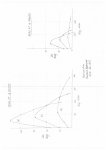
The article shows two graphs of prop drag (which I've re-drawn as they don't scan well from a Photostat (remember those) as an attachment to this post), in which the drag increases with RPM up to a maximum drag, then starts decreasing with additional rpm. In one case, a fixed prop shows 50 lbs of drag, 125lbs drag at about 175 rpm, the max drag, then tapering off to 20lbs at 400rpm, the minimum.
The graphs show three cases, with gearbox reductions shown of 1:1, 2:1, and 3:1. It assumes that higher reductions mean bigger blades, bigger diameter props.
the higher reduction (bigger diameter) props cause more drag, and the difference between freewheeling and fixed is greater. In other words the bigger the prop the better it is fixed rather than rotating.
It goes further to relate drag (expressed as pounds of drag) to reduced boatspeed. Quoting...
" Now what does 20 or 40 lbs of drag mean in terms of loss of sailing speed? Taking the situation at 6 1/2 knots with the largest propeller (3:1 reduction), the loss of speed due to the locked propeller would be around 0.3 kn (4.5%). If the propeller were windmilling under the restraint of a large amount of shaft friction the speed loss could be 0.8 knot (12%). The smallest propeller (no reduction) would give less than a tenth of a knot loss of speed."
The article goes on to state that it assumes a three bladed prop, but points out that a 2 blade can sometimes be "hidden" behind the keel, if aligned vertically and locked like that.
Earlier in the article, the author (Nigel Warren) says he measured the shaft resistance on his own boat. he got between 2/3 and 1.0 foot pounds (I love those old fashioned units of the day), and shows how the shaft resistance results in greater drag than the locked prop drag.
he concludes also that...
"Although the curves are for one particular boat and engine, the conclusion that it is usually better to lock the propeller holds good for the majority of yachts. This is because most are tied down to speeds under engine or sail of 6-7 knots maximum."
and adds that this means slow bats will likely have big, fine pitched props.
So for me it sort of explains why I still lock the prop, and think I get better speed that with rotating. (Rival 32 - almost as old as the article!)
Being 1972, most yachts then were longish keels, slow (5-7 knots), and with largish props, usually fixed blades not folding, feathering etc.
It concludes that for most boats of the day locking the prop produces less drag than allowing it to turn. The reasoning is that the predominant pitch, the gearbox and shaft resistance, etc all mean that a prop doesn't actually free wheel, it turns slowly creating (they say) more drag than if stopped.
The article shows two graphs of prop drag (which I've re-drawn as they don't scan well from a Photostat (remember those) as an attachment to this post), in which the drag increases with RPM up to a maximum drag, then starts decreasing with additional rpm. In one case, a fixed prop shows 50 lbs of drag, 125lbs drag at about 175 rpm, the max drag, then tapering off to 20lbs at 400rpm, the minimum.
The graphs show three cases, with gearbox reductions shown of 1:1, 2:1, and 3:1. It assumes that higher reductions mean bigger blades, bigger diameter props.
the higher reduction (bigger diameter) props cause more drag, and the difference between freewheeling and fixed is greater. In other words the bigger the prop the better it is fixed rather than rotating.
It goes further to relate drag (expressed as pounds of drag) to reduced boatspeed. Quoting...
" Now what does 20 or 40 lbs of drag mean in terms of loss of sailing speed? Taking the situation at 6 1/2 knots with the largest propeller (3:1 reduction), the loss of speed due to the locked propeller would be around 0.3 kn (4.5%). If the propeller were windmilling under the restraint of a large amount of shaft friction the speed loss could be 0.8 knot (12%). The smallest propeller (no reduction) would give less than a tenth of a knot loss of speed."
The article goes on to state that it assumes a three bladed prop, but points out that a 2 blade can sometimes be "hidden" behind the keel, if aligned vertically and locked like that.
Earlier in the article, the author (Nigel Warren) says he measured the shaft resistance on his own boat. he got between 2/3 and 1.0 foot pounds (I love those old fashioned units of the day), and shows how the shaft resistance results in greater drag than the locked prop drag.
he concludes also that...
"Although the curves are for one particular boat and engine, the conclusion that it is usually better to lock the propeller holds good for the majority of yachts. This is because most are tied down to speeds under engine or sail of 6-7 knots maximum."
and adds that this means slow bats will likely have big, fine pitched props.
So for me it sort of explains why I still lock the prop, and think I get better speed that with rotating. (Rival 32 - almost as old as the article!)