raising, reefing, dousing without engine

I'm pretty sure that no matter what the rudder was doing the bow would head downwind on my typical AWB but will experiment to see. Certainly when motoring at less than a knot (or two??) it will head downwind with rudder full over the other way even with the jib furled. So unless it was heaving to at some significant speed I doubt it would work, hence my practice of close reaching slightly pinched.
 
I'm pretty sure that no matter what the rudder was doing the bow would head downwind on my typical AWB but will experiment to see. Certainly when motoring at less than a knot (or two??) it will head downwind with rudder full over the other way even with the jib furled. So unless it was heaving to at some significant speed I doubt it would work, hence my practice of close reaching slightly pinched.

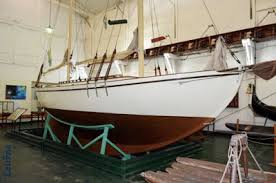
The aforesaid gaff cutter would do that under power if motoring into a fresh breeze; it was not unknown for the bows to blow off and for us to have to do a full 360, making use of the speed gained on the downward leg, to get back on course!

But she would heave to fore reaching at about a knot.

Early experience of the big Nic suggests that she “parks” very comfortably in the hove to position despite being a fin and skeg type and the mainsail (masthead rig, loose footed) can be handled OK like that.
 
I almost always drop the main heave to and once dropped the boat stays just as it was. It is the rudder hard over that ballances the jib and keeps the boat in a stable position.

I've sailed AWBs where this hasn't worked.
At least it hasn't been 'stable' in the engineering sense that if the boat gets knocked around a bit by a wave, gust, whatever, it won't return to its previous heading.
The ability to instantly give it a squirt of throttle may not be essential, but it's often very nice to have.
Particularly short handed, other idiots looking like they might get in the way, lack of sea-room or if anything goes off-script.
I've spent enough time sailing racing boats that don't have engines to appreciate that they can come in handy, and that if you don't have one, you need more 'margin'.
 
I've sailed AWBs where this hasn't worked.
At least it hasn't been 'stable' in the engineering sense that if the boat gets knocked around a bit by a wave, gust, whatever, it won't return to its previous heading.
The ability to instantly give it a squirt of throttle may not be essential, but it's often very nice to have.
Particularly short handed, other idiots looking like they might get in the way, lack of sea-room or if anything goes off-script.
I've spent enough time sailing racing boats that don't have engines to appreciate that they can come in handy, and that if you don't have one, you need more 'margin'.

On boats that would not “behave”, were the two ends very different in shape?
 
On boats that would not “behave”, were the two ends very different in shape?

Yes, most of the boats I get to sail on have a distinct 'pointy end' and 'blunt end'. I've done time in boats with two blunt ends (Fireball dinghy) but relatively little in canoe stern boats with two pointy ends.

Thing is, just because our boat behaved itself with 58% jib unrolled last week in 60cm chop at 40 degrees to the true wind of 18 knots, doesn't mean we can be totally sure what it will do in a shifty wind tomorrow, with different wave and wind vectors. Or with more or less jib out.
So, in the pursuit of domestic harmony, I sometimes rate having the engine running to have extra options for control, above 'purist' points for evolutions under sail.
Going in and out of places like Portsmouth (if there really is anywhere else like Portsmouth?), you can often run your engine less hours if you plan to hoist and drop with the motor running. You can confidently do the job in a small area, with power available 'just in case'.
OTOH, in other situations, with time and space, there is no need or benefit in using the motor, or even having it running in case you want it.
I like to sail as much as I can, and run the motor as little as possible, but I've put money and effort into having a decent motor so I want some value from the damned thing.

Besides, there's an optimum point to fire up the Yanmar to give hot water for the washing up and/or a shower.

I'd say to people, if they're not confident of how the boat will behave, have the motor running and see if you can do the job smoothly without using the motor. Particularly if you are going to be asking a less experienced person to control the boat while you hoist or hand sails.
 
I agree with all you write.

To illustrate my idea of “similar ends”, here are two - first, an extremely famous little boat, Vito Dumas “Lehg II”, the first boat to circumnavigate south of the three great capes:


She is the classic “double ender”.

And here is a Nic 55, much more modern but still with a canoe body and balanced ends:


Both designs renowned for being light on the helm and responsive and both able to heave to dependably.

I absolutely agree that one should not take chances in confined spaces. But I think you will also agree that that cuts both ways - it is foolish to manoeuvre without the engine available and it is foolish to rely on the engine!
 
Last edited:
Sometimes it's wise to know whether the engine can be relied upon?

Regarding heaving to with only the jib up, I would imagine that's largely about having some lateral resistance under the jib? So a reasonable canoe body draft forwards.
A Fireball will heave to perfectly well with the main up, but under jib alone, the bow will just blow downwind. AWBs with shallow ends may do similar.
My old boat would sail very handily to windward under just the No1 racing genoa, with the main flapping. Sometimes you could not make it bear away without easing the jib. But with the cruising genoa with a couple of rolls taken in, it was a very different animal. Changing the jib moves the centre of effort a long way.
 
I agree that the prudent mariner will have the engine running, if not in gear, when in close proximity to other people's property!

Heaving to - the elderly gaff cutter would park herself in the hove to position with the close reefed staysail only in F8. There was as much sideways as forwards in that, which is what one wants. What was "going on" was that the windage of the furled mainsail and gaff in the permanent gallows and the 9ft clinker dinghy on the coach roof with the helm lashed down was helping to hold the bows up to windward. In normal conditions she would heave to with the full staysail backed and the jib and mainsail set but the luff of the mainsail would be lifting. One would always want to bring the sails inboard in heavy weather, I think.
 
I agree that the prudent mariner will have the engine running, if not in gear, when in close proximity to other people's property!

Heaving to - the elderly gaff cutter would park herself in the hove to position with the close reefed staysail only in F8. There was as much sideways as forwards in that, which is what one wants. What was "going on" was that the windage of the furled mainsail and gaff in the permanent gallows and the 9ft clinker dinghy on the coach roof with the helm lashed down was helping to hold the bows up to windward. In normal conditions she would heave to with the full staysail backed and the jib and mainsail set but the luff of the mainsail would be lifting. One would always want to bring the sails inboard in heavy weather, I think.

All true I'm sure but the posts on heaving to are all missing the point that it is completely unnecessary to heave to when hoisting or dropping a main without the engine as the posts a long way above all descibe.
 
All true I'm sure but the posts on heaving to are all missing the point that it is completely unnecessary to heave to when hoisting or dropping a main without the engine as the posts a long way above all descibe.

I plead guilty to thread drifting, but i think the original point was "what happens if you heave to to drop the main, then drop the main" and the feeling seems to be that with some boats the bows will blow off and she will set off down wind and with other boats that may not happen.

Anyway, returning to our muttons, if any part of the mainsail contacts the spreaders or the shrouds in the course of hoisting or lowering, then, regardless of what the boom is doing, you are stuffed, unless you can get the bows back into the wind, and you probably won't be able to do that without bearing away and getting some speed up before trying to luff again. If you haven't got room to do that, you are stuffed properly.
 
I plead guilty to thread drifting, but i think the original point was "what happens if you heave to to drop the main, then drop the main" and the feeling seems to be that with some boats the bows will blow off and she will set off down wind and with other boats that may not happen.

Anyway, returning to our muttons, if any part of the mainsail contacts the spreaders or the shrouds in the course of hoisting or lowering, then, regardless of what the boom is doing, you are stuffed, unless you can get the bows back into the wind, and you probably won't be able to do that without bearing away and getting some speed up before trying to luff again. If you haven't got room to do that, you are stuffed properly.

That assume you haven’t kept control the whole time by close reaching under Genoa - if you do get slightly caught you can luff up to free it then back to close reach again. The room you need is an upwind track from - allowing for things to go wrong, a quadrant perhaps 0 to 90 degrees from the wind on one side. Control remains possible at any time by stopping the hoist and sailing on jib alone.
 
That assume you haven’t kept control the whole time by close reaching under Genoa - if you do get slightly caught you can luff up to free it then back to close reach again. The room you need is an upwind track from - allowing for things to go wrong, a quadrant perhaps 0 to 90 degrees from the wind on one side. Control remains possible at any time by stopping the hoist and sailing on jib alone.

This may be picky, but i really really don't like setting a Genoa in confined waters. I want to set a high cut jib so that I can see under it and around it.
 
That assume you haven’t kept control the whole time by close reaching under Genoa - if you do get slightly caught you can luff up to free it then back to close reach again. The room you need is an upwind track from - allowing for things to go wrong, a quadrant perhaps 0 to 90 degrees from the wind on one side. Control remains possible at any time by stopping the hoist and sailing on jib alone.

Wanting that much freedom of movement might easily mean I'd not get the main up until I was halfway to Cowes.
There's a time and a place for all this 'I don't need the engine' stuff.
 
If I let the mainsail right off with the wind at 90 degrees to the boat the sail would be hard on the swept back spreaders.
I regularly start the engine to reef to give the boat steerage because being single handed I have no one at the helm. Plus the self tacking jib will not always give enough forward drive in a big sea on autopilot for the autopilot to steer. This means that the autopilot will go hard over then cut out (Because it is a useless raymarine AV100)
If I have a crew to steer then the crew can steer the boat under jib to give the boat forward motion, & hence direction.
By running the engine I can get a few knots forward so the autopilot can steer & the main will come in enough to get the end of the boom just over the deck then I can get it up or down easily. Any further out & it will not move, it just jams solid. It is a fully battened mainsail. Once freed off it drops instantly, sometimes too quick
 
Last edited:
In-mast furling is wonderful, just sail on under the jib, ease off the mainsheet until the wind is out of the main, and then wind in or out, as required. Simple.
 
Quote Originally Posted by theoldsalt View Post
Doesn't anyone heave-to anymore ?

Yup, learned how to do that 35 years ago. And is has been the wrong way to reef every boat I've ever owned.

If I heave to the apparent wind is 60-80 degrees off the bow and the slides like to jam. The boom is also far to the side. If I point high and crank the jib in really tight, the jib backwash keeps the sail (at least near the mast) blowing straight back and the main drops like a rock. Running the engine wouldn't help anything.

So why would I want to do anything other than tighten the jib, point up, ease the mainsheet and traveler, and go take care of it? Simple and less wear on the jib. Oh, and I'm not in a hurry either. It just does not take long.

I suspect having full battens (multihulls) might be a factor; the main does not flog. It also drops neatly on the boom.

Heaving to is also a good way to wear or stretch the luff of an overlapping sail.
 
Wanting that much freedom of movement might easily mean I'd not get the main up until I was halfway to Cowes.
There's a time and a place for all this 'I don't need the engine' stuff.

I agree and for me the distance I’d want locally would be outside the Hamble or as soon as I could get out of the channel just outside Portsmouth harbour. But the main times I actually hoist the main without an engine is in open water after I’ve been reaching or running under Genoa alone and need to change course more upwind or winds dropped enough to need more sail. That’s only a few times a season but nice to avoid the engine for doing a pure sailing manoeuvre.
 
Top