Radice v Volvo shaft seal

Their website is not really set up for internet commerce, and they haven't answered my email enquiry made three days ago. Anybody know of a more reliable source?

Why not use the telephone? They are a well established and reliable company even if a little behind in the tech game.
 
I got very good service from Sillette once I managed to get them on the phone. The Radice seal arrived very quickly - next day. Having read on other threads that the vent tube can sometimes spurt if reversing hard, I decided to fit the tube to a small diameter through hull at the stern. I can see that there is an occasional dribble from it.
 
People are referring to a "vent tube" aft of the greasing point. Radice brochure on their website refers to this as an inlet tube, presumably from part of the cooling water before it goes to the exhaust water trap. Which one is correct please?
 
People are referring to a "vent tube" aft of the greasing point. Radice brochure on their website refers to this as an inlet tube, presumably from part of the cooling water before it goes to the exhaust water trap. Which one is correct please?

Both. On low powered applications such as yacht auxilliaries a vent is all that is needed to expel air and avoid burping. On higher powered applications a positive water feed from the engine cooling sea water may be necessary to prevent water being sucked out at higher speeds. Common to have positive water feed on shaft seals in power boats.
 
No, you need to push it past the first lip seals to get the grease between the two seals. It lubricates the lips.

Correct, and that is where the Radice seal scores because the greasing point ensures that you get it in the right place. As for cost, for my 30mm shaft the Volvo seal is quite a bit more expensive than the Radice, and the one from ASAP is a bit cheaper. I replaced a Volvo seal with the Radice one over two years ago, and am convinced that it was a good choice. Seal life is probably more dependant upon how well polished and scratch free your shaft is, than on any differences between makes. The old Volvo seal was probably ten years old when replaced. The sealing lips had worn down, but even so it did not leak. I replaced it because of the visible wear and the conviction that as I was to keep the boat in the water for another two years replacement was cheaper than paying for even a short lift out.
 
Just a side issue on this subject. I posted recently about the crevice corrosion which occured on my shaft under the TM1 seal that I have fitted. This is still a worry so I am investigating all these seals again. The PSS seal looks to be the favourite( in my circumstances)as any corrosion would be on the seal face rather than on my shaft.
I would like to understand my TM seal better though. It has a water connection to my raw water system, why does the TM seal need this, the Radice system just needs a non pressure water supply and the volvo no water supply at all. Is the sealing bit ( the actual seal) different on these seals. I am trying to find a diagram of the TM seal so I can see just how the seal fits in the housing.
 
Just a side issue on this subject. I posted recently about the crevice corrosion which occured on my shaft under the TM1 seal that I have fitted. This is still a worry so I am investigating all these seals again. The PSS seal looks to be the favourite( in my circumstances)as any corrosion would be on the seal face rather than on my shaft.
I would like to understand my TM seal better though. It has a water connection to my raw water system, why does the TM seal need this, the Radice system just needs a non pressure water supply and the volvo no water supply at all. Is the sealing bit ( the actual seal) different on these seals. I am trying to find a diagram of the TM seal so I can see just how the seal fits in the housing.

Think it needs a feed, because unlike the Volvo type which is solid rubber, you cannot squeeze it (burping) to expel air. The seals inside will be lip seals, but don't know whether they are moulded in or inserted into grooves. The original Tides does have replaceable lip seals. other similar lip seal units such as Vetus and Bukh also require positive water feeds to ensure no air as the seals are water cooled.
 
Think it needs a feed, because unlike the Volvo type which is solid rubber, you cannot squeeze it (burping) to expel air. The seals inside will be lip seals, but don't know whether they are moulded in or inserted into grooves. The original Tides does have replaceable lip seals. other similar lip seal units such as Vetus and Bukh also require positive water feeds to ensure no air as the seals are water cooled.

The Volvo Penta seal is quite stiff rubber so it needs a strong squeeze/sideways push to burp it until water comes out past the lip seal to indicate no more air is in there. I have done this a few times now. As to the water feed, for low rev low usage application this can be ignored but on other applications and most motorboats the seal needs a flow of water to ensure lubrication and cooling of the rubber bearing behind the lipseals and also ensure a flow of water through the cutlass bearing at the aft end if that has no other provision for creating a flow. This water feed can either be from the raw water system or, as used by Beneteau and other motorboats, a feed from a skin fitting that has a scoop water strainer that uses forward motion of the boat to create a flow of water.

Colin. Www.solocoastalsailing.co.uk
 
Last edited:
I fitted the radice for more than 10 years ago, when it was just introduced to the market. I do a lot of miles under engine ( just came back all the way from Poland to the Netherland via the canals. The seal is still ok and not a single drop of water was sseen.
 
You should grease your Volvo seal annualy.
1cc of their special grease.
Many threads describe the use of a big Maccy D straw.
I made an 'injector' like this.
20150214_115022_zpswryamezv.jpg


which is essentially a plastic straw araldited to a general pupose medical syringe.
It's graduated so you can put the right amount in and marked so you can insert it between the 2 seal lips (about 10mm)
 
The bearing is water lubricated, the lip-seals are grease lubricated. There have been many posts (including one by me) about techniques to apply grease.

Colin. Www.solocoastalsailing.co.uk
This greasing of lip seals interests me. Some lip seals seem to need it others dont. Is the grease meant to keep the rubber from aging or does it reduce wear or what?
My Tides Marine has a lip seal and there is no requirement for grease but I guess the actull seal bit is similar?
I thought the volvo seal was just a rubber moulding with the seal an integral part of that ( rather than sitting in a bearing ) and I thought the water was for cooling rather than lubricating.
 
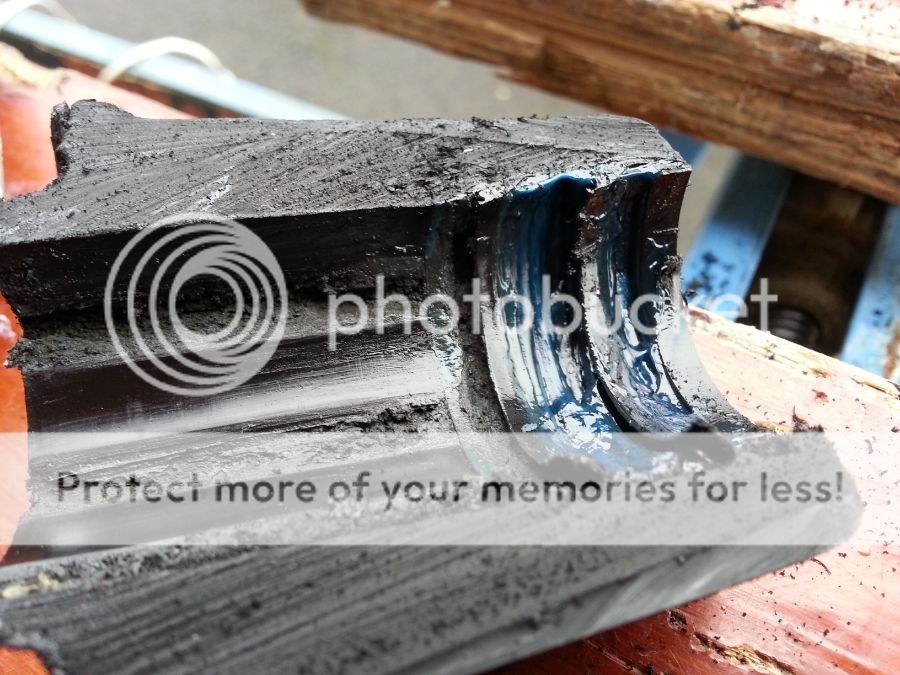
You are right the lip seals are moulded in the same 'shot' as the rest of the device , see here
20150314_095627_zpsxr9f6pdc.jpg


I'm guessing it is water cooled as you suppose but also will run i think with a water film between the lip and the shaft (most seals run with a film of the retained fluid inbetween the lip and the shaft.

I guess this the grease is there to ensure the lip does not stick or seize to the shaft and get damaged.
Once the shaft is rotating and the grease has been sheared a lot it will effectively become like an oil , thickening again when it cools.

Thinking about it 2 lips are sort of counter intuitive , I think one is a backup due to the failure modes and consequences of failure.
The grease will lubricate both lips but perhaps not much water will get to the outer lip.
This is why you burp it I think , otherwise the outer lip could run dry and burn.
 
Thanks, Jakeroyd, thats a useful photo. I suppose we could say its a ‘double lip’ seal?

Like you I wonder how, if the first seal is effective the second seal doesn't run dry or heat the small amount of trapped ( betwean seals) water too much.

Now we just need a pic of sections through Raddice seals and my Tides Marine.
My special interest is in my ‘crevice corrosion’ issue and how due to long term non use oxygen depleted water con affect the shaft under the seal.
 

Other threads that may be of interest

Top