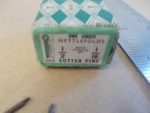
R clips or split pins

I thought seizing wire would be better in every application - but apparently lots of split pin lovers in this thread!

What do people like about split pins, over seizing wire?

It depends what and where it is. Seizing wire need something to seize to, twisting and wrapping takes time. A single bolt or pin with a drilling - split pin is easier.
 
So, back to split pins. Is the split pin in this pic fitted correctly? View attachment 116117
I can see it'll stop the screw undoing completely, but might not stop it loosening?
I would say not. I put mine at 90º to that and fold them around the turnbuckle, protecting sails and passing humans with a bit of tape. I appreciate that that makes inspection a bit more difficult, but I don't use enough tape to hide the form of the pin.

Out of interest, has anyone ever had a properly installed split pin fail?
 
Quite the opposite - several I've had to chisel off and punch or drill out, all because of age and corrosion.
But I thought they were easy? ;-)

It depends what and where it is. Seizing wire need something to seize to, twisting and wrapping takes time. A single bolt or pin with a drilling - split pin is easier.
Sure, but isn't there always something to seize to?
 
I would say not. I put mine at 90º to that and fold them around the turnbuckle, protecting sails and passing humans with a bit of tape. I appreciate that that makes inspection a bit more difficult, but I don't use enough tape to hide the form of the pin.

Out of interest, has anyone ever had a properly installed split pin fail?

Yes, I have bent the split pin ends around the turnbuckle and taped them. This would seem to be a good way (best method) of doing it. Unless someone has a good alternative?
 
When I had my standing rigging replaced one rigging turnbuckle only had no split pin hole in it. The rigger admitted he had run out of terminals with holes in, so I have one shroud terminal with a single nut on it and all the rest with split pins. It irritates the hell out of me for some reason. It's not that my boat is not full of imperfections anyway, I just don't want them added to ! ?
 
A word of warning re a failure mode I haven't seen mentioned elsewhere that came close to losing my rig....

After a rough night hove-to in the Celtic Sea, I became concerned with excessive 'mast slamming' and went forward in the half-dawn to investigate. The open-body forestay had unwound such that the lower screw-thread component had retracted completely into the lower part of the rigging screw body. There were perhaps just a couple of screw-threads still engaged....

This rigging screw - Hasselfors, I think - used a small machine screw fitted through the end of each male threaded component. The heads of these tiny machine screws, undone from flush a couple of turns, engaged with the main body and, thus locked, prevented turning. Except it didn't.

The head of one small machine screw was completely 'chewed away' on the sharp edge of the open body, and the other one was well on its way. I concluded that the slamming for hours had caused the forestay to jerk violently, hour after hour, and this caused the sharp edge of the body to 'chew' on the tiny machine screws until one head sheared off, allowing the system to rotate slack, bit by bit.

I had double-checked the rig and all locking before departure, as did someone else, and was lucky I got to the problem before the problem 'became very apparent'. Of course I tightened the forestay back up and replaced the sheared tiny m'screw with a long pop rivet, bent over - then checked everything else.


Something similar to this:

51210194571_c2549b025a_z.jpg


and/or this:

51210970929_5c7a8b405d_z.jpg
 
... A word of warning re a failure mode I haven't seen mentioned elsewhere that came close to losing my rig ... After a rough night hove-to in the Celtic Sea, ...

Good catch!

This is the sort of situation when weaknesses in cotter pins, rings are exploited. It's also why regular checking aloft at all elevations is low cost insurance and should be considered essential. Regarding bending back cotter pins in bottle screws, I find that it is easy for the bent back cotter pin to still allow the bottle screw to rotate, especially if the pins are undersized in the holes; they have to be proud of the bottle screw cheeks, which is why I prefer the pins and velcro tapes. I also agree with earlier comments that seizing wire is probably better for bottle screw security as well as less risky to sails and legs, and dare I say it, environmentally better by avoiding plastic tape.
 
I would fall back on the morse cable inner wire then, from your local skip especially near fishing boats. It does need a hammer and pliers to cut it though.
 
I think it is time to point out that 'cotter pins' in British English are something entirely different to 'split pins'. A cotter pin in anything other than American English is a pin with a flattened face which engages with a flat machined into a shaft, thus preventing rotation of a component relative to the shaft. The cotter pin was secured with a nut on the end. This is how old steel bicycle cranks were attached to the bottom bracket axle, and is the reason that UNI chainsets, which did away with the cotter pin, were known as cotterless chainsets.

Cotter (pin) - Wikipedia
 
I think it is time to point out that 'cotter pins' in British English are something entirely different to 'split pins'. A cotter pin in anything other than American English is a pin with a flattened face which engages with a flat machined into a shaft, thus preventing rotation of a component relative to the shaft. The cotter pin was secured with a nut on the end. This is how old steel bicycle cranks were attached to the bottom bracket axle, and is the reason that UNI chainsets, which did away with the cotter pin, were known as cotterless chainsets.

Cotter (pin) - Wikipedia
Quite right, they taught small boys how to use a hammer on machined, threaded and hardened components!
 
I think it is time to point out that 'cotter pins' in British English are something entirely different to 'split pins'. A cotter pin in anything other than American English is a pin with a flattened face which engages with a flat machined into a shaft, thus preventing rotation of a component relative to the shaft. The cotter pin was secured with a nut on the end. This is how old steel bicycle cranks were attached to the bottom bracket axle, and is the reason that UNI chainsets, which did away with the cotter pin, were known as cotterless chainsets.

Cotter (pin) - Wikipedia

If "Cotter Pin" is good enough for GKN, its good enough for me. Split Cotter Pin if you want the full name.


1622315769904.png
 
Top