Quick anchor windlass: has become noisy and often trips circuit breaker

You are correct Vic, our Muir was as you describe, you had a choice of 4 locations for the motor (obviously at 90 degrees to each other). Our Maxwell allows the motor to be at any orientation, you swing the gear box to which the motor is attached, and tighten a large thread collar to secure. The collar is loosed to allow the gear box to be removed to service, or fill with oil (its quite a neat system - but maybe also on many other windlass)

The OP will possibly be constrained by the hole for the chain fall of the original windlass (which he could fill and drill a new hole), the existing space and the dimensions of the new windlass. Ideally he will want to use the existing wiring and that simply adds another constraint.

It is only when you work in a chain/anchor locker you realise they were never 'designed' as such - but simply the, very small, space left over when they had filled the yacht with accomodation.

The motor might have a cover but the ones (the covers) I see are painted mild steel (and the motors primarily come from the same manufacturer or supplier) - (whose name temporarily eludes me - Ital?)).

Jonathan
 
You are correct Vic, our Muir was as you describe, you had a choice of 4 locations for the motor (obviously at 90 degrees to each other). Our Maxwell allows the motor to be at any orientation, you swing the gear box to which the motor is attached, and tighten a large thread collar to secure. The collar is loosed to allow the gear box to be removed to service, or fill with oil (its quite a neat system - but maybe also on many other windlass)

The OP will possibly be constrained by the hole for the chain fall of the original windlass (which he could fill and drill a new hole), the existing space and the dimensions of the new windlass. Ideally he will want to use the existing wiring and that simply adds another constraint.

It is only when you work in a chain/anchor locker you realise they were never 'designed' as such - but simply the, very small, space left over when they had filled the yacht with accomodation.

The motor might have a cover but the ones (the covers) I see are painted mild steel (and the motors primarily come from the same manufacturer or supplier) - (whose name temporarily eludes me - Ital?)).

Jonathan

Yes quick is italian , and yes they do come with a cover , well mine did and all the quick once I seen do , I did do a couple of repairs ( bearing /seals ) on other people boat to help the. Out .
 
If you are installing a new windlass, try and make sure the opening and the chain cannot drip water on the gearbox/motor. Turning the motor away from the hole is not enough. A baffle, or a pipe, so the chain (and water) exits below the level of gearbox/motor is a much better solution. This is usually not difficult to install although it seems to be rarely fitted as standard by modern boatbuilders.

If it is not one of the models encased in plastic then coating the gearbox/motor is helpful. The wax that is used by car rustproofers to spray into car door cavities is ideal for this. It is wonderfull stuff for protecting steel.
 
Last edited:
...A baffle, or a pipe, so the chain (and water) exits below the level of gearbox/motor is a much better solution. This is usually not difficult to install although it seems to be rarely fitted as standard by modern boatbuilders.
...

+1. I made such a hawse-pipe from 75mm black PVC guttering down-pipe, and a hot-air gun to change it to an oval to fit the windlass and mushroom over to stop it falling through. Took maybe 30 mins so not too hard to do.
 
+1. I made such a hawse-pipe from 75mm black PVC guttering down-pipe, and a hot-air gun to change it to an oval to fit the windlass and mushroom over to stop it falling through. Took maybe 30 mins so not too hard to do.

Brilliant idea. You couldn’t post a pic or a sketch could you?

I’ve ordered a Lofrans windlass which a yacht club in Kiel has kindly agreed to take delivery of and I’ll fit it on Monday or Tuesday when I’m there. It fits pretty much the same footprint and has the same fixing bolt pattern. I’ll need to wire a different relay as it’s a 2-terminal motor as opposed to Quick’s 3-terminal one. But it’s cheaper - and it’s available.

I would like like to take this opportunity to apologise to the Noble Sloop Belle Serene for all the pain I have caused her by hauling her up to her anchor mooring by the windlass in a breeze, for holding her at night on her windlass shaft rather than always on a snubber by the bow cleats, and for not once servicing her windlass (as opposed to just greasing her gypsy) in twelve years. She deserved better, I should have been a better master to her, and I hope she will accept this windlass in loving reparation.

I’d be grateful for advice on hawsepipe construction so that her chain may ever fit snugly into her nether foreregions and her windlass motor may remain clean of Neptune’s nasty saline fluids.
 
I'm frankly worried about hawse pipes - sorry to spoilt the party.

If you have a very deep locker, well and good. However within the list of long complaints of anchor lockers, windlass and chain is the problem of towering. Add a decent hawse pipe and you simply increase the speed at which towering will be an issue, the tower will reach the hawse pipe more quickly and the tower will also develop more quickly as it directs the chain in a restricted way. I prefer a baffle over the motor. The baffle over the motor is as far away from the chain fall as possible (but right next to the motor - a hawse pipe will make it more difficult to knock the chain tower (that inevitably develops).

If you have a very deep locker or stainless chain, preferably both, or a chain spreader - a hawse pipe might be a good idea. A very short hawse pipe might work.

A chandler will sell stainless pipes with flanges (they must have a name) that take cabling from the mast base through the deck (buy one, chop to size - leaving the straight portion). There are similar devices sold in chandlers for the base of stainless targa type fittings and larger davits, fishing rod holders (which also come in plastic) etc. If you can line any metal hawse pipe with plastic well and good, will reduce gal wear on the metal.

Having the motor at 180 degrees to the fall of the chain is the best idea, or as close to 180 degrees as you can get - or that baffle (which can be made from a sheet of aluminium with a 90 degree flange and screws through the flange (or stick it on with Sikaflex). If you go the flange route - make sure you have enough room to unbolt the motor.

Maybe those who advocate a hawse pipe can comment.

Don't think the hawse pipe will stop the motor casing corroding - remedial action now is still needed.

I hope your apologise to BS's windlass have been noted - though I doubt it. Your story is oh so common - do not feel too guilty you are amongst friends. But many of the issues are caused on commissioning - if only they would use Duralac (or grease) from the outset and align the motor correctly - it would be so much easier (but reduce windlass sales).

Finally - every time you wash your deck down with fresh water, stick the hose in the locker and wash down the chain. It holds water, which is obviously salt, and mud accumulates. Try to remove all the chain whenever possible and check for water at the bottom of the locker (it will evaporate, condense on the motor casing and the water and casing will love each other!). Make sure the drain hole(s) are free, to drain. Keep the locker hatch open whenever possible and let the locker dry out.

You will be surprised at the number of lockers whose drain hole is above the locker base (leaving a puddle of water to wick up through the chain, corroding the chain and evaporating so as to corrode the motor (and those stainless bolts in contact with aluminium).

If you lay up for the winter - take the chain out.

If you open your locker and your chain is white - that's white rust, your galvanising is being eaten away - its caused by a damp locker (inevitable) but you can reduce the issue by allowing it to dry whenever possible (and washing with fresh water). Many muds will also eat gal - wash the chain!

Rant over.

Jonathan
 
Last edited:
BS, which Lofrans are you buying?

Jonathan

The replacement windlass is already en route to my next port of call and I have shed a thousand euros for the privilege - so treat me gently here... it’s a LOFRANS Project X2, 1000W with drum, for (my) 10mm ISO chain. Why?


Thanks for your advice about the hawse pipe. The anchor locker is quite large and deep. I am thinking of some short baffle in plastic, perhaps a section of a large plastic drainpipe bracketed under the deck, next to the motor though. The windlass’ manual (p11 of X2 here [ https://www.lofrans.com/ajax/download.FILE.php?documents[]=14 ]) indicates that the one direction they don’t approve of the motor being mounted is to port - which is the way the previous Quick windlass motor was mounted and so is where the cabling is. The Quick one was happy with any direction other than forward.


Say, ignorant question - what do you do with the Duralac for this purpose? I have a tube of the stuff on board.
 
The reason not to fit it to port is so the chain don't fall on or around it .
I think you find nearly all these type windlass now come with a cover over the motor.

Edit
It's seen unless you burn out the motor, the only problem are the brushes and that happen to any motor in time .
The problems mostly are seals and bearing , not sure what you found with your old windlass bearing but mine was a open case bearing and when I replace them I used a seal bearing then seals on top .
Never found any rust on my motor or cables but as said best to coat it with some thing if you have it apart .
You will so find the cables are inserted in a way through the plastic cover that make sure it hard for any water to enter .
 
Last edited:
Belle Serene,

When you get the windlass have a look for stainless bolts that are part of the assembly of the various components, the gypsy/shaft is usually one component but you can obviously it apart to remove the gypsy and lubricate the shaft, the gear box and motor are the other 2 significant components. Some of the housings used to be alloy (and may still be alloy - but are often now composite). All of these components are usually attached to each other with stainless bolts - and if the housings are alloy they then corrode into one unmovable lump. If you have alloy housings and stainless bolts simply duralac the bolts before assembly (and replace the duralac) any time you disassemble.

Duralac is really messy stuff, keep some rags handy and some turps for clean up.

This is why I in disassembling windlass and Vic with his (I'm assuming this was a problem for Vic) have had issues and the usual recommendation of use of a blow torch does not quite work (as I'm sure you recognise as there is simply no room).

But windlass have improved and this problem might have been removed by a different (and better) choice of materials.

Why ask about a Lofrans, don't be too sensitive :) - I happened to have details of their windlass and I thought I'd have a quick look to see if there was anything that I might add. I have not yet looked - I'll look tonight - They are good windlass - so, no worries. If I don't comment - I have nothing to add - don't worry!!

I don't know your locker - but if there is lots of room and the 'bottom' of the windlass high enough above the pile of chain then towering might not be an issue. But 10mm chain takes up a lot of space and chain towers are amazingly quick to develop height. If there is plenty of space you can knock the tower over with a broom handle - if you install a plastic hawse pipe - it would be easy to shorten (or easier than one made from stainless). (But nothing is easy in an anchor locker :(.

And there is nothing wrong with a baffle and hawse pipe.

If Vic sees anything he can add - he gives good advise :) and has been through this himself.

Jonathan

Edit

If you find the cables a bit short - check the run of the cables (that's another monumental task) you might find some slack tucked neatly away. You might also find you can gain a little 'extra' by altering the run.

close edit
 
Last edited:
I have had boats with a baffle between the entrance hole of the chain and the gearbox/motor and boats with a pipe installed.

I don’t think there is much to pick between the two systems. Generally a baffle is more difficult to install as there is little room between the opening hole and the gearbox. The chain will hit the baffle as drops down so it needs to be reasonably strong, which is tough to design in the restricted space. As some water can also sometimes enter when sailing, the baffle needs to ideally extend across the width of the chain locker so at different angles of heel the water is still deflected away from the windlass. Unfortunately, the baffle tends to restrict the airflow to the windlass. The windlass motors become hot with use and very few are continually rated. Anything you can do to keep the motor cool is a help both for lifespan and to extend the duty cycle. However, stopping the salt water from dripping on the gearbox/motor makes an enormous difference to lifespan so if a baffle is the only solution I would accept the reduction in airflow. A fan can be used to provide some cooling.

A pipe is usually easier and it will have little effect on the airflow to cool the motor. It does slightly reduce the effective drop so if you have serious problems with the chain piling up such as on a catamaran like Jonathan’s then it may not be the best solution, but a baffle also adds some friction to the chain dropping so may not work either.

Some boats use a short pipe only a few inches long that does not reach below the gearbox/motor. This will not stop all the problem, but is a help in encouraging most of the water to drip clear of the gearbox/motor without adding any friction to the chain so this may be worth considering if a longer pipe will not work.

I am not sure how windlasses ended up with steel motors connected to aluminium gearboxes with often some bronze and stainless steel thrown in just to make sure there are as many dissimilar metals as possible, but that is the reality. If you can at least stop salt water dripping on the above combination you will be doing better than most.
 
I think I need to correct the above post

We have no problem with space for our chain, our locker is huge, as are most catamaran chain lockers as they are invariably located just ahead of the mast and are deep. They are not subject to breaking seas, as might be found on some monohulls, as they are quite far aft. Our motor is at 180 degrees to the fall of the chain. Now that we use 6mm chain - our locker is basically empty.

Our locker base is flat, slightly sloping aft and has generous drain holes. We installed a perforated, domestic rubber door mat with a dimpled base on the floor of the locker to better allow the chain too drain and dry - I was initially concerned this would increase towering - but our galvanising process offers a very smooth, effectively polished, surface and towering has simply not materialised.

Quite why you have imagined we have an issue - you must have a fertile imagination. Possibly you could be more careful with your assertion in the future.

I have been involved in number of windlass issues, primarily on mono hulls, and have taken the trouble to check installations - and pass comment.

Jonathan
 
Belle Serene,

I had a quick look at the manual you linked to and can find nothing to add nor comment to make. It looks the same basic design and arrangement to most other windlass, I don't know who introduced the first one of this design - but everyone has copied it!

I could not find any information on what materials are being used for the bodies of the various components - but it will be obvious to you when you get it.

The arrangement of motor to fall of chain seems clearly defined - its something for you to conjure with when you get it.

I did not find, maybe I missed it (very likely) a manual retrieval over-ride. If your electrics fail (or those of the windlass - commonly the solenoid) how do you manually retrieve. If the new windlass has one, commonly using a winch handle, make sure you have enough room to swing the handle (but if it has a big handle and there is not enough room - a smaller one might fit - I would not want to pull 10mm chain in by hand :( and frigging about with a sheet winch would be a pain.

Good Luck,

Jonathan
 
Quite why you have imagined we have an issue - you must have a fertile imagination. Possibly you could be more careful with your assertion in the future.

You have described an issue with your anchor locker yourself on several occasions (see below for an example) so I am disappointed by the assertion that I am making this up. The suggestion in your current post that your anchor locker is “huge” with no problems related to fall of the chain, is at odds with what you have previously written.

These problems are not unique to your boat, but when it is happening with short lengths of relatively thin chain then I think it indicates more fall would be desirable especially if (in keeping with the thread title) you fitted a deep baffle or pipe to keep the water completely away from the windlass. Both of these measures (slightly) increase the issue of the chain piling up.

All boats are compromises and it sounds like you have now solved the depth problem in your chain locker by fitting even thinner (for a 38 foot catamaran) 6mm chain, but this has its own issues and is not a solution most owners of your boat would employ.

To quote you from an article in Cruising Helmsman magazine, you wrote this about your catamaran chain locker:

“The 30m of chain was inadequate and we now carry 50m of 5/16” chain marked every 10m with cable ties. The difficulty that arose is that when our chain towers and jams the anchor winch at around 35m (the drop in the anchor locker is not enough for the 50m) and we need to topple the tower manually - which is why we need the quick release of the pelican hook for the jackstays”.
 
Last edited:
That was with 8mm chain, its not a problem if the chain 'fits' the locker. That was with another windlass, Muir Atlantic, a design of at least 20 years ago, that had critically different dimensions.

As you are well aware we now use 6mm chain and a Maxwell windlass - and have no issues with 75m.

The original chain was hot dipped galvanised and the new chain thermal diffusion galvanised, which is much smoother and more slippery.

You say our 6mm chain has issues - I wonder how you know that? Have you any evidence there are any issues. its a product you will be totally unfamiliar with and I certainly have not written it up.. A 50' cat is being equiped with 100m of high tensile 8mm chain to the same process as ours - are you aware how many such chains are being used. Please do not guess.

We have not fitted a hawser pipe nor baffle (it is unnecessary in our configuration). Because of the way our chain is retrieved, similar to some other multihulls, little water is carried by the chain into the locker.

However I have been actively involved in a number of mono and catamaran windlass (removals and) installations and have had first hand experience of the issues that can develop. I have tried to offer Belle Serene the limited experience I have, of monohulls, and not used our specific multihull experience as it is not always relevant, hence why I suggest a baffle even though we do not use one, and why I am twitchy about howse pipes as I know of towering being an issue for some yachts (and multihulls).

Please check before you want to attribute some defect to us.

Jonathan
 
Last edited:
I'm frankly worried about hawse pipes - sorry to spoilt the party.

If you have a very deep locker, well and good. However within the list of long complaints of anchor lockers, windlass and chain is the problem of towering. Add a decent hawse pipe and you simply increase the speed at which towering will be an issue, the tower will reach the hawse pipe more quickly and the tower will also develop more quickly as it directs the chain in a restricted way. I prefer a baffle over the motor. The baffle over the motor is as far away from the chain fall as possible (but right next to the motor - a hawse pipe will make it more difficult to knock the chain tower (that inevitably develops).

If you have a very deep locker or stainless chain, preferably both, or a chain spreader - a hawse pipe might be a good idea. A very short hawse pipe might work....
Don't think the hawse pipe will stop the motor casing corroding - remedial action now is still needed.
...

My locker is quite deep so I've never had any issue with the chain piling up. I use 9.5mm galvanised chain, and have 60m on top of 50m of 3-strand rope. I quite often let out all the chain and some of the rope, and it runs out and back in without problems.

My hawse pipe makes a huge difference to the water running over the motor. The one fitted originally didn't actually protrude all the way through the deck (I have very thick decks plus the windlass is mounted on a plinth) so water which came in ran along the underside of the deck and over the gearbox and electric motor. The hawse pipe I fabricated (I'll get a pic for the OP next weekend) only protrudes about 100mm below the roof of the locker, but that is enough to deflect incoming seawater so it no longer runs onto the motor, and is in no way eating into the height the chain needs in order to run smoothly.

I agree that remedial action to protect the motor is needed; I coat it in grease and then fit a rubber boot, but still I prefer that the top of the boot is not washed with seawater all the time. I've have done quite long passages upwind, where, despite my stuffing rags into the windlass, seawater is almost continuously coming in to the anchor locker for days on end which is rather unkind on any electric motor. It's not corrosion which is the real problem, but minute leaks past the plastic blanking plugs covering the brushes.
 
Last edited:
Belle Serene,

I had a quick look at the manual you linked to and can find nothing to add nor comment to make. It looks the same basic design and arrangement to most other windlass, I don't know who introduced the first one of this design - but everyone has copied it!

I could not find any information on what materials are being used for the bodies of the various components - but it will be obvious to you when you get it.

The arrangement of motor to fall of chain seems clearly defined - its something for you to conjure with when you get it.

I did not find, maybe I missed it (very likely) a manual retrieval over-ride. If your electrics fail (or those of the windlass - commonly the solenoid) how do you manually retrieve. If the new windlass has one, commonly using a winch handle, make sure you have enough room to swing the handle (but if it has a big handle and there is not enough room - a smaller one might fit - I would not want to pull 10mm chain in by hand :( and frigging about with a sheet winch would be a pain.

Good Luck,

Jonathan

Thanks very much, Jonathan (and others).

Model 472863 [ https://www.lofrans.com/product/5002-x2-alu-project-x2 ] is described as 'chromed bronze' rather than aluminium, which some of the models are. Quite which components are chromed bronze, I shall find out on Monday.

Yes, as you say they all seem to have a similar shape and design. Which makes it funny that Quick say to mount the motor any way but forwards, and Lofrans say to mount it any way but to port!

Yes, it has a manual over-ride. p19 of the manual: https://www.lofrans.com/ajax/download.FILE.php?documents[]=14. Fortunately there’s loads of room to crank a winch handle on the bow.
 
Belle Serene,

Now is a good time to consider how to attach a chain lock. You can buy proprietary chain locks, Lewmar make them (as do many of the windlass makers, they are a bit like a steel flap).

We simply use a chain hook on a short strop (its a cheap and cheerful solution - you can throw money at the issue, but it seems unnecessary). The strop is attached to a strong point (you could use a bow cleat, though they tend to make the snubber 'off line'.) The other option is to attach to, another, 'U' bolt in the locker - fitted to a suitable strong part of the build of the yacht. Next to the windlass might be good, as the windlass is attached, we all hope, to a strong point.

We use our short snubber as a back up to the main snubber we use for elasticity and snatch loads. So if our snubber fails, bridle in our case, we have a fall back. Main, long snubbers, do fail - if they don't fail (or need replacing) they are not stretchy enough. We also use it, the short snubber, to secure the anchor when at sea - it means the windlass is not holding the anchor, but the short snubber. The worst fear is the clutch slips and anchor and all chain disappear into the briny (and the bitter end is not as secure as it might be - and you lose the lot (I recall somewone here dropping their Spade off the Needles - it happens). The other use for the short snubber is when we power set, the tension is on the 'U' bolt and not the windlass and finally - if you have a well set anchor that is proving a bit difficult to free up from the seabed you can drop the chain hook on, takes the load off the windlass, and let waves or your engine pull it out.

You will never remove all snatch loads from the windlass - if you are retrieving and a big wash comes through unexpectedly - you will, or the windlass might, suffer a snatch load. All you can do is minimise the number of times this happens.

Our short snubber is dyneema - there is really no need for any elsasticity - the strop is too short to have any effect. Power setting using your long snubbers (boat length) are a bit of a waste of time as some of the tension goes into stretching the snubber, not setting the anchor. So use the short snubber. Using a chain hook, or claw, is simple and quick to attach and detach.

We don't have the issue of taking water over the bow and onto our windlass. Our windlass, as stated, is quite far aft and is located under the bridge deck - there is no opening above it. Our access is from an even bigger locker, you could almost live in it, that has access in its forward bulkhead to the windlass. The issues of having seas breaking onto our windlass is not something on which I can comment. The only water that gets into the locker is carried by the chain - and as its quite a long run from the bow roller - a lot of the water has drained off before it gets to the windlass Mud sticks and like everyone we have need to power wash as it comes aboard. The disadvantage is - access to the windlass is not great.

I'll read page 19, thanks, I suspected the manual retrieval was done using the capstan - and I assume it is above deck (allowing water to run all over it :( ).

As JDC suggests a short hawse pipe enough to stop water running under the deck and soaking everything - seems a good idea. And could simply be a short length of downpipe attached with Sika?

If JDC can take an image of his rubber boot - that would be interesting (as well). I'm not convinced that a baffle (or a boot) stops airflow to the motor, or that airflow is an issue. These motors are used only for a short time but are built, for other applications, for much more sustained usage. The windlass themselves are used all over the world, Maxwell, Lofrans, Lewmar, Muir etc have international coverage and sell their windlass to 'hot' place - like the UK this summer!. I have never, ever, heard of anyone having an issue with a hot motor, though it might happen if in-appropriately sized or, the windlass, not serviced. Baffles work here without complaint - so its - just another option.

Noelex presumably had reason and 'documentation' to support his comment - I for one would like to increase my background and education on the issue, of airflow round windlass motors, and would welcome some links to independent reports.

Interestingly our anchor locker always points to the breeze and we have ducted air from the combined anchor/chain and bow locker to help with fridge cooling. (Its easier to do this on our cat than it will ever be on a monohull).

Whatever works :) - if you have all the ideas you can pick and choose.

I'll be interested in the outcome, how it fits (and JDCs pictures) - this topic comes up not infrequently - and we all learn something everyday :)

Jonathan
 
Last edited:
Reading through the detail I have available, which is dated 2016, on the Lofrans X2 Vertical Windlass I concur that it has a 'luxury' chrome bronze base and drum, the manual override is available for the chrome bronze models only (but I cannot find an X2 that is not described as 'chrome bronze') BUT that the gearbox is described as 'anodised marine aluminium' - so keep that Duralac handy.

I do note they have an X2 ALU model but can find no details as to what that means.. Maybe its for aluminium yachts?

The detail I have also suggests that the gearbox and motor can be aligned at any of 6 positions viz parallel to the run of the chain to the windlass from the bow and then at 45 degree increments - except 90 degrees to port and - 45 degrees to port, so N (ahead), NE, E, SE, S (i.e. aft) and SW but not west nor NW - as Vic says to keep the motor away from the fall of the chain as the chain would actually fall onto the gearbox and or motor in these locations. The best locations seem to be E, SE and S.

I note the working load with the 1,000W motor is 165kg, so with a 20kg anchor (my guess) this allows you to lift 63m of 10mm chain - don't let the clutch slip and allow all you chain to drop (with anchor) on passage - if you have more than 65m - you might need to retrieve by hand.

Jonathan
 
Many thanks for the contributions and suggestions. What a great place this forum can be.

I fitted the new Lofrans X2 windlass and set sail again this evening. I’m currently at anchor using the new windlass.

I was wrong that thee Lofrans X2 windlass had a manual override - I must have read the online manual carelessly. That’s not ideal - but I never used the facility on the old Quick as the control seemed to be corroded, so I won’t be missing anything. And I got this Lofrans for €1050, which (scarily) compares favourably with prices for Quick windlasses. Plus, Quick's supply chain (pardon the pun) is absolutely useless and I wanted to fit a windlass for the rest of my cruise as I’m anchoring a lot.

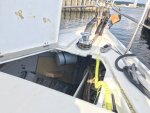
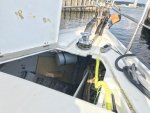
Here’s a pic of the result. In the end I mounted the motor in the SW position (if forwards is North); this doesn’t occlude the chain fall, doesn’t (quite!) protrude under the deck hatch, and I found just enough slack in the cable in the forepeak to make the cable run fit. (Jonathan, could you please point me to the source you found that showed the six mounting positions, as the one I found doesn’t, and the thing came with a CD for a manual, which I have no way of reading on board?)

The motor has a plastic box that you bolt over it once fitted to protect it. The three thick wires are supposed to pass through glands, but the crimped terminal connectors wouldn’t fit through them so I removed the glands. I’m likely to fit a protective flap to keep any splashes off the chain from entering here. Or else Sikaflex the entry holes up around the wires. But that can wait: it was time to put to sea again.

Contrary to the manual I had seen online, the X2 has a three-terminal motor so I didn’t need to change the relay. I found horrible corrosion in one of the microswitches inside the remote control, and as I couldn’t repair the microswitch on the dockside (alright, I did desolder and disassemble it but it didn’t survive my efforts) I replaced the whole PCB with a couple of big fat waterproof buttons from a German chandlery, mounted through a couple of large holes inelegantly cut in the front of the remote unit and sealed with Sikaflex. I tinned all the cable ends to fit into the screw connectors. The bastardised remote is visible in the picture. A convenient advantage of the monster buttons is that they will also serve as foot switches for convenience.

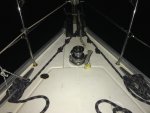
You recommended a chain lock - the second pic shows the one I’m using. As a snubber its two arms are intended to run outboard from the bow cleats down to the chain at water level; but for benign conditions such as tonight it works fine on deck, relieving force from the windlass, and the three rubber snubbers on each rope ease snatching too. Jonathan, I respect that you’ll probably vomit all over this, but I took the view that snakes passing down the side decks under tension are a hazard, and I suspect that my anchoring environment are not as rugged as yours.

The 12V cables passed to the old motor unit through a pipe, which I think maintained the integrity of the bulkhead between anchor locker and the rest of the boat. As this motor unit doesn’t have a fitting to take that pipe, I am aware that if the water level in the anchor locker should reach the top, the boat’s integrity would be compromised. I’m not too worked up about this - although I suppose a theoretical blockage of both vents at the bottom of the anchor locker could cause a problem in a storm - but I would value any advice.

Thanks again. Onwards to Sweden.

Windlass 1.jpg

Windlass 2.jpeg
 

Attachments

  • Windlass 2.jpg
    Windlass 2.jpg
    290.3 KB · Views: 2
Top