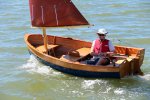
Questions about this type of Enterprise

Back to reality...

Tepco 12? A sort of Tideway clone but much cheaper. They also made a 10.

Or the Voyager which was less than 14ft and had a cabin?

Or the Tarpon 14 which from what I remember was a cruising boat with a removable cuddy from the start. It is a Percy Blandford boat.

Enough, I need to get out into the freezing garage and carry on rubbing down varnish...but then why bother? Its too cold to varnish!
Like the idea of the Tepco, can’t really find any information on it or weight but will keep an eye out for one.

Voyager, nice but want an open dinghy at the moment, thinking a maximum hull weight of 100kg but would like less

Tarpon 14, I like that nice concept but at the moment has to be GRP
 
I admire the SigneT for its simplicity, I am sure it has an external chine log to future simplifying building. It is obviously and old design and there are lots of simpler new concepts that have eased construction even further. Seeing boats like this keep pulling me down the design for myself and build route but I am good year off being in a position to do that.

T - 1 for the big move
 
There is another faux clinker 12ft dinghy that sails well but whose name I cannot remember. It will come in time. Well built and it has a particularly big centre plate which seems to make it stand up better in stronger winds. Mind you the one I know is sailed by an ex Finn sailor, generally speaking Finn sailors are not petite.

The name is bird related, probably wading...hmmm...
 
I do like the idea of a GRP faux clinker, good looking and all the plank lands give stiffness. If I could get bare hull to fit out would be fantastic.
 
As I dwell upon your original post it occurs to me that, as you originally said (I think), something 'lug' is best because it gives you more cruising room in a small boat. Many of the boats mentioned in this thread have that big poley thing nearer the middle of the boat. Then you probably want something quite wide for comfort's sake. Alternatively something without side decks would give internal width.

Scows are too small, International 12s are rare beasts, Cormorant is too big and I don't think there are any American Cat boats here. You original Enterprise idea is perhaps not so bad. By changing the rig, the apparent reputation the Ent has would not apply...but is the foredeck too big? Could it be cut back to add space?

Time to get onto the Findahull.com website and take it from there.
 
The lug rig does appeal short spars, easy to reef, easy to drop etc. I have watched many of the Roger Barnes Videos with him ably demonstrating these virtues. I have had two lug rig boats and so have an appreciation.

And yes back to Enterprise.
Light - tick
Readily available at good price - tick
Plenty of room to camp - tick
Easy to convert to lug rig - tick

Conversation would likely solve the flexiblity / centre board issue

Downsides, the Enterprise has the reputation of being a bit rolly, while my daughter was sailing I spent the weekend with my mate talking of cruising boats wandering the dinghy park. He has quite a bit of experience in Enterprises and looking at the hull he explained the rolling. The Enterprise is relatively full in the front and at this point the sections are very rounded. So as it heels there isn’t much change in section to give the secondary stability. I am sure with a smaller and lower rig this wouldn’t be a major issue
 
Presumably being fuller that the front will keep it drier in a sea when loaded? Whatever it will be significant less stressed.

Is there a problem regarding centre of effort or by moving the mast forward do you reckon this might roughly sort itself out?

Sounds like time to kick trailer tyres and suck air through teeth!
 
Forum looking all different so can’t find where picture insert is. Bit the older GRP Enterprises have a plywood bulkhead about a foot forward of the current mast. Pretty confident I can design a lug rig that with the mast fixed to that bulkhead.
 
I presume you have seen J&J's Grey Boat in the DCA and Hosteliers site? Rigged as a gunter for speed, but with a bermudan on the same mast for reduced cruising sail area. They have been here a couple of times with the DCA and it is a very well sorted boat.
 
Very nice-looking little boat, very practical too.

I took the cover off the Osprey today to dry her out a bit. I can't wait to get sailing again, but looking at the incredible tangle of lines on her, now that I've reinstated the symmetric spinnaker, I can see that she's not an obvious choice for cruising.

Interesting that that article looked hard at making a lead bottom to the centreboard, for better righting ability...

...I had exactly that idea, five years ago for the Osprey, and as I remember, I was laughed out of town...see for yourself, here:

http://www.ybw.com/forums/showthrea...bon-fibre-and-molten-lead&highlight=ballasted
 
My limited understanding of centre boards/centre plates are that a heavy metal one slows the speed at which a twitchy boat heels to a gust. It does not make the boat more stable. It is also unlikely to break when you are jumping on it trying to get the tip of the mast out of the mud.

This last point is more valuable than one might imagine.
 
Not if it slips back into the upside down case & you cannot get it out again because it is so heavy
And don't get your hand in the way of the trailing edge trying to stop it from falling intl the case!
You need a lot of weight to counter the leverage of the mast, anything less than a small crew's worth will hardly notice.
 
One step closer. We are now in our new house down South, exhausted. I am on the mailing list of CLC (Chesapeake Light Craft are probably the largest supply of kit plywood boats in the world, run by John Harris they have a vast catalogue, https://www.clcboats.com/shop/?type=kp ) and a picture of their ten foot Tenderly dinghy popped up in an email.

CCCE8BAD-4C69-404D-A286-7E033BCFF549.jpg

This photo describes better than I can in words what I want from my cruising boat. It also brings up another point, in the US the sit, on a ‘cushion’, on the sole of the cockpit. It must keep you out of the weather and and the boat must feel bigger. The Tenderly is a bit two small and hasn’t got a centre board but lovely in many other ways.
 

Attachments

  • 74FACBF2-2810-44E6-A2CF-D1FFBFA3D7A6.jpg
    74FACBF2-2810-44E6-A2CF-D1FFBFA3D7A6.jpg
    76.7 KB · Views: 0
We used to sit on the floor in old scows but they got leaky.

Do you want some sort of canvas dodger or at least a way of creating a canvas foredeck? Don't want your lunch to get wet.

It is quite lovely, I'll peruse their offerings at my leisure.
 
What a man...just moved house, nearly Christmas and researching boats. The rest of us would be digging thorough boxes trying to find the booster for the telly.
 
3rd full day in new house, today - surround sound TV set up, daughters boat dropped off at the sailing club (have been driving around for a week with an Optimist on the roof) spot of lunch and then outside Christmas lights.

Had to fit a new TV aerial and booster yesterday, if the family are happy I can find all the sailing kit and relax dreaming of boats.

At some point I am going to collapse in heap.
 
My limited understanding of centre boards/centre plates are that a heavy metal one slows the speed at which a twitchy boat heels to a gust. It does not make the boat more stable. It is also unlikely to break when you are jumping on it trying to get the tip of the mast out of the mud.

This last point is more valuable than one might imagine.

Actually one of the problems with metal centre boards back in the day was that if you pulled or jumped too hard on the centreboard the metal plate bent - which then jammed and wouldn’t go back in the case.

And it might give a little bit more stability due to slightly lower centre of gravity - but twitchiness resistance at speed is due more to the water resistance than weight, so metal centreboard likely no better than a wooden or plastic one
 
Top