
LittleSister
Well-Known Member
The aim is to cross at right angles as its the shortest distance
Javelin lights blue touch paper and retires!
 \\
\\Popcorn at the ready.


The aim is to cross at right angles as its the shortest distance
\\
Dutch and Belgian windfarms are closed zones, forbidden for all vessels except for construction or maintenance.Do you actually have to avoid the windfarm, or is it acceptable to sail through it? We were turned away by a guard vessel a couple of years ago but that was while it was still being constructed.
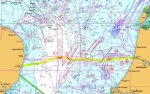
Do ensure your charts are post June 1st 2017 as there were some significant changes to the shipping lanes on the other side of the North Sea
Westhinder posted some info here that relates more to the Shelde area http://www.ybw.com/forums/showthread...t=#post6084749
The OP's intended route is miles away as only the West and North Hinders and the Maas West approaches are relevant to the changes.
I agree with Tillergirl: the changes to the TSS are on the Dutch/Belgian border, so not relevant to your proposed trip.
from what I can make out on your attached chart, points 1 & 2 are on "deep water routeing" for ships and are not part of a TSS therefore rule 10 does not apply. It may be advisory to cross at right angles to make best progress across if ships are in the vicinity but you are not required to do so.
I don't think the points marked 1 and 2 are part of the TSS, that starts further North. On my vector charts those parts of the channel are marked DW and have double headed arrows in them, The double headed arrows are not on the VMF raster charts though.
The 'Y' feature charted (1 & 2) is a deep water route, not a TSS. TSS Rules do not apply, there is no separation, but in my experience ships generally stick to 'Red to Red'.
However, rule 10 won't apply to 1 and 2, as they are South of the TSS.
I accept the point on the TSS. If there is a solid outline of the arrow tis a TSS, if the arrow has a dotted outline of the arrow it is just recommended directions of traffic flow. if there is no arrow, I assume it is only an IMO recommended route rather than a mandatory one.
I have done this from the Orwell to Ijmuiden, which sent us right through the junction South of (1), (2). As stated by others this is not technically a TSS, and is not particularly busy. We had the interesting experience of a ship passing astern of us Northbound, then doing a U-turn and passing in front of us Southbound.
No 3 - note sure I can see clearly enough but I don't see a TSS there. Looks just like 'other' chart marks
At your question mark, I don't think there is a TSS; the TSS has stopped short further north as best I see - but shipping will be generally heading south from that TSS further north as it will be wanting to join the North Hinder TSS (which is well south of your intended route.
Re 1 and 2 - You are required to head at rightangles to the TSS not 'cross at rightangles'. Obviously the tide will take you northward or southwards depending on the time. Worth planning to time to take the advantage of the tide as best you can.
i.e. your heading should be a right angles to the TSS, not your course over ground (unless for some reason there was no tide)
"not 'cross at rightangles'. " Rule 10 states otherwise. Ones heading should be at right angles to the direction of traffic flow.
The regulations require a crossing vessel to head at or as near as possible to 90 degrees to the flow of traffic in a TSS lane
It's the heading that matters, not the course over the ground
As to track or heading, Rule 10 was probably worst drafted text ever. The 1987 amendment however made it clearer: A vessel shall, so far as practicable, avoid crossing traffic lanes but if obliged to do so shall cross on a heading as nearly as practicable at right angles to the general direction of traffic flow.
The aim is to cross at right angles as its the shortest distance and therefore should take the shortest time and that should be the intention, however it's often the case that either the wind is on the nose or a series of ships require a turn to stb of 12 to 15 degrees or so for safe passage
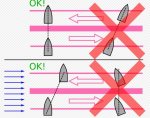
The TSS's are where there are shaded areas on the chart - not every outlined lane.
Regret I don't agree. TSS are shown either by separation zones (the shaded parts) or lines or both. Dotted direction arrows are not part of a TSS but are "Recommended directions of traffic flows".
The TSS's are where there are shaded areas on the chart - not every outlined lane.
No 4 and 5 - looks sense to me. My chart hasn't got the right scale but I would have thought you could skirt south of the edge of the TSS as you head for Ijmuiden - and north of the windfarm - not the largest windfarm at the moment - 43 turbines only.
The route you have planned looks right to me. Aim to go between the IJmuiden approach channel and the windfarm to the south of it. You will see shipping during most of your crossing, but it mainly follows clearly defined routes and thus is straightforward to deal with.
We found the shipping entering/exiting the TSS immediately West of (4a) to be more confusing [edit: than point (1)+(2)], as it was dark and they were not all moving in logical directions.
In the vicinity of TSS's there are often "precautionary areas" - again, rule 10 doesn't apply because they are not part of the TSS but extreme caution is advised when in those areas.
My Departure is usually further South (R. Orwell) but I head for North ShipWash and then set course for the RACON and then De Ruyters Gas Platform (Beware the exclusion Zone). I am a bloke who likes physical Waypoints rather than virtual Through the Gap, and then North of the Wind Farm.........From Southwold or Lowestoft Due East should be good until you pick up De Ruyters..
Thanks for this, good to get first hand experience of Ijmuiden where we plan to arrive, and I agree it would be nice to “pick up” the oil rigs etc as visual marks.If you stop at Ijmuiden Marina, follow the long pontoon around as there are loads of Berths (Green Tags) nearer to the Gate than the immediately stop on the left just inside the entrance.
Interesting – that will be next step, to do some tidal passage planning and look @ times.Timing the crossing to do quieter bits in the dark is perhaps more important than tidal considerations, unless you plan to travel along the coast at either end, personally I would not choose to close the coast at Ijmuiden in the dark (not that there is much of it at this time of year). Passing the gas platform in the dark is pretty spectacular though...
Do you actually have to avoid the windfarm, or is it acceptable to sail through it? We were turned away by a guard vessel a couple of years ago but that was while it was still being constructed.
Dutch and Belgian windfarms are closed zones, forbidden for all vessels except for construction or maintenance.
Shiny new WIFI AIS & ipad apps just installed !The most useful tool apart from the MkI Eyeball, was the iPad/ iPhone app that Calculates and shows CPA and TPA for AIS contacts as there is a lot of North/ South traffic

With ais transponder the ship will see your course, speed and intent and will often call you up direct and either ask you to hold course and speed or occasionally will request you slow or alter course.
Yes, know that feeling ... was nearly run over once by a Trawler moving erratically - having changed course several times, passed within 200m in front of us (after we stopped) with no-one visible on deck, and no answer on CH16 ! Will be suspicious of anything fishing.The only ships that give me concern crossing the lanes are the big trawlers that run up and down between the lanes, you're never quite sure whether they will continue or turn and at night it can be a bit worrying.
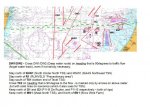

Again, thanks for all info. After reading back over + reviewing charts a bit more, this is the latest rough plan to keep on deck... will be interesting to see what tides do to it, but will try stick roughly to this...
View attachment 64912

Dutch and Belgian windfarms are closed zones, forbidden for all vessels except for construction or maintenance.
