Question about engine bay fire extinguishers

  • Thread starter Thread starter Deleted User YDKXO
  • Start date Start date
D

Deleted User YDKXO

Guest
My boat has one of these in its engine bay

IMG-0353.jpg


It was checked and serviced 2yrs ago

I have been told recently that this type of powder extinguisher system is no longer legal in France and should be replaced by a FM200 gas type extinguisher system (at enormous cost)

So I've got a couple of questions. If, God forbid, I suffered a fire in the engine bay which caused the powder extinguisher to operate and that resulted in damage to machinery, would my insurance co refuse the claim on the basis that the boat should have been fitted with a FM200 extinguisher which wouldnt have damaged any machinery? Second, I have been told that I need a 25kg FM200 extinguisher to replace the existing 12kg powder extinguisher. Anyone any idea why this should be and is it likely to be physically much larger?
 
Mike,

I have just replaced my dry powder system with an FM-200 system, mine is smaller than a 25Kg system (10). SeaFire made mine and here is a link - http://www.sea-fire.com/

I got mine through Dante Extinguishers in Cap D'Ail. Haaf is the owner and a great guy to deal with. Here is a link - http://www.dante-extincteurs.com/en/

I removed the old system and installed the new system myself as the process was very straight forward. Haaf will then come and inspect my work and sign it off.

Haaf told me about the risk to my engines from dry powder and also refused to work on my old system. He would have recharged the bottle, but that's it. Maybe it as a French wide scam against UK boaters on the Cote d'Azur, but as mine need some significant love I bit the bullet and got a new system.

I have pm'ed you my desk number so give me a bell if you would like some more info.

I hope this helps!
 
So I've got a couple of questions. If, God forbid, I suffered a fire in the engine bay which caused the powder extinguisher to operate and that resulted in damage to machinery, would my insurance co refuse the claim on the basis that the boat should have been fitted with a FM200 extinguisher which wouldnt have damaged any machinery? Second, I have been told that I need a 25kg FM200 extinguisher to replace the existing 12kg powder extinguisher. Anyone any idea why this should be and is it likely to be physically much larger?

In a UK policy I had on a small speedboat 4 plus years ago with an inboard, the policy was clear to exclude cover on the engine in the event of a fire if powder based extinguishers were used. So probably yes, but as always best to check with the insurer.
 
+1 for Dante Extincteurs in Cap d'Ail. They've serviced all the extinguishers on my boat for the last few years, including the SeaFire engine room system. This year they removed and serviced everything, replaced any worn/damaged parts and also changed the contents of the FM200 cylinders. Not cheap, but very responsive and they do a great job.
 
Quite glad you started this post Mike

Snap :)

We have what seems like a tiny powder canister and I put it on my “review / replace “ list for overwinter jobs this close season .
Dante quoted about €700 + tax for the new Fm 200 bottle with a auto active bulb as well as a pull activate valve .
The existing powder canister is pull only .
I did a bit of background tinterneting to find these days they all seem “ auto “ bulb melts at 80 degrees C apparently.

So two birds or three ( insurance issues ) to kill with one stone .
1- replace the powder ( mess and potentially harmful * ) with inert harmless gas
2- instal some sort of “ auto “ function
3- insurance - comply with policy terms - paper trail evidence of work done

We allready have a full RINA spec ( I think ? ) system
5- pull Toggles by the helm
Two for shouting the air intakes - spring loaded flaps on like a gate trigger - waiting to spring shut
Two fuel tank cock shuts ( one for each main day tank port / stb
One - canister pull ,to fire off what’s its attached to .
Plus additionally a pair of red illuminated engine cut out knobs you push .

Any how as said above I felt Dantes price a bit in SoF leg lifting territory, so used these
http://www.adecmarine.co.uk/?pi=210...Option+2=FBZ4FE+-+4KG+ROOF+MOUNTED&Quantity=1

I found ADEC marine very helpful - telephoned a guy and to cut to the chase paid £330 in VAT for a bigger inert gas container with a “ auto “ bulb .

I ,am gonna have to relocate it by a few inches ,but conect the existing pull toggle Bowden cable .
In theory the gas is harmless to machinery and people and we have over specced it .There are various online size calculators.

I,ll take some pics of the new instal and have the paper trail hopefully.

As far as some sort of legislation to remove powder I don,t know .Iam doing mine anyhow and if so that’s just a coincidence.
It’s stamped for 5 years btw after which it then needs a service but @ £330 in tax , bit like liferaft - buy another .

https://imgur.com/a/WUwM1
 
Last edited:
So I've got a couple of questions.
A few considerations, before coming to your questions.

1. Can you possibly understand if your existing tank is of the same vintage of the boat, or if it has been replaced?
If the first, I'm a bit surprised that Ferretti still used powder, when my DP which is a couple of years older already came with an FM200 tank.
If the latter, either the previous owner or his installer should be blamed, obviously.
Regardless, it doesn't matter now - just curious.

2. Do you put in place/remove the pin lock every time you enter/exit the e/r?
In your pic it seems in its "locked" position, which is like having no fire estinguisher at all...
Sorry if this sounds like an egg sucking lesson, but I thought to mention just in case - better safe than sorry!

3. Aside from its negative side effects, powder is known to pack up after sitting at the bottom of the tank for longish periods, potentially becoming useless when needed, because the tank might blow just carbon dioxide (or nitrogen), with no or little powder.
I'm saying this because you mention that it was serviced 2 years ago, while I was recommended (from someone dealing with fire hazard in chemical plants, who knows a thing or three more than anyone dealing with boats) to turn around and shake ANY powder tank onboard at least every year, at the beginning of the season. Btw, in doing that, if you pay attention with your ears/hands, you should feel the powder "moving" inside the tank, while shaking it.
If you can't feel that, it's a sign that the powder is packed hard enough to make the thing as useful as a chocolate teapot.
Now, this check is easily done with handheld tanks. And also in my old lady, with her two powder tanks directly attached to the e/r ceiling, it was just a matter of unscrewing two bolts. But with tanks connected to hoses like yours, that's a much more cumbersome job...
Bottom line, another good reason for switching to gas.

Coming to your questions:

Insurance - I can't tell for sure whether they could deny a refund of damages following the activation of a powder system, but fwiw, before accepting to insure both my old and new boat (neither having been surveyed), Y wanted to see pics of several boat components (seacocks, e/r, gas bottle and drains, etc.).
But they neither asked for specific pics nor for the specs of the fire estinguisher, so it would be weird if they should raise objections afterwards...

Powder vs. FM200 equivalence - I never heard that for any given e/r size you need double the amount of FM200 compared to powder, so I had a look at the specs of the tank that I recently replaced in my DP, which was past its due date (1k Eur+VAT ballpark cost).
This is the supplier website (they aren't just dealers btw, they actually build the stuff in their plant near Milan), if you wish to look for anything else.
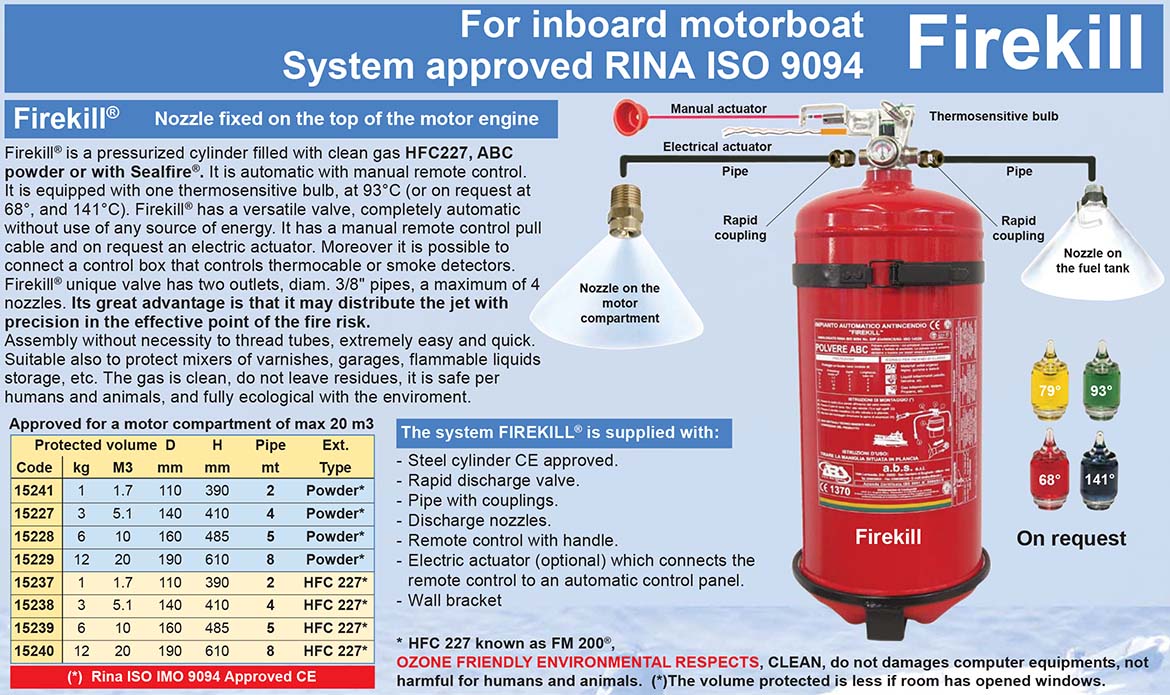
But the following table says it all, and as you see for any given volume the recommended tank size is exactly the same for powder and FM200.
In your boots, I would just check if 20 cubic meters is a sensible estimation of your e/r size, because that's what the 12Kg tank is rated for, and btw that's what I've got in the DP e/r.
Apropos, Portofino, I understand that your e/r is surely smaller, but I was a bit surprised to see the 4Kg tank in your link. Have you got two of those, maybe?

lFik5Iza_o.jpg
 
Last edited:
@Mapish M it’s about right 4 kg for 6.8 cu M of space less tanks batts etc , we have a factory fit extra long range tank and airco kit , black water tank some 200 L plus the engine iron ( some calc sites do some don’t inc the iron ? ) are nearly 13 L .The air intake baffles moulding intrude a bit too
Other comparable 13 M boats have D9 or TAMD 74
Gross vol is about 10 cuM less above clutter .

On the kit you have kindly linked ,the only critique poss from an insurance position is the gonna be the position of the “ thermosenstive bulb “ in Mikes example if I understand the pic he posted .
Should the bulb be high up reasonably centred in the ER ? For the auto requirement?

It may be worth finding out if the ins Co these days are able to differentiate “ auto bulb “ , and hand pull or want both or have no restrictions - just happy with what was fitted back then in the good old days :) of Wild West boat building.
Of course not Ferretti Group boats

Then there’s the so called service - another headache from peace of mind and ins paper trial .

That Fireblitz cylinder ( they do larger on request ) is a 5 year interval and as said ,I’ll just chuck it and buy another 5 y newie .
Actually from y 5 you suppose to send it back for service every 2 y - but not sure how logistically that’s gonna work .I mean I,ve only got one so when it’s away boats unprotected!!

Obviously a fire in the ER imho is a bigger risk than a sinking yet it’s all a little vague the protocol s for the thing Fire that’s most likely to kill you based in the Med ( warm water )

Pin
We had a “seafire “ in the SS - standard U.K. fitment .I had the boat 9 y .After about 5/6 with the help of an engineer mate started to do a bit of DIY , stuff like change exhaust elbows etc , One day mates busy working on his tools and pops his head up and say s
“ do you realise you extinguisher safety pin is in ? “
“ What’s that “ I asked

Fast fwd phaffing in the Itama ER same mate - same Q
He removed them .
Point is this wonder how many are out there merrily riding about with the pin in ?

He’s my score out of 13 years about 9 have been with the pin (s) in

So anybody reading this ps next time you go down to the boat ck the pin status :encouragement:
 
Last edited:
Point is this wonder how many are out there merrily riding about with the pin in ?
LOL, can't tell for sure, but I have a funny feeling that the cylinder which I replaced last year spent its whole life with the pin nicely inserted... :D

Ref. insurances, as I said I don't think Y has any specific requirements (gas vs. powder, pull vs. auto, etc.), but I agree that it might be worth checking - and maybe report here, if anyone cares to do that.

Fwiw, the fire extinguisher producer which I previously linked explained me that their latest valves are compliant with some very recent regulation (sorry, I don't remember the details) requiring ALL the following:
1. automatic release driven by thermostatic bulb (93° C);
2. manual release either through pull cable (which is what I've got) or electrical actuator (which imho is somewhat risky, as a fire might well be started by a major electrical failure);
3. electrical switch, driven by the activation of the estinguisher, meant to be connected to a dashboard alarm.

As I understand, this regulation is only mandatory for new builds, and doesn't apply retroactively to existing boats (in fact, I don't have the alarm, though I could consider installing it now).

One last point about the e/r volume: I can't find any reference right now, but I'm pretty sure to have read that it is supposed to be calculated as gross volume, i.e. without deducting the space occupied by ANY equipment - not even engines.
Btw, even the 10 m3 you mentioned sounds like a rather low number. I mean, if it were 3x2.5x1.5m (which is seriously tight!), it would be more than that... :confused:
 
Btw, even the 10 m3 you mentioned sounds like a rather low number. I mean, if it were 3x2.5x1.5m (which is seriously tight!), it would be more than that... :confused:

+1

going through this thread P, I roughly estimated my 43ft e/r size (which is fairly comfortable to work but with 6.7lt engines) and it's L3mXW3.3mXH1.5m=14.85m3
no mention of no powder down here, will ask again in a couple of months as I have to have a certificate of checking and servicing all extinguishers every year which means that every year I have to physically get the 3X6kg ones to be serviced.

cheers

V.
 
You’ve got me slightly worried now guys
Dante proposed the 4 kg
Here are the dims I just happen to have on my I pad notes measured from the inside .

Dims ER
L 2.4
W 2.8
H 1.6 at the keel

Sound proof area 2.4 x 2.8=. 6.72 M sq

Extinguisher vol 6.72x 1.6 = 10.7 gross , less V less equipment say = 6 cubic M

Additionally reading round the subject —nowts ever simple with boats :)

- although this gas is harmless to man and machinery there is a downside over powder .
If you release it while the engines are running ,the engines will suck it through - more so if the vents are open - replace it with fresh air .
With powder it’s so messy / sticky ( that’s the point btw ) it will clog an air filter stall the engines - kinda self stopping if you see what I mean ,so only a fraction will be wasted the rest will in threory smother the fire .

So it’s vital if you switch from powder to let’s call it “ magic inert gas “ ,because that’s the direction of travel for what ever reason ,and dicide to use it to tonking along @ 1800 rpm that you release it AFTER engine shut down and vent closure first .
Without that regime then any Vol / Kg calculations will be potentially rendered useless .

It’s not that tight I can get in between and climb over the top to drop either side for service etc ,but there only 20 cm Fwds and not really enough room ( unless you are a racing snake which I,am not ) to crawl round from the back - over the g boxes
As said full of other vol pinching stuff .
 
Last edited:
Mike,

I have just replaced my dry powder system with an FM-200 system, mine is smaller than a 25Kg system (10). SeaFire made mine and here is a link - http://www.sea-fire.com/

I got mine through Dante Extinguishers in Cap D'Ail. Haaf is the owner and a great guy to deal with. Here is a link - http://www.dante-extincteurs.com/en/

I removed the old system and installed the new system myself as the process was very straight forward. Haaf will then come and inspect my work and sign it off.

Haaf told me about the risk to my engines from dry powder and also refused to work on my old system. He would have recharged the bottle, but that's it. Maybe it as a French wide scam against UK boaters on the Cote d'Azur, but as mine need some significant love I bit the bullet and got a new system.

I have pm'ed you my desk number so give me a bell if you would like some more info.

I hope this helps!

The OEM Sea - Fire inert gas on my old Sunseeker was fitted with an electronic auto engine cut off switch .
So if you pulled the one toggle it cut the engines then fired off the gas

See my post above

Have you integrated an engine cut off during your move from powder to inert gas ?
 
Porto, that's why we have Seafire systems that shut the engines down before dumping powder / gas everywhere.

Yeh OEM whereby the Factory has integrated the electronic widget .

But guys on here Shane / Mike or others reading could be just swopping bottles thinking that’s it .
Maths vol calc aside :)
 
Last edited:
My boat has one of these in its engine bay

IMG-0353.jpg


It was checked and serviced 2yrs ago

I have been told recently that this type of powder extinguisher system is no longer legal in France and should be replaced by a FM200 gas type extinguisher system (at enormous cost)

So I've got a couple of questions. If, God forbid, I suffered a fire in the engine bay which caused the powder extinguisher to operate and that resulted in damage to machinery, would my insurance co refuse the claim on the basis that the boat should have been fitted with a FM200 extinguisher which wouldnt have damaged any machinery? Second, I have been told that I need a 25kg FM200 extinguisher to replace the existing 12kg powder extinguisher. Anyone any idea why this should be and is it likely to be physically much larger?

Mike, from a Y insurance perspective, you just need to ensure that the fire extinguishing equipment is 'all properly installed and maintained'. There is no expkicit exclusion for powder damage to the engines.
 
Here’s an interesting bit of background reading from a USCG perspective.
https://www.passagemaker.com/lifestyle/fire-suppression-systems

Arh the classic ins speak
“All properly installed and maintained “

Thing is Mikes on a 2 y service as per manufacturer and MapishM raised the issue of powder sediment settling .
One site suggest monthly turning / tipping / shake up of powder and loging it .
I doubt many with strapped heavy 10 Kg + powder have ever removed it at all .
If so with Mikes 12 kg then the “maintained “ bit is starting to look weak in Y,s eyes
Another reason to move away from powder ?

Check the pin status :encouragement:
 
Last edited:
I didn't fit an auto engine cutoff. I know I could have, but given that the likelihood of a fire in the engine room will be electrical rather than engine based (in my opinion and that of Dante) I am more concerned about dumping a large amount of inerting gas into my engine room and I have to take steps to shut the engines down.

Its a balance I guess, and I am happy with my decision. Others will want a different balance and I respect that too.
 
I didn't fit an auto engine cutoff. I know I could have, but given that the likelihood of a fire in the engine room will be electrical rather than engine based (in my opinion and that of Dante) I am more concerned about dumping a large amount of inerting gas into my engine room and I have to take steps to shut the engines down.

Its a balance I guess, and I am happy with my decision. Others will want a different balance and I respect that too.

My understanding is that, in an inert gas system, if you do not shut the engine down the engine will inhale the gas, this pulling in fresh air from the atmosphere and stopping the inert gas from being there to extinguish the fire, irrespective of the cause.

http://www.4abetterboat.com/WP/?p=329

A key factor in the effectiveness of these systems is keeping the agent in the compartment long enough to completely extinguish the fire. All systems should have the compartment blowers connected to the electric control in order to turn the blowers off in the event of discharge. Systems with Diesel engines need to have an automatic engine shut down control installed. This is because diesel engines will keep running blowing most of the agent out the exhaust. This can result in a re-flash of the fire. Also if a fire has started as a result of a leak in a pressurized fuel or oil line, the running engine could keep providing fuel to the fire. Gasoline engines on the other hand will stall when breathing the agent and do not need an auto shut down system.
 
Last edited:
If the assumption is that the fire starts and reaches a point where the auto function activates and the engine is running then yes - I guess so, but at the the same time if the fire reaches a point where the auto function activates and the engine isn't running (electrical fire with the boat either attended or unattended) then who cares.

Also you might notice smoke coming from the engine room, shut the engines down , manually fire the fire bottle which again will not present you with problems you are thinking off in the post above.

I don't think I need a Milspec fire system in my sub 40ft personal motor boat. I need something that provides a mitigation to the risk of fire in the engine room to a level I am content with. Risk balance is the phrase I like.
 
Top