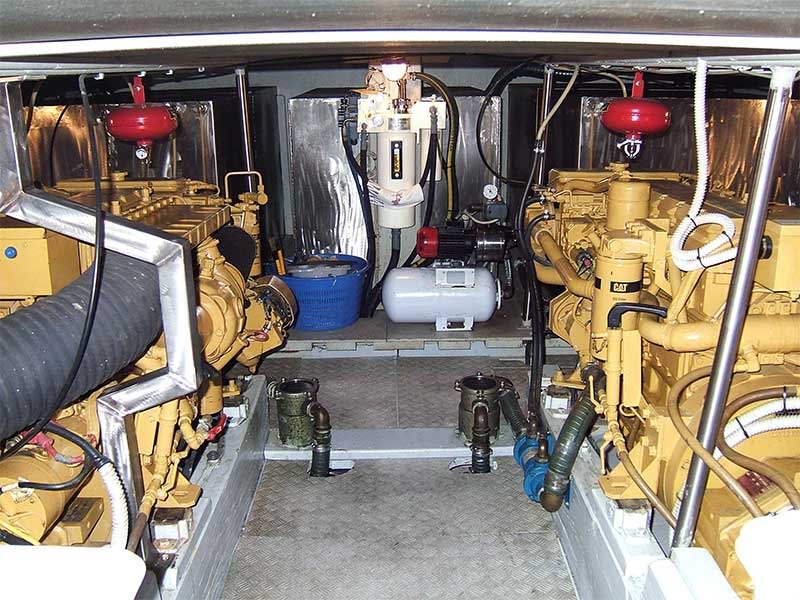
Question about engine bay fire extinguishers

  • Thread starter Thread starter Deleted User YDKXO
  • Start date Start date
Shane’s system is ok
The 2nd salient point being —- awareness of the importance of engine shutdown before inert gas discharge.

1st point —- pin status


Cat skinning excerise really with just those two points ( thus far ? )

Re - auto everything like in the link above —- hmm not so sure I would elect to have all those relays and supporting electro twackery - but realise if a bought a new 2018 boat of say 70 ft it may come with all that .
There’s a post recently about a VP boat that one engine started and kept stalling - many weeks later everything changed - usual filters - lift pump many £££ later etc - it turned out a duff “ sea- fire “ engine cut out - jammed on .

Of course with manual everything you have to go through the motions —- in the correct order .
Enigine off knobs push x2 on the ignition you have to ensure they are out to start up

Air vent close pull x 2
Cylinder discharge x1
Fuel tank cocks shut x2

Mine are all arranged in that order bow to stern .
 
Fire extinguisher technology has moved on of the last few years. You must surely have gas for the engine room - you don't want the engines ingesting powder under any circumstances. Halon gas extinguishers were fantastic (we used to use them in motorsport) but have been banned to save the planet so you have to use FM200 or equivalent. In my engine room, the capacity of the extinguisher is nearly twice the volume of the space. I want to make sure the fire is extinguished and the cost is irrelevant compared with people and the vessel.
A slight aside, I also replaced my 4 powder extinguishers in the cabins with the new water mist type last year. Having seen what a mess the powder types leave, water mist seem a better option. They can also be used on most fires including electrical.
 
Thanks to all for most informative replies especially mcanderson who has answered various questions by PM and email

Just to address a couple of points raised, the boat was manufactured in 2006 and I guess at the time there was no alternative to a powder type fire extinguishing system. I bought the boat in 2014 and the (well respected British) surveyor made no comment on the fire extinguishing system other than it had been recently serviced so I didnt give it any more thought. He certainly never raised the issue of changing it for a gas system. With regard to the safety pin, I had a discussion with a boatyard in Sardinia who serviced the boat in 2014/15 about whether the pin should be left in or out. Their opinion was that, in order for the remote pull to work, the safety pin should be left out. For obvious reasons we didnt want to test this reasoning!

Today I have been investigating FM200 systems and it seems that even a 25kg unit might be undersized for the volume of engine bay on my boat which I calculate at around 40 cu.m. It seems this might cost me even more than I thought
 
An interesting read.

HFC 227 is a HydroFluoroCarbon fluid also classified as a refrigerant R227 so not dissimilar to the refrigerants used in your AC and fridges, and is subject also to the F Gas Directive and its associated phase down. FM200 is a trade name owned by Chemours (formerly Du Pont) for HFC227ea. Sea Fire are a specialist offering extinguishers using for instance FM200 by Chemours.

I am surprised it was felt necessary to change the gas - why - it does not deteriorate in its cylinder, only the firing mechanism.

It is not inert. Unburnt it is of low toxicity if inhaled below 10%, but the way these gases work is by pyrolising (partially burning) around the flame and in so doing cutting off instantly the free supply of oxygen. Now once they have pyrolised they are anything but inert and under no circumstances should they be inhaled, because the hydrogen fluoride which is very acidic and very unpleasant and possibly dangerous.

They won't wreck and engine like dry powder will.

The key difference is that a pyrolising gas will knock a flame out almost instantly at fairly low concentration (6 - 9%) at which level the air into which it is mixed remains breathable, whereas a dry powder has to be physically placed at the site of the flame, so requires a massive discharge of powder to work, and the powder, similar to talcum powder (dried clay = silicon = sand dust) if drawn into an engine causes havoc.
 
There are alternatives to fm200 and lighter in weight, have a look at Stat-x systems supplied by marine fire safety. About to install that to replace my firepro system which is of a similar technology.
 
But the following table says it all, and as you see for any given volume the recommended tank size is exactly the same for powder and FM200.
In your boots, I would just check if 20 cubic meters is a sensible estimation of your e/r size, because that's what the 12Kg tank is rated for, and btw that's what I've got in the DP e/r.
Thanks for detailed reply P. The more I look into this matter the more complicated it becomes. Firstly, without having physically measured the engine compartment, I have estimated the volume of my engine compartment from drawings of the boat as around 40 cu.m which begs the question as to why Ferretti chose to fit only a 12kg powder extinguisher. I suppose it is possible that they deducted the volume of all of the major components from the total volume of the compartment to come up with a reduced volume? Anyone know if this was an accepted way of calculating the size of a powder extinguisher a few years ago?

The second issue that concerns me is that I have been told that the Seafire FM200 extinguisher size is calculated on the basis of 1kg to 1.4 cu.m whereas the Firekill system in your table is calculated at 1kg to 1.7cu.m. Why the difference? Also when the manufacturers state weight in kg are they talking about the weight of gas or the weight of the whole cylinder

Another thing I dont understand is why the Seafire unit seems to discharge just from the cylinder itself whereas the Firekill unit discharges through nozzles. Somebody correct me if I'm misunderstanding that
 
There are alternatives to fm200 and lighter in weight, have a look at Stat-x systems supplied by marine fire safety. About to install that to replace my firepro system which is of a similar technology.

Thanks that looks an interesting system too
 
Superheat...would you know what Fireguard "clean agent" is ? Seems an aweful lot less than FM 200.
Looking at the MSDS it is a mixture of several chemicals, notably potassium nitrate into a fine aerosol, that from the notes I found appears to pyrolyse around the flame in a similar manner to halon. However, it does not list it as any form of HFC or refrigerant.
 
Looking at the MSDS it is a mixture of several chemicals, notably potassium nitrate into a fine aerosol, that from the notes I found appears to pyrolyse around the flame in a similar manner to halon. However, it does not list it as any form of HFC or refrigerant.

Thanks..but if it pyrolyses the fire...does that matter?
 
Another thing I dont understand is why the Seafire unit seems to discharge just from the cylinder itself whereas the Firekill unit discharges through nozzles. Somebody correct me if I'm misunderstanding that

It’s not clear from your pic ( in isolation) without a further description of the system- if yours is fully automatic or partially automatic. Or just manual release ?

For auto release the bulb is on the valve - Seafire / fireblitz ,so the canister is mounted as high as poss where the heat in theory is thought to be detected sooner .

Where as I,am not sure how auto the remote cylinder storage systems with pipes / nozzles works .
Where are the bulbs located ?
If the bulbs are @ the nozzles ( you have not supplied a pic ) then why’s the trigger remote on the canister ?

Advantage of a auto release is it should discharge while you are not anboard say an electrical fire - charger / batt overheat scenario for example in a marina while you and guests are at restaurant on shore .

Flip side disadvantage- it may go off tonking along @2000rpm vents open etc and all the gas within seconds disappears through the engine ,you notice a slight hesitation/ flicker of the rpm guages or a stall .
Again possibly check read your ins policy to see if spec any system , or the policy stays silent just the std blurb

“ correctly fitted and maintained “ cut n pasted in ?

Here a pic of a Fireblitz with bulb - similiar to a seafire canister position

https://imgur.com/a/uvjXV

The weight is the actual kg of the liquid ,it’s compresed you can hear it slosh around if you care fully shake the canister.
Turns to gas when released into the atmosphere.
 
Last edited:
With regards to the concern of gas discharge and the engine still running, I have fitted smoke alarm that connects by wireless to the other smoke alarm in the cabin etc, so if the engine bay is triggered all the alarms sound. That over comes my concern of not hearing the alarm when the engine is running and catching the fire early. No false alarms either. Got these from B&Q.
 
What about Halon's replacement, FE36 by Dupont or alternatively known as CleanAgent by others? Much less than half the price of FM200 and available in larger sizes on request see bottom of web page. (10m3 6kg shown here http://www.adecmarine.co.uk/?pi=210...Option+2=FBZ6FE+-+6KG+ROOF+MOUNTED&Quantity=1)

Yes I think I linked that in my post #5 ^^^ - it’s what I went for to replace the powder.

As said with powder I think it can,t really get through the fine paper elements the air filter s mesh ( happy to be corrected if that’s not true ?) More like clogg em up = stall - dunno obviously never tried it .
The main issue I think is it’s messy and sticky and needs a prompt clean up .If it’s left on say the thread of fuel lines or injector seats ,over a shortish period of time it sets off corrosion making hassle later if there’s part s need removing .
I don,t think it kills the engine there and then because it suffocate s it to stall .- it’s just the aftermath many moons later with latent damage from hidden corrosion- cos you missed it in the clean up has ceased bolts to snapping off or rounding hex,s etc .

The double smoke detector idea from Scubadoo seems a good idea .
I don,t really want or have room for screen and CCTV monitor , and an early alarm regardless of who’s looking at what seems a good ideal .
Some sort of early detection for guys with the full monty of flaps / engine cut out / fuel cocks pulls now with let’s call it “ magic gas “ sounds good to prevent a discharge of said gas @1850 rpm

Was going to look a bit deeper into early detection and alarm - so Tnx
 
IMHO the most important feature of any fire extinguishing system or extinguisher is its 'knock down' ability, e.g, the ability to effectively kill the fire as swiftly as possible.

In this regard a dry powder does not come close to a gaseous drench, and I understand that the HFC227ea is only a second best to Halon, BCF, etc, which are now banned due to their environmental damage (CFCs). So if the Stat-X emulates the knock down of Halon and without the residue, nor noxious after components then this product should have serious consideration.
 
slightly off topic:

if one DOESNT have flaps to block vents, what are the options? Seems to me that the gasses are of no use, am I right?
I'm asking as I have 2X4 vents looking back (ie. venting OUT of the engine room) each one approx 100X150mm with scoops
BUT I also have 2Xinlets above deck which are 100X600mm (at least!) covered with a simple grille.

None of them is blockable and tbh it would be a major project to do something about it...

Do most (or all!) craft over 45-50ft have flaps on e/r vents, or is that a fairly recent addition/safety feature?

cheers

V.
 
if one DOESNT have flaps to block vents, what are the options? .

FWIW all 3 Ferrettis I've owned have had remotely operated flaps to block the engine air vents. Not sure what the alternatives would be
 
It’s not clear from your pic ( in isolation) without a further description of the system- if yours is fully automatic or partially automatic. Or just manual release ?

For auto release the bulb is on the valve - Seafire / fireblitz ,so the canister is mounted as high as poss where the heat in theory is thought to be detected sooner .

Where as I,am not sure how auto the remote cylinder storage systems with pipes / nozzles works .
Where are the bulbs located ?
If the bulbs are @ the nozzles ( you have not supplied a pic ) then why’s the trigger remote on the canister ?

...

Here a pic of a Fireblitz with bulb - similiar to a seafire canister position

https://imgur.com/a/uvjXV

You neither need a bulb on the valve nor any specific cylinder placement, to get auto activation.
If you look at the pic in my post #7, you can see that you can configure the system pretty much as desired, because the valve can be opened (the following being all "OR" options):
1) by manual activation (pulling a mechanical cable);
2) automatically, by the thermosensitive bulb;
3) by electrical actuator, which obviously can be either controlled from a manual or automatic switch, driven by a separate fire system.
Fwiw, what I have now on the DP is 1+2.

Now, IIRC in Deleted User e/r there is a (separate) fire/smoke detection system.
So, THAT system could activate the cylinder valve automatically, but my memory doesn't stretch far enough to tell if it actually does...
Anyhow, judging from his pic above, I don't see a thermal bulb on the valve, so I believe he doesn't have (2).
And I can't see any electrical cable, so I would think he doesn't have (3) either.
He obviously has (1), and theoretically the release cable could also be pulled by a mechanical actuator driven by the fire detection system, hence having both manual and auto release, but as I said I don't remember that, and it's impossible to tell from the pic alone.
Pretty sure, the release is on the cylinder valve only anyway, and there isn't any additional valve on the nozzles - that would be way more complicated (and useless).

That aside, the pic you linked reminds me of the installation I had in my old lady - see below.
But are you sure that it has also a manual release?
In my old boat, both bottles were filled with powder, and both were controlled only by an automatic thermal bulb.
A solution which I can't say I liked a lot, but hey-ho...!
B6n8HAvs_o.jpg
 
Do most (or all!) craft over 45-50ft have flaps on e/r vents, or is that a fairly recent addition/safety feature?
Fwiw, my old lady didn't have any flaps.
Just two openings on each side, the fwd one sucking air in and the aft one blowing air out, both smallish - about 10cm diameter.
They were unnecessary while cruising though, since natural ventilation courtesy of engines aspiration was enough.
I just used to run them for a while upon arrival, to keep the e/r from getting too hot.
I suppose that if the fire extinguishers should have released the powder, those openings would have made no meaningful difference on its effectiveness. But I'm glad I never had to check that! :D
 
Top