PWM Dual Battery Charge Controllers.

Ian_Rob

Well-Known Member
Joined
31 Jan 2008
Messages
1,207
Visit site
Photonics Universe’s 20A Dual Battery PWM Solar Charge Controller looks virtually identical to Victron’s Bluesolar Duo 20A PWM.

Is it?
 
Photonics Universe’s 20A Dual Battery PWM Solar Charge Controller looks virtually identical to Victron’s Bluesolar Duo 20A PWM.

Is it?

That's interesting. I have the Photonics Universe one. The Photonics one has worked perfectly for the last 4 or 5 years and is still going strong. I'd didn't look at the Victron one as mine came with a "bundle" but I also reckon that it is the same as the Victron one.

Richard
 
If you are buying a solar controller, an MPPT will get much more out of your panels. It may cost more in the first place, but will pay for itself over time.
 
If you are buying a solar controller, an MPPT will get much more out of your panels. It may cost more in the first place, but will pay for itself over time.

It won;t get much more, just a bit more. Probably worth it for large arrays of panels, but for smaller setups it's pretty marginal, not least because you have to connect 12V panels in series to use one and that makes them far more vulnerable to shading.
 
I am on a swinging mooring and just aiming initially at a small system (2 x 20 watt panels) sufficient to keep my 2 x domestic and 1 x engine batteries topped up. I think a dual, PWM controller should be OK and it’s price is such that I can always upgrade without loosing too much money.
 
I am on a swinging mooring and just aiming initially at a small system (2 x 20 watt panels) sufficient to keep my 2 x domestic and 1 x engine batteries topped up. I think a dual, PWM controller should be OK and it’s price is such that I can always upgrade without loosing too much money.

I use mine for 2 x 50W panels charging 2 x 60Ah domestic + 1 x 40Ah engine batteries, and it's absolutely fine for that. MPPT will cost more and add practically nothing.
 
Victron Blue Solar mppt starts at £69 on eBay. I don’t think the price differential with the cheap pwm is that much. It’s just because they are bundled in kits that make pwm convenient
 
Why do you say that (about series connection)? Ta

It is my understanding that to get the best out of a MPPT controller, you should feed it the highest voltage you can because it can then extract some useful power even on rather grey days. Hence you put the panels in series, which means that if either gets significantly shaded, you lose all output. Panels wired in parallel are far less susceptible to this.

I believe that you can use a 12V MPPT controller with (nominal) 12V panels as input, but it's doesn't really do you any good.
 
Why do you say that (about series connection)? Ta

Mine are parallel, the victron needs 5v above batt voltage to start up but that's not really a problem, still fires up just after sunrise. Series will cause more loss of power if one panel is shaded, apparently. From switching the mppt in and out the current gain prob about 20%, you can see the unit hunting around for a few 10s of seconds to find the best panel voltage.
 
Last edited:
It is my understanding that to get the best out of a MPPT controller, you should feed it the highest voltage you can because it can then extract some useful power even on rather grey days. Hence you put the panels in series, which means that if either gets significantly shaded, you lose all output. Panels wired in parallel are far less susceptible to this.

I believe that you can use a 12V MPPT controller with (nominal) 12V panels as input, but it's doesn't really do you any good.

I've just checked out the white paper on this subject produced by Victron ( https://www.victronenergy.com/uploa...Which-solar-charge-controller-PWM-or-MPPT.pdf ).
I found it very helpful.
One point they make is that a PWM controller will pull down the voltage produced by the solar panel to very close to the battery voltage, ie near to 12V, whereas the the MPPT will pull down the panel voltage to the level that produces most power, which for a single panel appears to be around 18V (but depends a bit on temperature). The difference between these two regimes is about 20% more power from the MPPT.
In the case of a pair of series connected panels the pwm controller would still drag the panels' output down to 12V, (or 6V across each), which would be even more disadvantageous for power generation, compared to the MPPT controller which would still be operating with about 18V across each panel (36 volts in total).
Therefore, for series connected panels, the mppt is much more advantageous.
 
I've just checked out the white paper on this subject produced by Victron ( https://www.victronenergy.com/uploa...Which-solar-charge-controller-PWM-or-MPPT.pdf ).
I found it very helpful.
One point they make is that a PWM controller will pull down the voltage produced by the solar panel to very close to the battery voltage, ie near to 12V, whereas the the MPPT will pull down the panel voltage to the level that produces most power, which for a single panel appears to be around 18V (but depends a bit on temperature). The difference between these two regimes is about 20% more power from the MPPT.
In the case of a pair of series connected panels the pwm controller would still drag the panels' output down to 12V, (or 6V across each), which would be even more disadvantageous for power generation, compared to the MPPT controller which would still be operating with about 18V across each panel (36 volts in total).
Therefore, for series connected panels, the mppt is much more advantageous.

I have 2 x 245W panels in series through a 40A Tracer BN MPPT controller, and usually see the panel voltage between about 50V and 65V, (25V to 33V each).
 
Mine are parallel, the victron needs 5v above batt voltage to start up but that's not really a problem, still fires up just after sunrise. Series will cause more loss of power if one panel is shaded, apparently. From switching the mppt in and out the current gain prob about 20%, you can see the unit hunting around for a few 10s of seconds to find the best panel voltage.
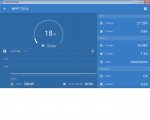
My two Victron MPPTs do the same, taking the 21.3v from the separate solar panels and reducing it down to 14.4v to the battery although it does jump around as the MPPT constantly searches for the best solution. In the photo the current goes up to 1.3A, not huge in this instance because the batteries are full. The amperage would be much higher with discharged batteries.

27361-albums1537-picture28824.jpg
 
Last edited:
I have 2 x 245W panels in series through a 40A Tracer BN MPPT controller, and usually see the panel voltage between about 50V and 65V, (25V to 33V each).

That is interesting.
Do you think that happens when the batteries are well discharged, or when nearly or completely full?
If the mppt controller has nowhere to put the power from the panels it may perhaps allow the voltage to rise up towards the open-circuit panel voltage.
 
That is interesting.
Do you think that happens when the batteries are well discharged, or when nearly or completely full?
If the mppt controller has nowhere to put the power from the panels it may perhaps allow the voltage to rise up towards the open-circuit panel voltage.

seems to not matter what the SoC of the batteries is. Right now the voltage is 57V, and the batteries are drawing 16A at 14.8V, (a couple of amps are being used to power stuff).
 
Top
