Putting turks head knot on top centre of the steering wheel

tudorsailor

Well-Known Member
Joined
12 Jun 2005
Messages
2,756
Location
London
zebahdy.blogspot.co.uk
Rather than resurrect a thread from some years ago, I thought that I would start afresh.

Having recovered the steering wheel with lovely new leather from SeaDogs I wanted to put a Turks Head knot at top centre. Now that I have worked out how to do it, I thought that I would share how I got it done
The best video for instructions is here. The still pictures are not as good as the video.

I used 3mm white cord. A lacing needle makes it easier. I bought a 3" Paracord Needle Stainless Multi Purpose Leather Lacing Kit Screw Thread Shaft from eBay.

Since I have a 3D printer I made a model of the wheel and spoke to size (22mm diam rim and 8mm spoke)

To make the 4 pass knot, I used 2metres of cord, so load a bit more, but no more than 2.5m. I use a surgical clamp to grab and pull the cord to snug it up once the knot is complete. Click on thumbnails to enlarge

I hope that this helps someone else

TudorSailor

 
Last edited:
neat work, Doc.

I love the eleven word descriptor of the lacing needle :)


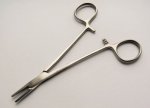
What's a surgical clamp, and should every practical boat owner have one, please ?
 
Descriptor is lifted from eBay to make sure you go straight to the correct needle!

Surgical clamps are really useful for all sorts of things. I have easy access to them as the hospital has them in packs where everything is meant to be thrown away after one use. Apparently its cheaper than have better quality instruments and repacking + sterilising! So if they are still clean, I save a pair from the bin occasionally!

They are available on eBay, such as these
s-l500.jpg

TudorDoc
 
I had white cord turks head knot previously and it came up clean with a bit of soap and water. If the cord is polyester it should not absorb the dirt. Of course, no reason, not to make it coloured or even multi-coloured...

TS
 
Traditionally, such decorative knots were painted over, giving a surface that was cleanable. Personally, in that position I'd have tied a 4x5 Turks head, to be a bit more symmetrical about the spoke. Turks heads can have any number of turns and bights as long as the two are not mutually divisible - the usual one is 3x4. There's a whole chapter of Ashley about Turks Heads.
 
Rather than resurrect a thread from some years ago, I thought that I would start afresh.

Having recovered the steering wheel with lovely new leather from SeaDogs I wanted to put a Turks Head knot at top centre. Now that I have worked out how to do it, I thought that I would share how I got it done
The best video for instructions is here. The still pictures are not as good as the video.

I used 3mm white cord. A lacing needle makes it easier. I bought a 3" Paracord Needle Stainless Multi Purpose Leather Lacing Kit Screw Thread Shaft from eBay.

Since I have a 3D printer I made a model of the wheel and spoke to size (22mm diam rim and 8mm spoke)

To make the 4 pass knot, I used 2metres of cord, so load a bit more, but no more than 2.5m. I use a surgical clamp to grab and pull the cord to snug it up once the knot is complete. Click on thumbnails to enlarge

I hope that this helps someone else

TudorSailor


Photobucket has links to all your personal photo's. Not a good idea to expose your family to internet trolls.
 
Traditionally, such decorative knots were painted over, giving a surface that was cleanable. Personally, in that position I'd have tied a 4x5 Turks head, to be a bit more symmetrical about the spoke. Turks heads can have any number of turns and bights as long as the two are not mutually divisible - the usual one is 3x4. There's a whole chapter of Ashley about Turks Heads.
Happy to have criticism. However, I found it quite difficult to find instructions for Turks Head that I could understand and follow. If you know of a video of a 4x5 Turks head, then I will try that. If not, I am happy with what I have achieved
TudorSailor
 
If you can find a copy of The MARLINSPIKE SAILOR by Hervey Garrett Smith its a book with fascinating rope work and with clarity in the drawings.
 
Spencer-Wells clamps are still on the trays. Here is the history that I found showing him to be one Mr Spencer Wells rather than Mr Spencer and Mr Wells. Shame the days of naming things after oneself are gone.........

Spencer Wells artery forceps have become the standard forceps used in abdominal surgery following their introduction in 1879. They are used during surgery to compress the artery, seal small blood vessels or keep the artery out of the way. The innovation of English surgeon Thomas Spencer Wells (1818-97) was in eliminating the gap between the handles of the forceps in order to prevent arteries and tissues being entangled. The jaws of the forceps were also shortened and were given strong ridged teeth to improve compression and grip. It was found that compression could seal small blood vessels permanently. Spencer Wells forceps could be applied to larger vessels which could then be stitched later rather than being done immediately.

TudorSailor
 
Top