
Putting a diesel heater into a Macwester 26

Recently, there was an involved discussion here concerning the fresh air/burner air inputs, which might also be of help. I bought some standard 'exhaust muffler wrap shield' as a way of diffusing the great heat coming from the exhaust. Because it's enclosed in lockers, with the intakes coming from external sources, I used copious lengths of wrap, generally loosely fitted, and found that the chemicals used in the manufacture of the wrap did take time to 'steam-off', and give a smoke free experience. In fact I was so concerned that I bought a gas monitor, very similar to this, which indicated nothing untoward as it happens, but is reassuring to have.

1762370335571.png
 
Typically (not specific to your boat) people throw away all the exhaust components that come with the cheap heaters and install a sealed marine grade exhaust using an appropriate through hull which separates the grp from the hot bits. I think most people would not be comfortable with the idea of your exhaust and butane cylinder sharing the same space.
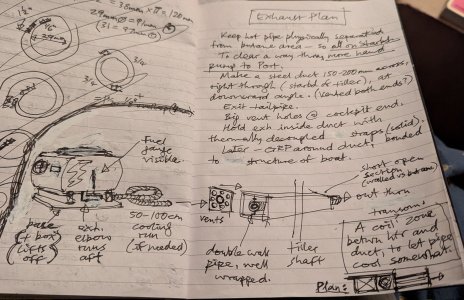
Thanks, I have redesigned the route based on your comment. The exhaust will pass through a steel and grp box tunnel on the left of the photo, away from the butane locker. Suspended by thermally decoupled straps, so the tunnel barely gets warm.

The hand pump (yellow pipe) will be shunted over to Port, to clear space inside.

It might have a run of pipe before entering the area, to cool off a bit; and double walled, double lagged as it goes through - see photo.
 

Attachments

  • PXL_20251105_210725462.jpg
    PXL_20251105_210725462.jpg
    1.4 MB · Views: 13
I
Yes, valid concerns... I put feet under the heater to raise it some inches and folded the flexible exhaust hose that comes out the bottom round and up the side of the case, then put a steel bracket on the side at the top where I fitted the silencer so that's where the exhaust gas comes out. Lifiting it and feeling underneath, the cockpit doesn't even feel slightly warm,. I lay it on the seats in the cockpit rather than at the bottom, so the exhaust is probably close to the top of the cockpit (its a pretty small boat :-) ) , and CO is very slightly lighter than air. The height of the duct into the boat works out better that way anyway.

It has occurred to me before that there are risks.... especially if any of the exhaust can ever get into the vent that sucks air in through the heat exchanger to the cabin. So to an extent I'm trusting the CO alarm - it has never detected anything - but on this occasion I agree with AI. Then fire risk is another thing that's gone through my mind, although arguably a fire starting in a locker is as bad/worse.

There are youtube videos of people running Chinaspachers inside garages etc... wouldn't be for me. Even if carbon monoxide doesn't get you, it will stink of diesel fumes especially as it starts up. I'd rather be cold in my garage (and I have electricity/a fan heater there anyway!).
If you are "trusting" in the CO alarm, maybe you should have 2 of them? 🤔 If one dies, you and the other one stay alive.

Thanks for the long reply. Is that a 2kw or a 5kw?

I did wonder about taking the exhaust upwards (with a rain cap). It is risky though, because of the 2m max length. And you might get a rust spot going through at the low point. There is risk with every layout, it seems.
 
Recently, there was an involved discussion here concerning the fresh air/burner air inputs, which might also be of help. I bought some standard 'exhaust muffler wrap shield' as a way of diffusing the great heat coming from the exhaust. Because it's enclosed in lockers, with the intakes coming from external sources, I used copious lengths of wrap, generally loosely fitted, and found that the chemicals used in the manufacture of the wrap did take time to 'steam-off', and give a smoke free experience. In fact I was so concerned that I bought a gas monitor, very similar to this, which indicated nothing untoward as it happens, but is reassuring to have.
View attachment 201681
I have a similar one at home. It is a cheap type, and some of the sensors are only approximate guesses. It doesn't see smells at all. But gluey smells / candle wax etc, or offgassing can be very harmful. You can also be poisoned by microplastics these days! They come off old carpets and water fittings; microwavable food bags, etc.
 
Buy a Taylor’s diesel drip feed heater. Imho.

Built like a Sherman tank.

QUALITY engineering.

Character and pleasing to look at.

They WORK; year after year too.

I can see the desire for other types, but…

Mine, Still working, serviced regularly and has always passed muster.

Contentious issue I imagine.

I can only speak of my experience.

Had a diesel hot blow air heater; failed within two months. Cost about £100 , a Taylor’s can be bought second hand (often as good as new) for about £500 - £600 but WILL do the job, WILL last (from my experience of many boats with them) and be worth money down the line.

I consider Taylors an investment as well as a quality heater.

Info published from here:
Best diesel heaters for boats - An expert buyer's guide - Yachting World


Reasons you’ll like it
Quiet when in use, radiates heat, simple and easy to maintain, requires no electricity
Something to be aware of
You will need to fit a flu through the top of your boat, it requires a little effort to light it


What I think of it


Fuelled by red or clear diesel, fed from from its own gravity tank – Header tank version – or pumped direct from the boat’s supply – main fuel tank version.


It is a superbly simple heater for boats. Fitted to a bulkhead the heater radiates heat rather than pumps hot air around ducting. As a gravity fed unit this is virtually silent running.


Front opening door gives access for maintenance or adjustment, Supplied with a 1.5 gallon tank, a safety on/off fuel control valve, in-line fuel filter, pipe work and fittings for installation,


Externally vented and bulkhead mounted, through-deck fitting flue sections are also supplied.


Available in a brass or a Stainless Steel finish.


An excellent choice for anyone wanting to live aboard or use their boat year round. This model suits a smaller boat up to 38 foot.
 
Last edited:
Buy a Taylor’s diesel drip feed heater. Imho.

Built like a Sherman tank.

QUALITY engineering.

Character and pleasing to look at.

They WORK; year after year too.

I can see the desire for other types, but…

Mine, Still working, serviced regularly and has always passed muster.

Contentious issue I imagine.

I can only speak of my experience.

Had a diesel hot blow air heater; failed within two months. Cost about £100 , a Taylor’s can be bought second hand (often as good as new) for about £500 - £600 but WILL do the job, WILL last (from my experience of many boats with them) and be worth money down the line.

I consider Taylors an investment as well as a quality heater.

Info published from here:
Best diesel heaters for boats - An expert buyer's guide - Yachting World


Reasons you’ll like it
Quiet when in use, radiates heat, simple and easy to maintain, requires no electricity
Something to be aware of
You will need to fit a flu through the top of your boat, it requires a little effort to light it


What I think of it


Fuelled by red or clear diesel, fed from from its own gravity tank – Header tank version – or pumped direct from the boat’s supply – main fuel tank version.


It is a superbly simple heater for boats. Fitted to a bulkhead the heater radiates heat rather than pumps hot air around ducting. As a gravity fed unit this is virtually silent running.


Front opening door gives access for maintenance or adjustment, Supplied with a 1.5 gallon tank, a safety on/off fuel control valve, in-line fuel filter, pipe work and fittings for installation,


Externally vented and bulkhead mounted, through-deck fitting flue sections are also supplied.


Available in a brass or a Stainless Steel finish.


An excellent choice for anyone wanting to live aboard or use their boat year round. This model suits a smaller boat up to 38 foot.
Totally agree , a superior solution. Other gravity feed heaters also available, both floor and bulkhead mounted.
 
Last edited:
Buy a Taylor’s diesel drip feed heater. Imho.

Built like a Sherman tank.

QUALITY engineering.

Character and pleasing to look at.

They WORK; year after year too.

I can see the desire for other types, but…

Mine, Still working, serviced regularly and has always passed muster.

Contentious issue I imagine.

I can only speak of my experience.

Had a diesel hot blow air heater; failed within two months. Cost about £100 , a Taylor’s can be bought second hand (often as good as new) for about £500 - £600 but WILL do the job, WILL last (from my experience of many boats with them) and be worth money down the line.

I consider Taylors an investment as well as a quality heater.

Info published from here:
Best diesel heaters for boats - An expert buyer's guide - Yachting World


Reasons you’ll like it
Quiet when in use, radiates heat, simple and easy to maintain, requires no electricity
Something to be aware of
You will need to fit a flu through the top of your boat, it requires a little effort to light it


What I think of it


Fuelled by red or clear diesel, fed from from its own gravity tank – Header tank version – or pumped direct from the boat’s supply – main fuel tank version.


It is a superbly simple heater for boats. Fitted to a bulkhead the heater radiates heat rather than pumps hot air around ducting. As a gravity fed unit this is virtually silent running.


Front opening door gives access for maintenance or adjustment, Supplied with a 1.5 gallon tank, a safety on/off fuel control valve, in-line fuel filter, pipe work and fittings for installation,


Externally vented and bulkhead mounted, through-deck fitting flue sections are also supplied.


Available in a brass or a Stainless Steel finish.


An excellent choice for anyone wanting to live aboard or use their boat year round. This model suits a smaller boat up to 38 foot.
Absolutely agree. The eber is good at getting the boat warm. However on a long winters’ evening there is nothing better than sitting in front of the fire with a dram. That goes for on the boat too.
 
Absolutely agree. The eber is good at getting the boat warm. However on a long winters’ evening there is nothing better than sitting in front of the fire with a dram. That goes for on the boat too.
With a good book to hand and one’s feet up, nestled in a sheltered anchorage… and the ability to fall asleep safely without flicking switches.
 
I

If you are "trusting" in the CO alarm, maybe you should have 2 of them? 🤔 If one dies, you and the other one stay alive.

Thanks for the long reply. Is that a 2kw or a 5kw?

I did wonder about taking the exhaust upwards (with a rain cap). It is risky though, because of the 2m max length. And you might get a rust spot going through at the low point. There is risk with every layout, it seems.
I suppose I'm trusting it in the same way as I trust the CO alarm in my living room next to the wood burner. I don't think either is the most dangerous thing I do in life, but who knows. As I say, crazy people on youtube are running these with the exhaust in a closed room and they somehow stay alive (or, hmm, is it just the ones that stay alive that go on to upload videos to youtube 🤔?).

The one I got off Amazon claimed to be 8kW. It is a magic heater, because it also claims something like 0.5l per hour fuel consumption at the highest setting, I make that about 160% efficiency! Good old Chinaspacher defies the laws of physics. On that note, its OK on fuel, a few litres lasts me ages I never really bothered to measure how much it uses on different settings. I'm using it mostly for an hour here and there, not sitting with it running all day.
 
I

If you are "trusting" in the CO alarm, maybe you should have 2 of them? 🤔 If one dies, you and the other one
I have only one CO alarm.
I am trusting in the quality marine exhaust I fitted instead of the cheap rubbish supplied with the Chinese heater. If that fails I am trusting in the CO alarm.
(I know my CO alarm works because the fuel vapour from my spirit stove triggers it if I leave the seals off.)

Do I need another CO alarm in case I have 2 concurrent and unrelated system failures?
How many levels of protection do you need to be confident?
 
I put one into my Tomahawk 25. First thing i did was throw away all the exhaust, clips, screws, etc that came with it and bought decent parts. Probably cost more than the heater did, which was a gift, but safety first.

I actually fitted the heater itself into the engine bay and as such, the run for the exhaust to go through the transom and the warm air into the cabin, eere both straight runs.

Works a treat

Andy
Exhaust should be a s/s somewhat flexible tube with a drain circuit like the pic. Do not use the type meant for trucks/vans, or it'll fill your boat with exhaust and kill you.


Exhaust should be covered in a heat proof sheath to stop it melting stuff nearby. Still needs sensible routing so the exhaust isn't in contact with anything.

There are special diesel heater through hull fittings. Fit high up on the transom.

Fit a Co2 Detector next to where you sleep in the cabin.
The elbow looks mighty useful. I could put the heater under the seat and run it up high on the transom. Then - maybe run the drain (copper pipe?) down near the water - through a valve and mini thru-hull?

Presumably, make the copper replaceable every 5 years?

Where did you buy that part / what is it called?
 
My exhaust is all flex tube as supplied with an Eberspacher, and insulated. It goes down from the heater, bends up through 180°, to one of the proper double skinned exhaust fittings. There is no drain, and it's been like that for more than 30 years.
Maybe moisture burns off regularly, or somehow never runs down enough to pool? Nice trick tho.
 
I have only one CO alarm.
I am trusting in the quality marine exhaust I fitted instead of the cheap rubbish supplied with the Chinese heater. If that fails I am trusting in the CO alarm.
(I know my CO alarm works because the fuel vapour from my spirit stove triggers it if I leave the seals off.)

Do I need another CO alarm in case I have 2 concurrent and unrelated system failures?
How many levels of protection do you need to be confident?
At least 66 levels of protection, if failure means never waking up 😨. It's not the same as a situation you can respond to and deal with.
 
Maybe moisture burns off regularly, or somehow never runs down enough to pool? Nice trick tho.
The outlet on mine comes out of the side of the decksaloon, so is above the deck, and very visible. When first lit, there is often a trace of water on the deck. Once it's been running for a couple of minutes, that trace is dried up by the heat coming out, and there is no more. Presumably, the tiny amount of water is caused by the initial exhaust gas condensing on the cold exhaust. Once the exhaust is warm, there's no more condensation.
 
I have only one CO alarm.
I am trusting in the quality marine exhaust I fitted instead of the cheap rubbish supplied with the Chinese heater. If that fails I am trusting in the CO alarm.
(I know my CO alarm works because the fuel vapour from my spirit stove triggers it if I leave the seals off.)

Do I need another CO alarm in case I have 2 concurrent and unrelated system failures?
How many levels of protection do you need to be confident?
..
 
The outlet on mine comes out of the side of the decksaloon, so is above the deck, and very visible. When first lit, there is often a trace of water on the deck. Once it's been running for a couple of minutes, that trace is dried up by the heat coming out, and there is no more. Presumably, the tiny amount of water is caused by the initial exhaust gas condensing on the cold exhaust. Once the exhaust is warm, there's no more condensation.
Apparently yes, it is hot gases on cold metal. But I also wonder about condensation every night if I am away, eg. 3+ months worth, running down inside? I don't know if it's a big factor or not.
 
Having used a Chinese diesel heater for a short while I can speak of condensation:

If the air drawn into the heater is from inside the boat and re-heated you will have condensation/ mould.

Draw the colder and drier from outside into the heater and pump that drier and hotter air into your boat you will not have as much condensation/ mould.

This requires more ducting, obviously.
 
The elbow looks mighty useful. I could put the heater under the seat and run it up high on the transom. Then - maybe run the drain (copper pipe?) down near the water - through a valve and mini thru-hull?

Presumably, make the copper replaceable every 5 years?

Where did you buy that part / what is it called?
On mine the copper coil just drains into the bilge.

It's only a bit of condensation, or if rain enters via the double skinned transom fitting (i.e., not much water)

S/S 24MM EXHAUST DRAIN ELBOW WITH 2 CLAMPS FOR EBERSPACHER WEBASTO DIESEL HEATER

It separates water from fumes. Another thru hull seems way over complex.

The copper coil was a separate item, but I expect it's easy to make. A 3mm flexible copper pipe and a compression fitting.

Make sure you order the correct size!!!!
 
Having used a Chinese diesel heater for a short while I can speak of condensation:

If the air drawn into the heater is from inside the boat and re-heated you will have condensation/ mould.

Draw the colder and drier from outside into the heater and pump that drier and hotter air into your boat you will not have as much condensation/ mould.

This requires more ducting, obviously.
Both boats I've owned had the air drawn from inside the lazerette, which was vented to outside air.

Never had a condensation issue. Don't recirculate cabin air.
 
Last edited:
The exhaust drain is only advised on long runs of exhaust,the Eberspascher manual will tell you that. I prefer to recirculate the air rather than bring the moist (over 90% today) cold salt laden air in to the boat for a quicker warm up.
 
Top