Putting a diesel heater into a Macwester 26

mac26mk1-1969

New Member
Joined
5 Nov 2025
Messages
16
Visit site
Mac 26 Mk1 1969 project well under way, adding a diesel heater for the winter 🥶🥶

Where have you / would you / probably think it should go? - And how would you route the exhaust, support it, heatproof the grp vs 200⁰C, etc?

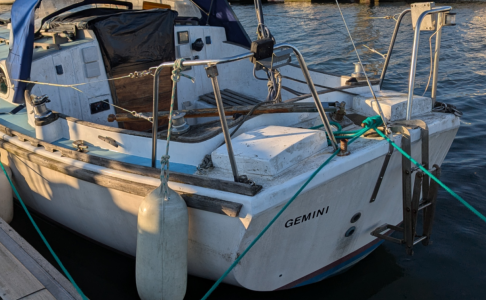
Best plan so far is on top the starboard seat, at the stern, filling in that corner, and running a 6m cable from the starboard battery in the bow.

It can't easily go inside. Eg. Above the heads = bad because exhaust and muffler must drain/leak outside, and they would be gurgling when heeled starboard. (The muffler has drain holes for condensation, which also leak fumes).

Under starboard seat = exhaust outlet would be on the waterline at the stern. (These heaters can go wrong if blocked).

On top of starboard seat gives an easy exhaust route, going downhill and out the back. But I am worried about it touching other pipes.

Am beginner, learning quick. Give me your hard-won advice 😅

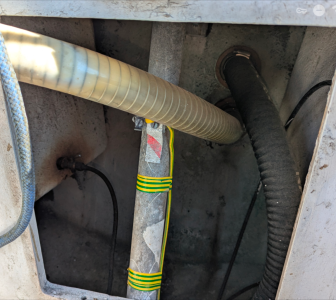
Photos for your perusal. The pipes are inside the stern looking aft - yellow is the hand pump, grey is the engine exhaust. Left (starbd) is diesel tank locker and fuel line. Right (port) is the butane cylinder locker. The heater exhaust would pass through here and out.
 

Attachments

  • Screenshot_20251105-005134.png
    Screenshot_20251105-005134.png
    1.3 MB · Views: 38
  • Screenshot_20251105-023034.png
    Screenshot_20251105-023034.png
    1.6 MB · Views: 34
Typically (not specific to your boat) people throw away all the exhaust components that come with the cheap heaters and install a sealed marine grade exhaust using an appropriate through hull which separates the grp from the hot bits. I think most people would not be comfortable with the idea of your exhaust and butane cylinder sharing the same space.
 
Probably completely irrelvant for your size of boat, but I got a standalone diesel heater already fitted in a case (just over 70 quid on Amazon when I looked just now) for my leisure 17 and made up a washboard with an inlet vent and I just run it sitting in the cockpit. The "installation" consisted of screwing a CO alarm inside the boat. I only really use the heater in April and early May (my boat always comes out by October as my mooring wouldn't be safe over winter). I leave it in the cabin in the early part of the year when I'm not using it and take it back home as soon as things start to warm up enough. It hooks onto my battery via croc clips (I added a fuse to the power connection). Just a thought if you struggle too much to find a good place to fit it permanantly. It all works well enough, although a permanant installation would I'm sure be nicer if there was space.
 
Last edited:
Probably completely irrelvant for your size of boat, but I got a standalone diesel heater already fitted in a case (just over 70 quid on Amazon when I looked just now) for my leisure 17 and made up a washboard with an inlet vent and I just run it sitting in the cockpit. The "installation" consisted of screwing a CO alarm inside the boat. I only really use the heater in April and early May (my boat always comes out by October as my mooring wouldn't be safe over winter). I leave it in the cabin in the early part of the year when I'm not using it and take it back home as soon as things start to warm up enough. It hooks onto my battery via croc clips (I added a fuse to the power connection). Just a thought if you struggle too much to find a good place to fit it permanantly. It all works well enough, although a permanant installation would I'm sure be nicer if there was space.
Thanks, I've considered standing it in the cockpit. But my AI says the whole cockpit/cabin is a well for exhaust fumes, which could be bad news while you sleep. Where do you send the exhaust, and how do you support it without scorching things?
 
I suggest you fit it where is has an easy downward exit for the exhaust, use a sealed muffler - not the original and get a proper exhaust outlet for the stern. Insulate the exhaust with proper exhaust wrapping and stainless jubilee clips. Insulate all hot air outlets with correct insulation. I used Eberspacher/Webasto exhaust tubing and exhaust outlet. Scrap the clips supplied, use proper all stainless Jubilee clips or equivalent. Sealed muffler you can get from ebay. On my installation I spent more on the superior items than on the original heater.
 
Typically (not specific to your boat) people throw away all the exhaust components that come with the cheap heaters and install a sealed marine grade exhaust using an appropriate through hull which separates the grp from the hot bits. I think most people would not be comfortable with the idea of your exhaust and butane cylinder sharing the same space.
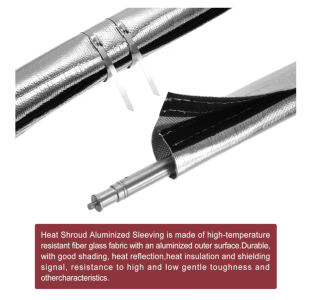
I am looking at heat wraps for the exhaust pipe, and outer metal shields around it, with plenty of air circulating. That should keep all the heat within 5-10cm. The cost is adding up, but it has to go somewhere.
 

Attachments

  • Welding bkanket (6).png
    Welding bkanket (6).png
    1.2 MB · Views: 29
  • Screenshot_20251105-090056.png
    Screenshot_20251105-090056.png
    583.2 KB · Views: 25
I suggest you fit it where is has an easy downward exit for the exhaust, use a sealed muffler - not the original and get a proper exhaust outlet for the stern. Insulate the exhaust with proper exhaust wrapping and stainless jubilee clips. Insulate all hot air outlets with correct insulation. I used Eberspacher/Webasto exhaust tubing and exhaust outlet. Scrap the clips supplied, use proper all stainless Jubilee clips or equivalent. Sealed muffler you can get from ebay. On my installation I spent more on the superior items than on the original heater.
My costs are coming to triple the heater price! I am upgrading various bits, running a long cable with fuse and switch (£100 for that), getting a double wall exhaust and double layer wrap for it, to bring the temperature down; and heat shields through the stern. Then clips, thru-hull, and a box. Everything stainless, 304 or 316, hunting for bargains.

So, I *think* this is the best place, on the seat. Exhaust goes downhill. Where do people commonly put it?
 
Before making any decisions it is worth double checking the manufacturer's recommendations for routing the fuel pipe/pump location, exhaust routing/outlet position, warm air out ducting route and supply air in.
IIRC the fuel pump should be below the furnace, the exhaust should have a swan neck with the outlet about level with the furnace or higher, All fittings etc have a "score" and the route should not exceed the max score, supply air is needed, possibly by natural air into a locker. It's some time since I did one so memory is a bit faded.

BTW, where are you located?
 
Thanks, I've considered standing it in the cockpit. But my AI says the whole cockpit/cabin is a well for exhaust fumes, which could be bad news while you sleep. Where do you send the exhaust, and how do you support it without scorching things?
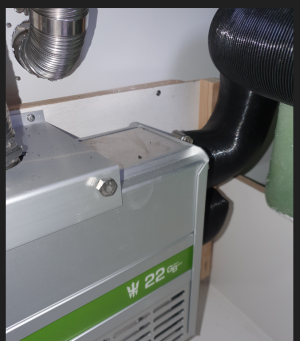
Yes, valid concerns... I put feet under the heater to raise it some inches and folded the flexible exhaust hose that comes out the bottom round and up the side of the case, then put a steel bracket on the side at the top where I fitted the silencer so that's where the exhaust gas comes out. Lifiting it and feeling underneath, the cockpit doesn't even feel slightly warm,. I lay it on the seats in the cockpit rather than at the bottom, so the exhaust is probably close to the top of the cockpit (its a pretty small boat :-) ) , and CO is very slightly lighter than air. The height of the duct into the boat works out better that way anyway.

It has occurred to me before that there are risks.... especially if any of the exhaust can ever get into the vent that sucks air in through the heat exchanger to the cabin. So to an extent I'm trusting the CO alarm - it has never detected anything - but on this occasion I agree with AI. Then fire risk is another thing that's gone through my mind, although arguably a fire starting in a locker is as bad/worse.

There are youtube videos of people running Chinaspachers inside garages etc... wouldn't be for me. Even if carbon monoxide doesn't get you, it will stink of diesel fumes especially as it starts up. I'd rather be cold in my garage (and I have electricity/a fan heater there anyway!).
 
I have fitted a diesel heater in my 25ft yacht. I faced similar challenges to you, so some of my ideas may be of help. The heater is under the cockpit seat at the stern.
It is only intended for use while not underway so I was able to simplify the design and keep the costs down.
The exhaust is short and falls at a very low gradient to a twin wall outlet in the transom. The exhaust does not rise at any point so drains to the outlet.
The outlet in the stern is about 400mm above the waterline. When the heater is not in use the outlet has a secure bung.
I have kept the muffler supplied with the heater but not mounted it inside the boat. If I am in a noise sensitive location, the muffler is mounted in the exhaust outlet, outside the boat.
I used the exhaust pipe supplied with the heater as it appeared to be of adequate quality, wrapped it in fibreglass exhaust wrap, covered by silicone tape to contain the loose fibres.
The space where the heater is mounted was part of a cockpit locker, the hatch of which is located further forward in the seat.
Heater, pump, filter, exhaust, etc, are mounted on a panel which is in slide rails so that the whole assembly can be removed via the hatch once the exhaust is disconnected from the transom, the hot air supply duct is disconnected from the heater, and the diesel line is disconnected via a quick connect fitting.
The heater space is separated from the remaining cockpit locker space by a removable panel.
 
Mac 26 Mk1 1969 project well under way, adding a diesel heater for the winter 🥶🥶

Where have you / would you / probably think it should go? - And how would you route the exhaust, support it, heatproof the grp vs 200⁰C, etc?

Best plan so far is on top the starboard seat, at the stern, filling in that corner, and running a 6m cable from the starboard battery in the bow.

It can't easily go inside. Eg. Above the heads = bad because exhaust and muffler must drain/leak outside, and they would be gurgling when heeled starboard. (The muffler has drain holes for condensation, which also leak fumes).

Under starboard seat = exhaust outlet would be on the waterline at the stern. (These heaters can go wrong if blocked).

On top of starboard seat gives an easy exhaust route, going downhill and out the back. But I am worried about it touching other pipes.

Am beginner, learning quick. Give me your hard-won advice 😅

Photos for your perusal. The pipes are inside the stern looking aft - yellow is the hand pump, grey is the engine exhaust. Left (starbd) is diesel tank locker and fuel line. Right (port) is the butane cylinder locker. The heater exhaust would pass through here and out.
Don't ignore the route of the warm air outlet. With Autoterm heaters the ducting needs to be straight for 90 cm (from memory) Otherwise the heater soon shuts down on overheat and will never run properly.
 
Typically (not specific to your boat) people throw away all the exhaust components that come with the cheap heaters and install a sealed marine grade exhaust using an appropriate through hull which separates the grp from the hot bits. I think most people would not be comfortable with the idea of your exhaust and butane cylinder sharing the same space.
Don't ignore the route of the warm air outlet. With Autoterm heaters the ducting needs to be straight for 90 cm (from memory) Otherwise the heater soon shuts down on overheat and will never run properly.
Thanks for the note. One of the manuals assigns points for each bend or length. So the plan is to give it a wide smooth channel, either behind the seat back or under it, going straight through the cabin wall to a grille. It is a HCalory upgraded 2025 model, so hopefully will be more tolerant -?
 
Typically (not specific to your boat) people throw away all the exhaust components that come with the cheap heaters and install a sealed marine grade exhaust using an appropriate through hull which separates the grp from the hot bits. I think most people would not be comfortable with the idea of your exhaust and butane cylinder sharing the same space.
Don't ignore the route of the warm air outlet. With Autoterm heaters the ducting needs to be straight for 90 cm (from memory) Otherwise the heater soon shuts down on overheat and will never run properly.

Before making any decisions it is worth double checking the manufacturer's recommendations for routing the fuel pipe/pump location, exhaust routing/outlet position, warm air out ducting route and supply air in.
IIRC the fuel pump should be below the furnace, the exhaust should have a swan neck with the outlet about level with the furnace or higher, All fittings etc have a "score" and the route should not exceed the max score, supply air is needed, possibly by natural air into a locker. It's some time since I did one so memory is a bit faded.

BTW, where are you located?
South England coast.
I've seen the gooseneck thing, and I think it exists to get the pipe high enough above the water, to resist flooding - while routing the air duct low around the rooms - in bigger boats than mine. That creates a low point which needs a drain. I am trying to keep it simple, with a downhill run down from the heater. Am newbie, so simple wins.
 
It is a HCalory upgraded 2025 model, so hopefully will be more tolerant -?
I don't know that device but the straight ducting requirement is a function of thermal output, nothing to do with age. If you put a significant bend immediately after the heater there is strong chance it will not work well.
 
I put one into my Tomahawk 25. First thing i did was throw away all the exhaust, clips, screws, etc that came with it and bought decent parts. Probably cost more than the heater did, which was a gift, but safety first.

I actually fitted the heater itself into the engine bay and as such, the run for the exhaust to go through the transom and the warm air into the cabin, eere both straight runs.

Works a treat

Andy
 
Thanks, I've considered standing it in the cockpit. But my AI says the whole cockpit/cabin is a well for exhaust fumes, which could be bad news while you sleep. Where do you send the exhaust, and how do you support it without scorching things?
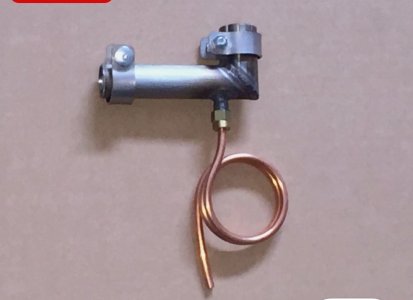
Exhaust should be a s/s somewhat flexible tube with a drain circuit like the pic. Do not use the type meant for trucks/vans, or it'll fill your boat with exhaust and kill you.


Exhaust should be covered in a heat proof sheath to stop it melting stuff nearby. Still needs sensible routing so the exhaust isn't in contact with anything.

There are special diesel heater through hull fittings. Fit high up on the transom.

Fit a Co2 Detector next to where you sleep in the cabin.
 

Attachments

  • Screenshot_20251105_161912.jpg
    Screenshot_20251105_161912.jpg
    59.8 KB · Views: 23
Exhaust should be a s/s somewhat flexible tube with a drain circuit like the pic. Do not use the type meant for trucks/vans, or it'll fill your boat with exhaust and kill you.


Exhaust should be covered in a heat proof sheath to stop it melting stuff nearby. Still needs sensible routing so the exhaust isn't in contact with anything.

There are special diesel heater through hull fittings. Fit high up on the transom.

Fit a Co2 Detector next to where you sleep in the cabin.
My exhaust is all flex tube as supplied with an Eberspacher, and insulated. It goes down from the heater, bends up through 180°, to one of the proper double skinned exhaust fittings. There is no drain, and it's been like that for more than 30 years.
 
Top