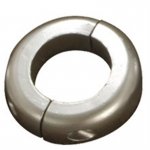
PSS shaft seal

THAT's a good answer.... ;)

As posted in post #16

PSS do have a seal with a locking ring in their PRO range.

03-200-300_-_003_280x@2x.jpg


The issue with the grub screw is that it is stainless steel possible 316 fitted into a stainless shaft the grub screw is not hard enough to bite into the shaft to give a positive location. The cup point grub screws should be hardened steel fitted with a water proof grease to prevent rusting.

The other was is to dimple the shaft and fit a dog point grub screw to positively locate the rotor to the shaft.
 
Exactly VYV so many forget its there and leave the maintenance period garb too long. Mine was my fault which will never happen again.
It took five minutes to fix and the anode idea is a good failsafe but I’ve not had any problems since he first time.
Service and maintenance is the key to everything
 
A couple of years ago in a similar thread I posted a list of builders who fit PSS as original equipment. It was two full pages of A4, closely typed, one builder per line.

I have just checked my records and was quite surprised to find that mine was installed (by me) in 2009. I had one problem with it when the stainless steel rotor suffered contact staining/crevice corrosion, probably due to being left salty and wet. I have always flushed it at end of season since.

Otherwise it is as bought, same bellows, carbon ring and everything else. I check it at start and end of every season and so far all is well.
 
There are no 'known problems' if they are installed and maintained correctly.
This seems to indicate the contrary
"After a near-sinking following a failure of the PSS seal setup ( and multiple others discovered ) I won't sail with one that doesn't have a 'failsafe' Jubilee clip or two preventing the rotor component from sliding forward and letting the ocean in. The grubscrew arrangement is inadequate.

It's a cheap and easy fix. It's what the PSS people insist on for all their commercial products. Why they haven't responded to the many 'failures in service' of their yottie product demands an explanation."
The product requires extra bits, jubilee clip etc to make it safe.
 
This reminds me a little of an apocryphal but true story of an RAF squadron leader who struggled to bring back a crippled Canberra with hydraulic failure and restricted flying controls, who finally 'lost it' close to the airfield, and ejected. The Fire Section Landrover crew brought him, his parachute and his ejector seat - all muddy, grass stained and bedraggled - back to the squadron's flight-line Engineering Office, where he had to make the necessary entry in the aircraft's engineering log book - the Form 700.

Addressing himself to the Warrant Officer in charge, and holding his composure and the still-pumping adrenalin together, he announced "I'm afraid that bloody 'plane is broken, 'spanners'. You'll need to get another one."

The WO took a deep breath, drew himself up to his full 5'5", and declared "Well, sir, it was perfectly all right when it left the hanger this morning. Must have been something you did to it, sir...."

:rolleyes:
 
This seems to indicate the contrary
"After a near-sinking following a failure of the PSS seal setup ( and multiple others discovered ) I won't sail with one that doesn't have a 'failsafe' Jubilee clip or two preventing the rotor component from sliding forward and letting the ocean in. The grubscrew arrangement is inadequate.

It's a cheap and easy fix. It's what the PSS people insist on for all their commercial products. Why they haven't responded to the many 'failures in service' of their yottie product demands an explanation."
The product requires extra bits, jubilee clip etc to make it safe.

My experience is that the grub screw fixing is perfectly adequate. If people cannot judge how tightly they should install them using the hex key provided they should ask somebody who can. My rotor has been removed from the shaft and replaced twice with no issues at all. I do not have a hose clip or any other device ahead of it.

I cannot understand why there should be any problem if the screws are driven home. The pressure is negligible, just a few inches head of water. The shaft is soft in most cases and will comfortably accommodate a well driven grub screw. The exact same technique works perfectly well for cutless bearings that quite probably need to take higher loadings.
 
Last edited:
.
Why does anyone use these things when they have been proven to sink boats if they fail catastrophically? (One incident known to me personally).

There are far safer alternatives (eg Volvo seal) which do not have the potential for catastrophic failure.

- W
 
.
Why does anyone use these things when they have been proven to sink boats if they fail catastrophically? (One incident known to me personally).

There are far safer alternatives (eg Volvo seal) which do not have the potential for catastrophic failure.

- W

Well, one reason is that a Volvo needs a shaft in perfect condition, not always the case. The need for burping rules it out for many, although after 20 years they have finally understood that a vent overcomes this fault.
 
.
Why does anyone use these things when they have been proven to sink boats if they fail catastrophically? (One incident known to me personally).

There are far safer alternatives (eg Volvo seal) which do not have the potential for catastrophic failure.

- W


"Catastrophic Failure."

I have been anticipating this. Always a pleasure to see the old favourites ;-)
 
Dunno about 'catastrophic' but when it happened to us we were just a tad narked!

I'm very aware that, had we not turned right out of Plymouth and instead headed south as we'd intended, we'd have discovered the consequences about 50 miles south. At night. That could have spoiled our whole day.

As it was, it cost 'Pants' about £20,000 in replacing water-damaged equipment and labour costs. Their surveyor knew exactly what to look for.

I looked hard into this issue. We were far from being the only peeps to encounter this difficulty.... A passenger launch that plies the waters around Scilly was in the yard for the same problem. I found a list of people who had discovered something similar. Their complaints to the manufacturer and the European agent went round in circles for some years, so they knew there was 'something of a problem', but they didn't exhibit the same concern for the customers as some other responsible US businesses.

It seems to me crazy, as the effective solution - once known - is about as 'cheap as chips' and detailed in posts above. If anyone bothered to trace it back, the decision to 'keep schtum and say nothing' could probably be traced back to one management-type in a large office in Washington State..... and we know about those types.

I wrote the story up for PBO maagazine, encouraged by the then editor. There was the stated intention to publish it - then it was spiked. Probably no connection whatsoever, but it emerged that the mag's Boat Refurb project sported a brand new PSS Seal at the next boat show.

I remain unimpressed. For a device that claims to 'keep a dry bilge' and WAS sold to my friend and many others as 'no maintenance', it failed unsafe and many hundreds of litres of ocean came spurting in. I'm still unclear how I would stop that if it happened again, or if the bellows split..... as has happened to others. There's only so much you can do with wooden bungs and self-amalgamating tape.....

Me, I like to keep the ocean on the outside.
 
.
Why does anyone use these things when they have been proven to sink boats if they fail catastrophically? (One incident known to me personally).

There are far safer alternatives (eg Volvo seal) which do not have the potential for catastrophic failure.

- W
Well my own experience is the complete opposite having nearly sunk my first powerboat when the Volvo 'Blackjack' seal failed. Yet the 15+ year old PSS seals on my Turbo 36 were still completely dry despite the sealing faces being of an appalling appearance.
 

Other threads that may be of interest

Top