
lustyd
Well-Known Member
Mine just have spliced loops, no rings at all. I don’t faff with them much though, just set and forget.


Did it come with an anchor pre spliced?When I made up lazyjacks for the cruising main last year I just went into the chandlers and bought the cheapest string they had.
It never occurred to me to worry about what it was!

No....Did it come with an anchor pre spliced?

Now that’s a good idea, it’ll keep me entertained for a couple of hours.You could make a scale drawing (or do some nifty trigonometry!).

Ahem, yes, quite so.Now that’s a good idea, it’ll keep me entertained for a couple of hours.
Alternatively, I could always measure the old one?
View attachment 189227

Confess that I’ve never put an eye splice in a coreless braid. Sounds like something to learn over a dull winters evening.Jimmy Green have the 6mm too. The great thing about this stuff is that, as Lusty has shown, you can splice it as easily as dyneema, making your lazyjacks look proper professional, and snag free. 6mm, even spliced, is easily strong enough to hold up our fully battened 12 metre luff square top sail, it is Heavy… capital H. It has not so far broken if I swing on the boom either.

I did this too. Is there a reason for the particular line type? E.g. does it chafe less or catch less easily as the sail goes up?When I made up lazyjacks for the cruising main last year I just went into the chandlers and bought the cheapest string they had.
It never occurred to me to worry about what it was!
Bit of bent wire for a one off to make a D splicer. But I would have thought that even a limited rigging set would be in every sailor's kitConfess that I’ve never put an eye splice in a coreless braid. Sounds like something to learn over a dull winters evening.
My search engine skills have yet to find an instructional YouTube video. Any help?
For this 6mm coreless line, what size fid should I buy?
Many thanks.
It is a pretty slippery rope yes but also UV resistant and cheap as well as easy to splice. Seems quite kind to the sails too whereas I’ve seen some braided lines cut into sails quite harshly. It’s not a complex requirement but this stuff does seem well suited to it.I did this too. Is there a reason for the particular line type? E.g. does it chafe less or catch less easily as the sail goes up?

Is this really any different from polyester double braid with the core removed? I bet lunch it's the same thing. DB is de-cored for furler lines (so it will lie flat) all the time, so using the cover alone is common practice. The core has no separate use, so you pitch it.

If you don’t have a fid in your toolkit that will certainly work. But if you have, it takes 2 mins to put a neat, strong eye splice in.A neat solution is to whip a loop & cover it with a length of 10mm heat shrink tubing.That way you can get a nice small eye on to a pulley or ring.
But then you have to join the eyesplice to the pulley if you do not do it in situe. That means a big eye to go over the pulley & when pulled tight it forms a "lump". If you do a brummel splice around an eye direct, then you could end up pulling 20 metres of line through the splice. Alternatively, shackle or pin the pulley to the loop which creates wear points.If you don’t have a fid in your toolkit that will certainly work. But if you have, it takes 2 mins to put a neat, strong eye splice in.
My lazy jacks comprise 4 lines (per side). The one that has chafed/broken is the longest of the 4 and has an eye splice on both ends. Other lines pass through these eyes, there are no blocks on my as-fitted-from-new arrangement.If you don’t have a fid in your toolkit that will certainly work. But if you have, it takes 2 mins to put a neat, strong eye splice in.
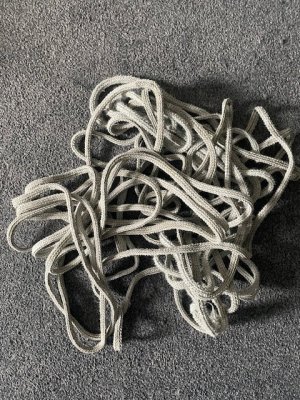
If it's the same as mine - and it looks like it is - then it's core without outer and identical to dyneema as I said above. Use dyneema splices, I used this oneThe line is braid without a core and I’ve yet to find a video to show me how to put in an eye splice in 2 mins. Any suggestions?

I remove the inner on my furling line, but as far back as the cleat which is about 8m. I just milk? the outer back from the inner, cut the inner so that it is tapered and then pull / work the outer fully back.Is it possible/easy to remove several metres of core - for furling line purposes - while leaving the core in at the other end of the line?
I found instructions online about teasing the core out of the outer at an intermediate point, but imagine the friction between core and outer could severely limit the length of core you could get out that way.
I'd never come across that approach to furling line, could do with thinner (or better laying on the drum) line at the furling drum end on my boat (it sometimes bunches up overfilling and jamming the drum), but want to have a thicker line at the control end for grip and comfort of handling. I'd thought I'd have to splice a thinner line to a thicker one, but perhaps I could get half(ish) of the length of the core out of the current line (which is 6mm or 8mm)?
Very helpful, thank you. I need to put an eye splice on both ends. Would the first eye pass through the centre of the braid?If it's the same as mine - and it looks like it is - then it's core without outer and identical to dyneema as I said above. Use dyneema splices, I used this one
I made a splice in both ends of mine. You don’t need to pass the whole rope through with this one.Very helpful, thank you. I need to put an eye splice on both ends. Would the first eye pass through the centre of the braid?