Propagation distance of AIS.

Technically VHF based Frequency is 'visible' horizon. Visible Horizon - that is the direct line from antenna to horizon ... not you the 'eyeball on deck' !
But with low power - that distance reduces significantly not only as a result of the power radiated - but the conditions and other RF prevailing.

Its not a simple calculation such as Height of Eye ........ too many other factors.

I regard it as : If I can see the other vessel, and my AIS antenna has clear line to it - then I expect my AIS to be rec'd by them. (I have a 2W system). My antenna is pushpit mounted - but soon to be sorted at masthead. My visible horizon at present is technically about 5nm

Ship to Ship on A class - its generally regarded as 20nm plus - based on Horizon distance ... with up to reception at 100nm where a shore station may be seriously elevated.

Class B at 2W is generally not expected to exceed 10nm for even a high elevation antenna - its all about horizon distance vs Tx power. Class B+ at 5W should give a reasonable increase in Tx range - possibly out to that 20nm depending on horizon distance again

Of course there will be exceptions and pick up at greater distances. VHF radio has been "bounced" and heard over 1000's of miles - but its not the norm.

If you want to calculate the Visible Horizon .... lots of online pages do it ... such as :

Distance to the Horizon Calculator

I am sure someone is now going to come along and give all sorts of stuff ... but basically - if you can see on a clear day the other vessel - its most likely if he receives AIS - he has your transmission.
 
Standard class b through a Raymarine active splitter and antenna about 16m above sea level.

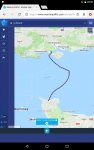
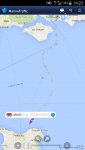
We're picked up by MarineTraffic all the way across the channel..

FB_IMG_1638224455129.jpg
 
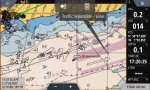
Unfortunately we also seem to receive way too much, including ships sixty miles away. This used to slow down the old chart plotter as it tried to cope with displaying so many other ships and yachts.

Perhaps worthwhile checking / replacing antenna cable if you think yours is not 100%.
 
We regularly come across boats with AIS that doesn't transmit more than a mile or two. I suspect this is down to bad connections somewhere on their system. We had this a few years ago. A corroded connection on the dedicated masthead antenna
 
I think this was the view on the plotter whilst moored in Southsea Marina many years ago.. There was no option to reduce clutter and it was having to display everything within the Solent as well as multiple ships across the shipping lanes. The cursor point is at 60 miles distance.

20210815_234232.jpg

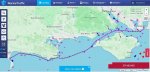
Wish I could find the screenshot showing vessels near Boulogne and one in the Thames estuary.
 
We regularly come across boats with AIS that doesn't transmit more than a mile or two. I suspect this is down to bad connections somewhere on their system. We had this a few years ago. A corroded connection on the dedicated masthead antenna

Possibly some of those like mine - antenna is on aft rail - not masthead. Then you are seriously range limited ...
 
Cluttered screen ... its why I swap from AIS on Chart screen to AIS own screen at times depending on where I am and also the range setting I'm using.

Its similar to when I did my early Radar courses for my Licences ....

In busy areas - choose short range display to get rid of the distance targets .. then work the close ones as they come ... (at intervals swapping to longer range as a check of what more is on its way !)
 
As said above, theoretically VHF line of sight between antennas. However, on a number of occasions in the western approaches I could see foreign fishing vessels visually and on radar when about five to ten miles away but they only showed on AIS when within one or two miles.
 
Possibly some of those like mine - antenna is on aft rail - not masthead. Then you are seriously range limited ...
Mine is on a sailboard boom adapted to a mast on the aft rail so about 6 ft above the deck. I have picked up boats over 80 miles away, although incomplete info. I have been contacted by approaching ships at 10 miles range (requesting that I hold my course, or change it, ) I consider 10 miles ample. Being an extending boom I can get it another 2 feet higher, which I do in fog. In the end it really boils down to what is at the other end of the signal.
 
Possibly some of those like mine - antenna is on aft rail - not masthead. Then you are seriously range limited ...

That was something which we checked regularly and most especially just ahead of any offshore passages; we consistently got other yachts picking us up at around 10M with an antenna mounted on our solar panel arch, those with masthead antennas were visible 3-5M further, but even those with antenna mounts at pushpit rail height seemed good from 7 or 8M; the times - usually well offshore - when we enquired of a commercial vessel, they usually reported having seen us from 5 or more miles further away, no doubt due to their own greater antenna height? As noted by others, transmission is 'line of sight' and even in big seas, there are times when you're sat at the top of the swell, I suspect that once you've been 'picked-up' the receiving station perhaps holds on to your position for those periods when you're down in the trough?
 
Mine is on a sailboard boom adapted to a mast on the aft rail so about 6 ft above the deck. I have picked up boats over 80 miles away, although incomplete info. I have been contacted by approaching ships at 10 miles range (requesting that I hold my course, or change it, ) I consider 10 miles ample. Being an extending boom I can get it another 2 feet higher, which I do in fog. In the end it really boils down to what is at the other end of the signal.
We pick up many yachts presumably with class B AIS normally at circa 6-8nm then occasionally some that only transmit a mile or two. Even picked up one showing it was going the other way and one showing it was going 90 Deg to its actual direction! I think being able to show up on a big ships AIS at 6nm is fairly useful. Not sure how much ability they would have to turn if you only show up a mile or two away. Whether the poor range on some installations is lack of hieght or poor transmission power or both can't really be determined but it makes the AIS pretty useless in some circumstances
 
Top