Prop shaft earthing

AndrewDu

Member
Joined
17 Aug 2013
Messages
24
Visit site
I have a slightly pinkified propellor. There is no exposed shaft to mount an anode on, and so far I've relied on connection to the hull anode via the gearbox and engine. Clearly this is inadequate. What to do? I have found a really expensive MG Duff shaft earthing thingy (MGDUFF - Shaft Bonding Instructions) but how on earth are you supposed to mount it? Has anyone used this thing (how?) or does anyone know of a cheaper and workable alternative? Web searches seem to show up only things for massive ships or American items.
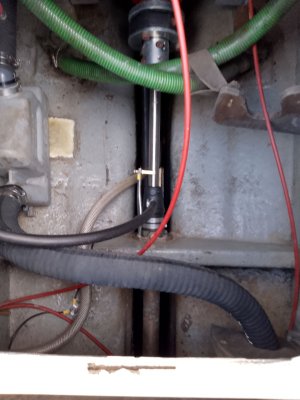
 
That works very well but fitting depends on the layout of the inboard end of your stern tube. On mine see photo the rod is attached to the bolt holding the stern tube housing. I used this device because a Flexible Bullflex coupling is used between the gearbox and shaft. However before you go down that route check the continuity between the anode and the propeller. You don't say what sort of coupling you have, but it it is solid you should get a good connection through the gearbox. If it is flexible then you need to bridge across the flexible part. It could also be just bad connections.
 

Attachments

  • IMG_20231016_165203.jpg
    IMG_20231016_165203.jpg
    277.9 KB · Views: 32
That works very well but fitting depends on the layout of the inboard end of your stern tube. On mine see photo the rod is attached to the bolt holding the stern tube housing. I used this device because a Flexible Bullflex coupling is used between the gearbox and shaft. However before you go down that route check the continuity between the anode and the propeller. You don't say what sort of coupling you have, but it it is solid you should get a good connection through the gearbox. If it is flexible then you need to bridge across the flexible part. It could also be just bad connections.
Presumably if you have consistent continuity between the anode and propshaft (via gearbox etc) then the anode will protect the propellor?
 
Unfortunately an anode offers very limited protection against dezincification. The beta phase, which is the one lost in dezincification, has a high zinc concentration, with a galvanic potential very close to that of the anode, whether zinc or aluminium.
 
I have a slightly pinkified propellor. There is no exposed shaft to mount an anode on, and so far I've relied on connection to the hull anode via the gearbox and engine. Clearly this is inadequate.
If you put a meter between your hull anode and prop do you get a good contact - ie low resistance? If it looks good then fitting an electro eliminator will not improve it. However, if you don't, then why not? Do you have a flexible coupling for example?
 
Presumably if you have consistent continuity between the anode and propshaft (via gearbox etc) then the anode will protect the propellor?
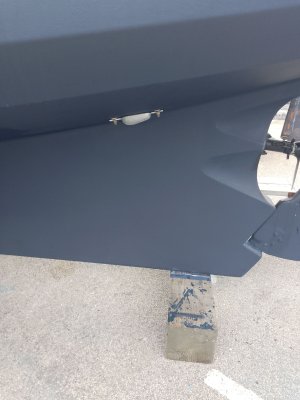
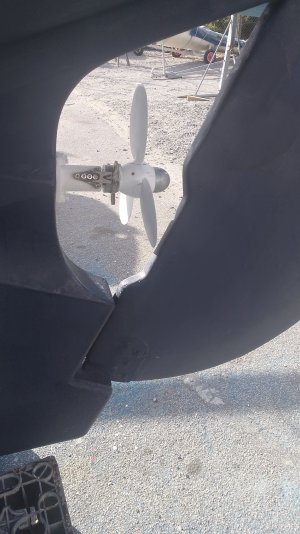
Yes, that is how it works, but many feathering and folding props like my Featherstream also have mixed metals, bronze and stainless in the geared mechanism so have additional anodes on the body of the prop. I theory this should be enough, For example on saildrives where there is no hull anode and some like the Flexofold I had on my Bavaria do not have an anode at all. With the GH I initially relied just on the prop anode but it lasted less than a year, hence adding the hull anode and painting the propeller. I reported at length here when I did it. Effectively the hull anode is there as a backup because the one on the prop goes first being closer. There was some sign of activity on the hull anode after a tear or so and the prop anode was less than half gone. Fitted a new one which is about 30% greater mass than the original and think it should last 2 years or more. Photos show the hull anode when originally fitted and the Veloxed prop done last September. I would have liked the anode a bit closer but there is a fuel tank above so this was as far back as we could get it.
 

Attachments

  • IMG_20231023_135230.jpg
    IMG_20231023_135230.jpg
    356.1 KB · Views: 20
  • IMG_20250715_180159.jpg
    IMG_20250715_180159.jpg
    565.4 KB · Views: 20
Unfortunately an anode offers very limited protection against dezincification. The beta phase, which is the one lost in dezincification, has a high zinc concentration, with a galvanic potential very close to that of the anode, whether zinc or aluminium.
Interesting! Thanks for the link, lots of good stuff there. If anodes are not the best answer, what is?
 
Interesting! Thanks for the link, lots of good stuff there. If anodes are not the best answer, what is?
Paint is good protection. I use Hammerite Special Metals primer with Velox antifouling on my prop and P-bracket. I find this doubles the life of anodes by reducing the size of the cathode. Propeller antifouling with Velox
 
Yes this is a possible solution. How are these anodes fixed?
You need a special nut onto which the anode is attached like this google.com/search?q=Propeller+nut+anodes&rlz=1C1VDKB_en-GBGB1067GB1067&oq=Propeller+nut+anodes&gs_lcrp=EgZjaHJvbWUyBggAEEUYOTIJCAEQABgNGIAEMggIAhAAGBYYHjINCAMQABiGAxiABBiKBTINCAQQABiGAxiABBiKBTINCAUQABiGAxiABBiKBTIKCAYQABiABBiiBDIKCAcQABiABBiiBNIBCDc3ODNqMGo3qAIIsAIB8QV8wiwE8jJBFA&sourceid=chrome&ie=UTF-8#fpstate=ive&vld=cid:b98bc74f,vid:TumToHvVl84,st:0 (apologies for the long link!)

They are commonly used on Beneteau and Jeanneau shaft drive boats to avoid using a hull anode. However they are relatively small in mass and tend not to last long. You don't say what boat you have as for most boats a properly installed and locate hull anode is usually more than adequate to protect the propeller if it is a typical fixed blade prop. Folding and feathering props are different and need more protection. As Vyv says and I explained in more detail in post#9 a combination of painting to reduce exposed surface area and properly located anode is more than enough to get more than a year's life out of the anode.

You don't say anything about your existing anode or how long it lasts. If little is happening with it and you prop is showing pink then it is likely the connection is poor. If it is disappearing quickly then you have a different problem. As I suggested earlier, first thing is to check out your existing arrangement, particularly continuity as the anode won't work without it.
 
You need a special nut onto which the anode is attached like this google.com/search?q=Propeller+nut+anodes&rlz=1C1VDKB_en-GBGB1067GB1067&oq=Propeller+nut+anodes&gs_lcrp=EgZjaHJvbWUyBggAEEUYOTIJCAEQABgNGIAEMggIAhAAGBYYHjINCAMQABiGAxiABBiKBTINCAQQABiGAxiABBiKBTINCAUQABiGAxiABBiKBTIKCAYQABiABBiiBDIKCAcQABiABBiiBNIBCDc3ODNqMGo3qAIIsAIB8QV8wiwE8jJBFA&sourceid=chrome&ie=UTF-8#fpstate=ive&vld=cid:b98bc74f,vid:TumToHvVl84,st:0 (apologies for the long link!)

They are commonly used on Beneteau and Jeanneau shaft drive boats to avoid using a hull anode. However they are relatively small in mass and tend not to last long. You don't say what boat you have as for most boats a properly installed and locate hull anode is usually more than adequate to protect the propeller if it is a typical fixed blade prop. Folding and feathering props are different and need more protection. As Vyv says and I explained in more detail in post#9 a combination of painting to reduce exposed surface area and properly located anode is more than enough to get more than a year's life out of the anode.

You don't say anything about your existing anode or how long it lasts. If little is happening with it and you prop is showing pink then it is likely the connection is poor. If it is disappearing quickly then you have a different problem. As I suggested earlier, first thing is to check out your existing arrangement, particularly continuity as the anode won't work without it.
Thanks for this detail. Hull anode (a large pear-shaped job) is eroding but very slowly - it's several years old. I suspect as you say a poor connection through the engine - I have noticed there's no connection at all when the gearbox is "in neutral" which is how you leave it if you don't remember to leave it in gear! I think based on all these replies I will apply a careful paint job as per Vyv's suggestions, and try to remember to leave the drive in gear. The boat is an Elizabethan 30 which I keep on a mooring about three hours' drive away so I can't do anything quickly. It's currently out of the water for the winter, relaunching some time in April.
 
It should not make any difference in or out of gear. The electrical path is through the gearbox, cable usually attached to one of the bell housing bolts, to the coupling and hence the shaft. The weak spot as suggested earlier is across the coupling if it is the flexible type. If there is little activity on the anode it is either a poor path or the anode is too far away from the propeller. It should be less than 1m away and in line of sight.
 
It should not make any difference in or out of gear. The electrical path is through the gearbox, cable usually attached to one of the bell housing bolts, to the coupling and hence the shaft. The weak spot as suggested earlier is across the coupling if it is the flexible type. If there is little activity on the anode it is either a poor path or the anode is too far away from the propeller. It should be less than 1m away and in line of sight.
I agree about in gear/out of gear; I think I discovered this by measurement, but I may have mis-remembered - I'll check again next time I am there. There is a flexible coupling, but it is bridged with a wire braid - I guess I had better make sure this is clean and well-connected. The anode is more than 1m from the prop, but probably not much more. My plan now is to make sure the path from prop shaft to engine to anode is all good and connections clean. Then a paint job as mentioned before. Again thanks for the helpful responses.
 
Top