Prop Cavitation

Cavitation is a LOW pressure thing .Normally occurs on the back side which is low .It can occur on the front ( shaft side ) but it’s not as common .
As the pressure lowered the water boils and the bubbles of gas implode and the released energy takes chunks out the metal surface .
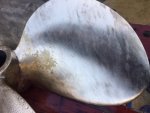
This is all mixed up/180degrees wrong The back side of the prop is hp not lp. The shaft side is lp. The bubbles implode as the water pressure goes higher not lower. That's why you get cavitation pitting on the hp side of a prop. Just like shiny picture above.
 
This is all mixed up/180degrees wrong The back side of the prop is hp not lp. The shaft side is lp. The bubbles implode as the water pressure goes higher not lower. That's why you get cavitation pitting on the hp side of a prop. Just like shiny picture above.

For the purpose of cavitation ( which this thread is about ) I stand by the WATER pressure is lower .It has to be lower for the gasses to come out of solution .No gas no cavitation.

This lowering of WATER pressure ,not to be confused with blade pressure mostly occurs on the back , rudder , stern side .
If the pitch is way out occasionally through effectively stalling Fwds in a small areas then cavitation through low pressure pockets can also occur on the front , shaft, bow end side .

Of course as the pics by the OP shows it’s not ALL the surface area , never is it’s just an area adjacent to the LOW pressure pockets .

Make s perfect sense to me .

For those it doesn’t, permit me to post this , saves typing .:).

https://www.iims.org.uk/introduction-propeller-cavitation/

Btw used cavitation in a past life , well the imploding gas bubble energy to clean/ debride in some surgical aspects .Yes too long time wise , too much power and you “ scratched “ metal surfaces .Not conducive with tissue regeneration! So to avoid it one requires to know a little about it , cavitation .

It’s a LOW pressure thing .
 
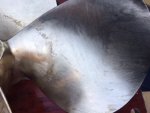
To try and clear things up here are two pictures which are each side of the same blade so you can see the cavitation damage. Both props show the same 3D5FB00F-A370-449A-B07B-CA64E8D2E159.jpeg0DB38C82-861B-4F48-BA59-8527D88C28DB.jpeg
 
Just started cleaning one of my props and noticed some cavitation damage.

Should (can?) this be repaired or is minor damage ok to just live with?

I’m not entirely sure whether this is recent or old. The props were covered in scale and there was no indication of it until it was polished. Surely if it happened recently it would have been noticeable before cleaning, as how can the metal of the blade be damaged without effecting the scale too?

Whilst I understand what cavitation is, what causes this to happen? No issues with performance of the boat or anything like that to indicate something with the props is awry.

I’ll try and attach before and after pics. View attachment 76041View attachment 76043

Cheers
D

I guess there’s some embrittlement over time of the same effected area caused by mild cavitation.Eventually the same suface pits microscopically .So you don,t really notice at previous haul outs / prop cleans .Its starts as a minor gradual thing but then once the surface eventually goes hey presto you notice it .

You say no noticeable change in performance which suggest it’s been happening from the start .That line on the recent pics in the post above this post is the low pressure area .
Probably a tad too much pitch in that part leading to too much friction , heat generation, pressure drop and cavitation.
So in theory if that was addressed you may see a slight gain in performance.

One more thing do you think there’s been any insidious increase in drag caused by weight gain, you know extra cruising stores , accumulated crap etc .

And trim angle when running any changes or problems like fighting bow high attitude.Remember the prop inclination to the oncoming water changes with hull trim angle and that might adversely effect in a localised way part of the incoming water flow , just tipping a tight pitched area over like that line , leaving the rest of the blade out of frame cavitation wise .

How many seasons have you cleaned them up ?

I often see badly trimmed FB boats running very bow high and wonder what it’s like to be those props ?
If the shaft angles are on the high side , then the water flow hitting the props is further on a angle .
Ideally it needs to be as perpendicular as it can be .
Just imagine a prop blade with variable pitch along its leading edge now increase the angle of oncoming water , keep going and sooner or later some part of thst edge is going to drop out of optimal water flow and open up the door to cavitation at that location,hence the linear appearance .
 
Last edited:
That line on the recent pics in the post above this post is the low pressure area.
Porto, I will not argue with your post #22 because that would start and endless (and useless!) semantic debate, so let's just agree to disagree. But strictly for sake of avoiding confusion, it would be nice if you would call the fwd/aft sides of the blades like anyone else in this planet do, i.e. lp/hp respectively. :encouragement:

That said, the quality/resolution of the last pics is nowhere near as good as those in the OP, so while the pattern on the HP side of the blades (which btw looks very consistent on at least two blades, base on the last pics) strikes me of cavitation, it's more difficult to judge the LP side.
As far as I can see on the first of the last two pics (LP side or RH prop), I would be more concerned about the blade root, which doesn't look in good shape - to the point of making me wonder if the prop wasn't already patched, at some stage in the past.
But as I said, the pic leaves a lot to be desired...

PS: in any case, if there's one fact that I don't think can be debated, it's that those props must be evaluated by a good prop shop.
Any half decent one, looking at the props in flesh, can give you much better recommendation than any asylum debate!
 
Last edited:
Porto, I will not argue with your post #22 because that would start and endless (and useless!) semantic debate, so let's just agree to disagree. But strictly for sake of avoiding confusion, it would be nice if you would call the fwd/aft sides of the blades like anyone else in this planet do, i.e. lp/hp respectively. :encouragement:

!

Thought I delt with that ?

From my post #22

“This lowering of WATER pressure ,not to be confused with blade pressure mostly occurs on the back , rudder , stern side .”

I thought it’s best stay away from “Hp “ high pressure wording when discussing cavitation as it’s a LOW pressure phenomenon, now that would confuse .Thats all .
You gave me the impression and to some extent JFM that it’s caused by high pressure .

Just pointing out it’s a low pressure thing , you need a lowering of the pressure , by heat normally by excessive pitch or excessive speed or both for the vapourisation bubbles to form .They are only there for fractions of a second before the surround water higher pressure as the boat move s collapses them .
It’s this energy release on calapse that causes the damage .As old ones collapse new ones form as the prop advances and so basically there’s a constant stream literally hammering away at the metal surface .

It’s irrelevant which side , but the back side , rudder side is most common , as explained in the link in post #22 .

And in subsequent post I highlighting the localised low pressure area where the line appears .
Either the pitch at that part was wrong to start with , only a bit out and the effects appeared insidiously or there been a change in boat running trim changing effectively alternating the pitch due to the change in water direction angle and that bit starts cavitation.
 
That said, the quality/resolution of the last pics is nowhere near as good as those in the OP, —————//—————-
But as I said, the pic leaves a lot to be desired...

PS: in any case, if there's one fact that I don't think can be debated, it's that those props must be evaluated by a good prop shop.
Any half decent one, looking at the props in flesh, can give you much better recommendation than any asylum debate!

Pic looks good to me ?

And re your PS is it not interesting to debate this - prop cavitation??

View attachment 76120

Here I can see the edge marked with a blue line that’s generating a lot of heat in the water as it passes .
The yellow are illustrative bubbles , large at first as max heat and LOW pressure .
As the prop advances through the water or water flows back see the blue arrow, same effect , those large bubbles start to compress as they move into higher water pressure , some will split into two , three or more smaller bubbles .
As they do, split a little energy is released compared to a total implosion.
But hang on eventually you end up with 1000 ,s more little bubbles as the prop advances running down the surface to the back edge , eventually more and more implode hammering the surface as you can see it’s more hammered as it goes towards the back edge .Theres a distinct rash .

Some will be released into the wash and “die “ there ,harmlessly some may even implode on the rudders .In which case there may we cause a rash on the rudder surface they come in contact with when they implode / die .
 
Last edited:
You gave me the impression and to some extent JFM that it’s caused by high pressure .
Very wrong impression, which I'd be curious to hear on which of my previous statements was based.
I used lp and hp strictly with reference to the blades sides, nothing else.
Now, if you prefer to call those sides fore and aft, fairenuff.
But referring to the aft blades side as low pressure is quite simply the opposite of how anyone in the industry call them.
 
Blimey PF, R U for real? That's a RH prop, forcrissake.

Unless... Hang on... did all your reasoning assume that the OP only uses his boat in reverse?
That would also explain the LP/HP side thing! :D :D :D
Nope that’s exactly why , you just confirmed it btw not to get too hung up on the Hp / Lp nomenclature.

View attachment 76121

Is the red line the leading edge or not ?
And the red marks at the bottom LHS of the ammended pic the side of the hub nearest the P bracket ?
And the blue arrow the general direction of water movement?

I don’t understand why you are getting so hung up on this ?

My eyes see a streak of cavitation a typical streak on good quality pic btw , It’s the aetiology ( apparently suddenly? ) That the interesting thing to work out .
 
I guess there’s some embrittlement over time of the same effected area caused by mild cavitation.Eventually the same suface pits microscopically .So you don,t really notice at previous haul outs / prop cleans .Its starts as a minor gradual thing but then once the surface eventually goes hey presto you notice it .

You say no noticeable change in performance which suggest it’s been happening from the start .That line on the recent pics in the post above this post is the low pressure area .
Probably a tad too much pitch in that part leading to too much friction , heat generation, pressure drop and cavitation.
So in theory if that was addressed you may see a slight gain in performance.

One more thing do you think there’s been any insidious increase in drag caused by weight gain, you know extra cruising stores , accumulated crap etc .

And trim angle when running any changes or problems like fighting bow high attitude.Remember the prop inclination to the oncoming water changes with hull trim angle and that might adversely effect in a localised way part of the incoming water flow , just tipping a tight pitched area over like that line , leaving the rest of the blade out of frame cavitation wise .

How many seasons have you cleaned them up ?

I often see badly trimmed FB boats running very bow high and wonder what it’s like to be those props ?
If the shaft angles are on the high side , then the water flow hitting the props is further on a angle .
Ideally it needs to be as perpendicular as it can be .
Just imagine a prop blade with variable pitch along its leading edge now increase the angle of oncoming water , keep going and sooner or later some part of thst edge is going to drop out of optimal water flow and open up the door to cavitation at that location,hence the linear appearance .

Cheers for the reply

I’ve let my engineer look over th props and he says the cavitation is really rather minor so it’s a case of just keeping an eye on them.

I only bought the boat a few months ago so haven’t really used it much - the most I used it was when I collected it and took her from Gosport to Dover. A steady 20knts the whole way and about 5hrs. But no extra weight at the moment.

Regarding trim angle, anyone who’s had a corniche will tell you they ride bow high even with full trim so perhaps that could be a factor?

Obviously as I’ve just purchased this is the first season I’ve cleaned them up, but the surveyor reported the props to be in good condition and free of any cavitation or corrosion which I find interesting.

As I say my engineer seems to think the cavitation is only really minor and I did try a very fine bit of wet and dry on one small part and they do rub out but I don’t think I will do that on the whole prop. Also as I think I mentioned earlier I’m wondering whether it’s old cavitation as when I took them off the boat they were covered in scale. Surely if it was caused recently there would be areas of no scale - after all how can the metal surface of the blade be damaged without removal of the scale too in the effected area?

Cheers
 
View attachment 76121

Is the red line the leading edge or not ?
And the red marks at the bottom LHS of the ammended pic the side of the hub nearest the P bracket ?
And the blue arrow the general direction of water movement?

I don’t understand why you are getting so hung up on this ?
Not getting hung up on the whole matter at all, PF - quite the opposite, since actually I'm completely losing any interest in it.
But frankly, your previous post made me laugh, because the answer to all your three questions above is no, I'm afraid.
 
Hi
Interesting post all together.
The cavitation effect is a complex thing indeed. As we know caused by disturbance having an effect going from LP to HP areas, then almost having a detonating effect.....anyway.
Is there anything a miss or assisting/causing this further up the hull ? What like are your inlets for toilets and strainers etc ? Anything hanging off or rough that might be half breaking the surface at planing speeds ?
 
Above post may be referring more to ventilation effect. Perhaps unlikely but just trying to thing of what’s in the path of the LP side of the props. I know our similar Vintage VP powered princess has shaft gland cooling, with total loss water flow exiting at the glands. Are these pipes (if fitted) in good shape and not perhaps educting air into the pipe and out the glands ? Like a Venturi effect ? Unlikely but just trying to think of causes. Perhaps more likely it is ventilation from an uneven surface further up the hull at a certain trim level ? Just a thought.
 
Above post may be referring more to ventilation effect. Perhaps unlikely but just trying to thing of what’s in the path of the LP side of the props. I know our similar Vintage VP powered princess has shaft gland cooling, with total loss water flow exiting at the glands. Are these pipes (if fitted) in good shape and not perhaps educting air into the pipe and out the glands ? Like a Venturi effect ? Unlikely but just trying to think of causes. Perhaps more likely it is ventilation from an uneven surface further up the hull at a certain trim level ? Just a thought.

The water intakes are mid ships so nothing really in the way that I can see

75F41F0F-871F-4502-A640-A7158A649C8E.jpeg
 
The water intakes are mid ships so nothing really in the way that I can see
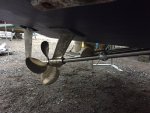
Are you sure that those collar anodes on the shafts are necessary?
I can't understand from your pic, but if you do NOT have anodes on the prop nuts, I would rather fit them and get rid of the shafts anodes - see example below.
Otoh, if you already have anodes on the prop nuts, it's still a matter of understanding whether the shaft collars are ALSO necessary or not.
And even if they are, I would at least move them as forward and as close to the hull as possible.
You might think that they shouldn't be so relevant, but anything that disturbs the water flow in front of a prop is bound to affect its efficiency, to some extent...
IiqCNceU_o.jpg
 
Not getting hung up on the whole matter at all, PF - quite the opposite, since actually I'm completely losing any interest in it.
Me too. It's kinda pointless arguing when Porto writes post after post of completely incorrect science. He is basically 180 degrees wrong saying that the cavitation pictured above = low pressure effect but it's pointless trying to correct it because so I give up posting. This forum used to be a little library of quite decent knowledge. Bravo to you mapism for trying though!
 
Me too. It's kinda pointless arguing when Porto writes post after post of completely incorrect science. He is basically 180 degrees wrong saying that the cavitation pictured above = low pressure effect but it's pointless trying to correct it because so I give up posting. This forum used to be a little library of quite decent knowledge. Bravo to you mapism for trying though!

I tend to back up the science - see post #22

Surley this link @post #22 adds to the thread knowledge in a “ decent manner “ ?

https://www.iims.org.uk/introduction-propeller-cavitation/

Could have posted more , but I thought that one sums it all up so refrained.


@MapishM - agree the pic my be the other way round , but the principle is the same ,just localised low pressure starting on the other edge of the streak .Remember is said “ illustrative “ the point works either way round for diagrammatic purpose.
Doesn’t change the basic principle of cavitation , heat leading to LOW pressure vaporisation .

Btw from experience using cavitation to cut and abrade in surgery the bubbles have to be actually incontact with the thing you want to operate on , not near or close ish actually physically touching .
 
Top