Princess 366 in Norfolk

Hi,
Does anyone know the history of a Princess 366 named Dorothy Dream, lying Brundall?
It seems like a decent boat with many updates but I have concerns about the 30 year old Yamaha 420sti diesels.
Any info would be greatly received
Regards
Rob
Did you buy the boat ? I have a princess 366 with Volvo D4s
 
  • Like
Reactions: ari
Repowered I imagine. But why change for the reliability of the Kad42s and the DP290. Those engines are endless works horses, and fairly trouble free.
D4 a much nicer engine (as you'd hope given that it dates from 2005 rather than the KAD/TAMD motors that date back certainly to the eighties, if not the seventies?). More economical, smoke free, electronic rather than clunky cable controls, lovely.

KAD 42 is a solid engine no doubt, but 30+ years old in that boat and very dated technology (in fact, arguably no technology!)
 
D4 a much nicer engine (as you'd hope given that it dates from 2005 rather than the KAD/TAMD motors that date back certainly to the eighties, if not the seventies?). More economical, smoke free, electronic rather than clunky cable controls, lovely.

KAD 42 is a solid engine no doubt, but 30+ years old in that boat and very dated technology (in fact, arguably no technology!)
I don't know how you define technology but I say it includes the mechanical parts of an engine. A dictionary definition includes machinery.
1741266121079.png
The kad42 dates from 1991. The absence of reliance on electronics is potential major benefit in favour of the kad42.
Also please note a kad42 could be fitted with electrically actuated controls if wanted.
 
D4 a much nicer engine (as you'd hope given that it dates from 2005 rather than the KAD/TAMD motors that date back certainly to the eighties, if not the seventies?). More economical, smoke free, electronic rather than clunky cable controls, lovely.

KAD 42 is a solid engine no doubt, but 30+ years old in that boat and very dated technology (in fact, arguably no technology!)
Each to their own but I would much rather have older ‘no technology’ engines - no common rail and no ECU, just plain old mechanical that will keep going pretty much come what may.

Our Perkins are just that - sat for five months over the winter and started first turn this week with no issues and if they do go wrong affordable to repair. Volvo D series will swiftly empty a bank account - just look at the cost of replacement injectors.
 
Last edited:
Each to their own but I would much rather have older ‘no technology’ engines - no common rail and no ECU, just plain old mechanical that will keep going pretty much come what may.

Our Perkins are just that - sat for five months over the winter and started first turn this week with no issues and if they do go wrong affordable to repair. Volvo D series will swiftly empty a bank account / just look at the cost of replacement injectors.
Agree with this 100% (and post #26). No ECUs to go wrong and find Volvo don't make them any more.
 
The kad42 dates from 1991. The absence of reliance on electronics is potential major benefit in favour of the kad42.
Also please note a kad42 could be fitted with electrically actuated controls if wanted.
The KAD 42 was a lightly modified and supercharged AQAD 41 200hp, itself a boosted and aftercooled version of the AQD 40 with 165hp, and we're already back to circa 1982. And I can't say for certain that was a new engine even then, rather than an update of an even older engine (hence my assertion that it dates back at least to the eighties, possibly to the seventies. The roots of the 40 series Volvo Pentas go back too far even for me! :D

I don't recall ever seeing KAD 42 engines with electronic controls unless retro fitted with something like the Glendinning system (which electronically actuated the cable controls in the engine space). The KAD 44 was the first from Volvo Penta with electronic controls to my recollection.

You're absolutely right that there is less to go wrong, just as there is less to go wrong on a Model T Ford than a modern car.
 
Each to their own but I would much rather have older ‘no technology’ engines - no common rail and no ECU, just plain old mechanical that will keep going pretty much come what may.

Our Perkins are just that - sat for five months over the winter and started first turn this week with no issues and if they do go wrong affordable to repair. Volvo D series will swiftly empty a bank account / just look at the cost of replacement injectors.
I prefer not having to clean soot off the back of the boat after every trip, but each to their own indeed. :)
 
I don't recall ever seeing KAD 42 engines with electronic controls unless retro fitted with something like the Glendinning system (which electronically actuated the cable controls in the engine space). The KAD 44 was the first from Volvo Penta with electronic controls to my recollection.
Electronic controls could be specified at the factory build stage so not necessarily retro fitted. My boat has electronic throttles fitted from new (it has kad 32 engines). I think it was a very expensive option.
1741290334512.png
I have seen a Mercruiser diesel engined boat with the same throttles.
But even if we call this retro fitting then at least you accept this is possible.

I prefer not having to clean soot off the back of the boat after every trip, but each to their own indeed. :)
I don't get soot with my kad32's. And I dont see this as an issue with friends boats that have ad41 amd kad43 engines.
You're absolutely right that there is less to go wrong, just as there is less to go wrong on a Model T Ford than a modern car.
This is exactly the point being made so I am pleased to see you agree with it.
 
Electronic controls could be specified at the factory build stage so not necessarily retro fitted. My boat has electronic throttles fitted from new (it has kad 32 engines). I think it was a very expensive option.
View attachment 190442
I have seen a Mercruiser diesel engined boat with the same throttles.
But even if we call this retro fitting then at least you accept this is possible.


I don't get soot with my kad32's. And I dont see this as an issue with friends boats that have ad41 amd kad43 engines.

This is exactly the point being made so I am pleased to see you agree with it.
Splitting hairs a little bit there. Volvo Penta didn't offer electronic controls on the KAD 42. Yes you can buy aftermarket controls that could actuate the cable controls on the engine, and yes you could even get a boat manufacturer to fit them from new. It's still an old cable controlled engine though.

I'm surprised you've not had yours removed and replaced with cables though, should be fairly straight forward and you'd have less electronics and so less to go wrong. Much better surely..?;)
 
I prefer not having to clean soot off the back of the boat after every trip, but each to their own indeed. :)

I agree and I am not a fan of smoky old lumps but not all are like that and the transom of our Hardy isn't ever covered in soot.

In contrast our latest boat at work has nice shiny new Tier III diesel engines (VP D13) and the boat is full of electrical wizardry, which is great to use but snags are not unusual. Multiple sensors on engines are good in helping diagnose issues and prevent a major problem but the trouble is they sometimes have a tendency to say there is a fault when there isn't one.

No going back to the old style of course and by nature I tend to embrace change and new technology but as a leisure boater operating within affordability constraints, old school reliability that I can tinker with myself and no worries about ECU's being discontinued is what works for us.

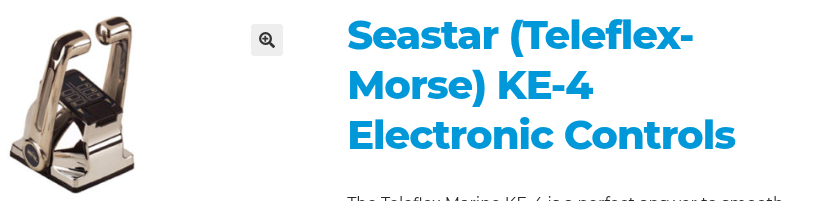
No question that there is much to commend modern kit though, in fact I switched out our Morse 'mechanical' engine controls for electronic last year, which are a great improvement but I am sincerely hoping we don't regret! :rolleyes:
.
 
Last edited:
I'm surprised you've not had yours removed and replaced with cables though, should be fairly straight forward and you'd have less electronics and so less to go wrong. Much better surely..?;)
Yes it would be better in the sense of less risk of a failure that can't be fixed.
The point here is that old school stuff may well still be running when the electronic stuff is in the scrap bin. I thought you had grasped the concept but it seems not.
 
Yes it would be better in the sense of less risk of a failure that can't be fixed.
The point here is that old school stuff may well still be running when the electronic stuff is in the scrap bin. I thought you had grasped the concept but it seems not.
Patronising, much? :D

Yes of course I understand that old basic stuff has less to go wrong, but if we all operate solely along that principle then we'd still be starting cars with a cranking handle and adding up on an abacus. There is a reason you've not removed the electronic controls from your boat in favour of traditional cable controls.

Having actually owned and used both (twin AQAD 41s in a previous boat, D6 more recently), I prefer the lower emissions and greater fuel efficiency of a more modern engine (and a car that starts at the push of a button, not the swing of a cranking handle).
 
Splitting hairs a little bit there. Volvo Penta didn't offer electronic controls on the KAD 42. Yes you can buy aftermarket controls that could actuate the cable controls on the engine, and yes you could even get a boat manufacturer to fit them from new. It's still an old cable controlled engine though.

I'm surprised you've not had yours removed and replaced with cables though, should be fairly straight forward and you'd have less electronics and so less to go wrong. Much better surely..?;)
They did it was the stand alone EC system which worked very well for a time then they stopped making the control boxes which was a shame , the only issues they suffered from was when the cables from the box to the engine seared it caused the motors to overload causing a shut down , and the voltage instability as they sought power from 2 different sources which caused shut down issues , other than that they were great .
Bouch like volvos edc issues of late possibly down to whoever manufactured them for Volvo either stopped production or became too expensive, plus the outgoing of old style Morse cable engines closed the demand for this system.
 
Are they the same as Yanmar or Nanni engines?
Correct - the base engine is the venerable Toyota 4.2 straight six and engine parts are available from Toyota and lots of pattern parts too. The marinised Yamaha only parts are the eye watering bit on the assumption you can locate them
 
Top