
Positioning of shaft anode

eddystone

Well-Known Member
Joined
18 Aug 2013
Messages
1,936
Location
North West Devon
Visit site
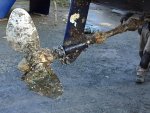
Earlier this year after finding the propellor anode on my then new Featherstream was pretty well eaten away after 8 months, I fitted two shaft anodes to try to mitigate this. In fact there may be no scientific basis for this at all as the prop anode deals, I think, with the difference between the bronze boss and the stainless steel blades. They were positioned as so:
IMG_0906.jpg

This is after 6 months so noticeable improvement in prop anode degradation. In avoiding placing them in the middle of the shaft (section from P bracket to hull is fairly short) the aim was to mitigate any vibration. I recall that Vyv Cox has said shaft anodes should be close to prop they are meant to protect so would it be better to place both together about 2.5cm from the P bracket - or would putting weight at one end of shaft cause vibration?
 
These MG Duff MGD range are much better due the the steel reinforcing band cast in so dont fall off

6d2fa330453495521d50d153ff5f9e30.jpg
 
The worst place for rotordynamic reasons is in the middle between bearings. Near the cutless bearing is better from this POV and also better for protection. Painting the prop with a good paint system is better for corrosion and would reduce fouling considerably.
 
It just crossed my mind that maybe I should be hanging on to all the zinc I come across.

I am currently melting down wheel weights for ballast but a lot of the wheel weights are zinc which is easily melted. Is there any point in holding on to some of it?
 
It just crossed my mind that maybe I should be hanging on to all the zinc I come across.

I am currently melting down wheel weights for ballast but a lot of the wheel weights are zinc which is easily melted. Is there any point in holding on to some of it?
No
The zinc used for anodes is a special high purity grade, with very low lead, copper and critically iron content but with the addition of small amounts of cadmium and aluminium

It is usually to the US military specification MIL-A-18001K
 
No
The zinc used for anodes is a special high purity grade, with very low lead, copper and critically iron content but with the addition of small amounts of cadmium and aluminium

It is usually to the US military specification MIL-A-18001K

Thanks for that. I will heed your advice but there wouldn't be any iron or copper but there could be lead though. (I was starting to curse the fact that I must have turfed out 20kg or so but now I can relax :encouragement:)
 
My boat will be in sea water but I didn't know that magnesium anodes should be used in freshwater.
" An alloy much more active than zinc or aluminum is needed. Magnesium is the answer. A magnesium anode is a super activated metal which means it will protect more efficiently in fresh water. Traditional zinc or aluminum anodes are just not effective as they do not produce the voltage necessary to work properly.
 
These MG Duff MGD range are much better due the the steel reinforcing band cast in so dont fall off

6d2fa330453495521d50d153ff5f9e30.jpg

I use these now. They are also about twice the size of the ones you're using and I find that one of these does the job of 2 of the little ones.
 
Thanks for that. I will heed your advice but there wouldn't be any iron or copper but there could be lead though. (I was starting to curse the fact that I must have turfed out 20kg or so but now I can relax :encouragement:)

This is the spec

Cadmium . . . . 0.025% - 0.07%
Copper . . . . . . .0.005% Max.
Iron . . . . . . . . . 0.005% Max.
Lead . . . . . . . . .0.006% Max.
Aluminium . . . . 0.1% - 0.5%
Zinc . . . . . . Remainder (special high grade 99.995%)

I understand that 0.005% iron is only tolerated by the addition of cadmium.
 
My boat will be in sea water but I didn't know that magnesium anodes should be used in freshwater.
" An alloy much more active than zinc or aluminum is needed. Magnesium is the answer. A magnesium anode is a super activated metal which means it will protect more efficiently in fresh water. Traditional zinc or aluminum anodes are just not effective as they do not produce the voltage necessary to work properly.

I dont know where you find this information but the reason zinc and aluminium are not used in fresh water is because they become passivated by an oxide layer, which remains even on returning to salt water,
Aluminium, but not zinc, may be used in brackish water
 
I dont know where you find this information but the reason zinc and aluminium are not used in fresh water is because they become passivated by an oxide layer, which remains even on returning to salt water,
Aluminium, but not zinc, may be used in brackish water

Sorry! Sorry! Sorry! (I should have given you the link to the source)
http://martyranodes.com/freshwater-anodes

But if you googled (say) the first line of my quote you would get the source. When I'm listening to music on the radio and I decide I like the song I take note of some words of the song and then google them. That gives me the title to the song.

Google " All of a sudden the water tastes like wine" and tell me the name of the song!

As far as understanding the chemistry of anodes I'll take your word for it : too technical for me!
 
Last edited:
Can anyone comment on these devices? Do they do away with anodes?

How To Fit An Electro Eliminator

Fit an electro eliminator to the shaft to provide the best protection for the stern gear, and earth it to the hull. See how to fit an electro eliminator!
 
I have. Imagine motoring for a few hours with the bloody thing rattling followed by a 'clonk' sound and then no more rattle.

Whilst it's an improvement, you do wonder if it has damaged anything on the way.

Same here, last year. An hour spent diving under the boat with a screwdriver to remove the surviving bolt, picking up some nasty scratches on the barnacles. Perhaps I shouldn't have left the anode on for a second season. Having no anode for a couple of months didn't seem to do the propeller any harm.
 
Last edited:
Can anyone comment on these devices? Do they do away with anodes?

How To Fit An Electro Eliminator

Fit an electro eliminator to the shaft to provide the best protection for the stern gear, and earth it to the hull. See how to fit an electro eliminator!

Ships and large structures use impressed current to combat corrosion, although generally they also use anodes. The method works but might be overkill for a grp yacht.
 
Can anyone comment on these devices? Do they do away with anodes?

How To Fit An Electro Eliminator

Fit an electro eliminator to the shaft to provide the best protection for the stern gear, and earth it to the hull. See how to fit an electro eliminator!

No they do not do away with the sacrificial anodes, unless you fit an impressed current system of cathodic protection, with permanent anodes, instead.

They are a means making the electrical connection to the propeller shaft instead of relying on a connection to the gearbox casing, there being a good electrical path through the gearbox internals and bridging the flexible shaft coupling.

Dont know what instructions you were hoping to link to :confused:
 
VicS;6974117. [I said:
Dont know what instructions you were hoping to link to[/I] :confused:

That was meant to be a test!! If you googled my comment it would have lead you to an article which explained how to do it.

I once was a Lecturer (read teacher) of Accounting/Law/Economics etc and set an assignment. On the front cover I stated Your assignment must be your own work (Do not copy)

When I got their assignments I googled the content on their assignments and found a whole lot of students (who were barely literate) had cut-n-pasted their assignment. Incredibly a few of them had submitted their assignments that were pinched from papers written by Emeritus Professors and so on! (Their jaws dropped when I fronted them and told them where they had copied their assignment from!!)

I failed 15 of the 20 students but I was over-ruled by the Head of Department. (We won't have any students for next semester!)
 
Last edited:
Regarding zinc vs aluminium in brackish water. Fresh to salt water is a spectrum therefore, I assume, going from an estuary up a river the saline level will not only progressively diminish but also vary according to ebb and flow of tide. At what point do aluminium anodes become advisable? For myself, I don't have a choice as Darglow don't make aluminium anodes for the Featherstream prop and I don't want to mix zinc and aluminium.
 
Regarding zinc vs aluminium in brackish water. Fresh to salt water is a spectrum therefore, I assume, going from an estuary up a river the saline level will not only progressively diminish but also vary according to ebb and flow of tide. At what point do aluminium anodes become advisable? For myself, I don't have a choice as Darglow don't make aluminium anodes for the Featherstream prop and I don't want to mix zinc and aluminium.

I don't think I have ever seen any definite recommendations in terms of salinity

This diagram from Wikipedia shows the usual accepted ranges for fresh , brackish and salt water.

https://en.wikipedia.org/wiki/Brackish_water#/media/File:Water_salinity_diagram.png
 
Last edited:
Top