Portable Wood Stove on board?

Tim Good

Well-Known Member
Joined
26 Feb 2010
Messages
2,888
Location
Bristol
Visit site
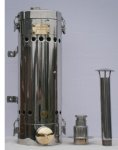
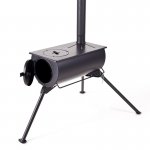
We've been in Norway all year and will be working out way down to Patagonia. For heating we have a webasto water heater than does radiators which is not bad but heavy on the batteries. Also a matrix heater when engine is running. However for days at anchor in Patagonia we'll need something else. Space is an issue though. Has anyone considered a portable stove than can be easily deployed when at anchor for more than a couple of days. Like this:
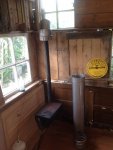
IMG_7334.JPG

IMG_7335.JPG

Only issue is the storage of wood as fuel I suppose.
 
Why not fit a small permanent diesel heater like a refleks, sigmar, Dickinson etc in addition to your other diesel heater.
My Webasto air top is frugal on electricity and my Sigmar 100 uses none at all.
 
Those little bell tent stoves are temptingly priced, but I wonder if they're a bit lightweight for long term use?
Heaters take up a surprising amount of room in a boat. You've got to position them carefully to draw well, and everything needs to be heat shielded.
Charcoal fired stoves are one option, they tend to be less bulky than wood stoves, with smaller diameter flues.
 
I had a solid fuel stove on board only burn smokeless coal on it though because it takes up less space of course in Fiji at the moment so I took off the stove months and months ago but I think you have not got a hope in hell but buying coal in Patagonia and where would you get dry wood from the wooden must be well seasoned else it just will not burn properly I wish I had a diesel heater with radiators like you 4 colder places I would stick with that
 
The word "portable" rings alarm bells for me - the exhaust from a solid fuel stove is deadly, and it only takes one leak in the cabin to kill the crew. And anything portable means that the flue has to be assembled and disassembled on a regular basis. How are you going to ensure the gas-tight integrity of the flue?
 
The Refleks oven is made her in Denmark and has a long history of presence in ferries, yachts, commercial fishing vessels and houseboats hence well tried and tested.

Safer and cleaner than a wood burning stove in my honest opinion.

look into it here

https://refleks-olieovne.dk/en/
 
I had a multi-fuel stove (in practice wood burning) in my previous (large) boat, and it was lovely. We carried a chainsaw, and had great fun collecting, sawing, and splitting driftwood logs. An added bonus was that we were able to burn practically all of our rubbish. BUT, dry storage was always a problem. In cold conditions at anchor, the fire, a Morso Squirrel used a lot of wood, and even with a big boat it was difficult to find adequate dry stowage.

In a smaller boat I now have a modern Eberspacher, which uses remarkably little electricity, and gives instant heat at the push of a button. If I was going seriously "off piste", I would want to have an alternative to Eber, just in case, but it wouldn't be a solid fuel burner. I would be looking at a simple diesel drip feed heater.
 
I'm just looking into fitting a solid fuel stove on my 30-footer (for use when stationary).

I've ruled out using wood because of the mess, the creepy crawlies, the awkward bulk storage, and because when a seasoned dry log it is efficient but that efficiency drops to 35% when unseasoned (full of sap) or otherwise wet (picked up for free but in winter its got to be wet) or otherwise smaller branches. So I'm considering solid fuel briquettes. That said if I choose the 'multi-fuel' stove carefully - then it'll burn any waste or bits I might find for free. Here's a useful link to solid fuel data and other advice < soliftec/fuelproperties >.

The other thing about wood is that it is most efficient when burn quickly (which means the fire needs to be attended to very frequently), and with a secondary burn system, otherwise the out-gassing (see volatile % gases in the chart of the link) just go out the chimney. = not very efficient. Conversely Volatile gassing is very much lower with processed solid fuel, so the burn can be very much slower (glowing hot ambers rather than flames). Depending on the type of fuel the output (in KJ/Kg) can be 1.5 to 1.75 as much per weight., or almost four times as good by volume ( KW/m^3).

^ Flames are good for short fast heat transfer to pots and kettles, whereas slow but very hot burning ambers are best for heat transfer which takes longer, ie., around a room.

Bought in plastic bags / 15 or 25 kg sacks, I reckoning this type of home fuel / smokeless coal 'ovals' can be tucked away around the boat until needed.

It is worth noting that wood burns best if sitting on a bed of ash and the air flow is from around the sides and above, whereas coal types are best sitting on a grate which allows ashes to drop away so that air can come in from underneath.

More on stoves in a minute. I need a cup of tea ;)
 
Last edited:
we have wood burners at home, providing both heat and our hot water. They are fantastic, and for us the wood fuel is free. But the mass required for heat compared to a liquid fuel is huge. The wife and I have been running a long term off grid experiment, living at the bottom of the garden in a series of interconnected sheds while the teenage kids have the run of the house. Biggest issue, in our "pod" a living room comparable to a 30ft yacht interior, is not making enough heat, but space for fuel. We built a diesel drip feed heater at work, fed with a computer fan to control combustion temp, that got so hot ob full blast it made the calor gas bottle it was made from begin to sag.
Wood is great as a fire, both to watch, and to feed, but just hard work in a confined space. HOWEVER, there is an alternative if you are willing to be labour intensive, and only want to heat a small space. A rocket stove. Have a google. Easy to make, and they work. BUT they will still need a lot of solid fuel. The stove in the OP post is made of very thin metal, feels like 1.6 or 2mm max as it is designed to be portable - they sell them in camping shops here, and wouldnt last long if used every day Saw one today in Go Outdoors. it was about 210 quid too. Ouch!
 
continued..

Whatever the fire or stove type, the combustion process needs air. It is said that a fire needs about four times the volume of air to feed the fires as is coming out of the exhaust (chimney). For a fast burning wood fire then that can cause a cold air draft to be sucked in (typically around your back and feet in a house).

As coal and other processed solid fuels burn hotter and slower - then a smaller firebox may be appropriate. I know from working on my boat when outside air temperatures are below zero that a 2kw fan heater will keep the small but non-insulated interior of my boat warm and so a big roaring fire is not appropriate. But a low speed (and quiet) fan to draw the warmth down and to circulate it around is.

Stoves.. Aside from tinny construction of portable types which may last a few years with care, the three fundamental problems with most portable stoves are :
.. a.) the chimney is out of the top (updraft) so the heat takes the shortest route to getting outside without allowing a decent degree of heat transfer to the room. So the firing might be efficient but the 'system efficiency' is poor.
.. b.) is that most often they have no refractive lining, so heat loss through the metal tray is quick but the heat produced (ie. all the fuel's potential energy being released and burnt) is poor.

This is easiest explained in terms of 'married' burning two logs facing each other. The heat radiates from one to super heat the other and vice versa, only together they stay alight ..and only when close enough together do they burn all the way down to a fine powder - they die together. A refractive lining to a stove works in the same way except that the heat is mirrored back (and the lining lives to find a new bridegroom to bed with). In the firebox, this makes for an all around burn, so out-gassing (farts) don't quietly slip away unburnt.

.. c.) has been mentioned in another post and that is in respect to their generally not being C.O. sealed for use inside use. CO alarms should be fitted in all cases of combustibles on board, but heaters are worse because they may be alight while you are sleep (..and CO poisoning adds to drowsiness).

Buying a stove is not going to be easy for my boat, and so I might well make one myself, or else adapt one. Firstly, it has to be small and efficient so as to not take up too much space, either in itself or in fuel storage. Air feed to it is best piped in from outside, and the chimney is by necessity going to be short and very soon pass close to and then through a flammable material (the coach roof).

The firebox needs only be very small (with refractive lining) but its hot air then need to pass slowly through a heat dissipating chamber (laid out quite like a firebox feeding a brick-firing furnace or boiler). So, within this I can have exchanger pipes for hot water. Ribbed cast iron would be a good material for this chamber, as its top's temperature may exceed 750 degrees (aluminium castings melt at 660 degrees).

A small fan gently blowing passed it will better circulate the air around the boat. Mostly the heat should be extracted by the time the gasses exit the flue (exhaust temperature about 120 to 150 degrees would be good to prevent sooting and to maintain draw). And then of course the thing should be easy to clean, easy to remove & cap the chimney for when sailing, and inexpensive to buy or make.

That's not asking for too much is it ? :)

Btw. I do have a multi-fuel stove in my home, which is most efficient when only about 1/4 of the grate is used (bricks laid on the grate form a low wall around the fire itself). I also had a small (10" dia.) 'Goblin' stove in my workshop which was great but I often had issues with smoke when the wind blew down the chimney. In retrospect I suspect that was too big in diameter for the size of stove.
 
Last edited:
When we first started building our own log burners about 30 years ago, we made our first air/water heater, from domestic copper pipe and brass unions, it performed a series of 180 degree bends and sat in the top of the stove. Worked brilliantly - until it cooled. Then the difference in expansion between copper and brass made every single union leak. After that we used steel pipe!
we use them at home, I would love to have one on our 24ft yacht, but I cannot imagine how we would feed it. Even as day sailors, maybe away for a couple of days. But I think a rocket stove and a few bags of kindling would be enough to warm for a night or two. Compact and efficient - but you need to keep an eye on it even the "self feeding" ones.
 
SC, there used to be a builder of little wood stoves for small yachts. Basicly a bit of 10cm square tube with a grate and top baffle and a 1" flue. Force Ten or something similar.. Used wood or charcoal. I have built stoves in the hundreds as a sideline and the technology is not complex to get a good burn. With your facilities and a bit of reading, not a prob.
 
Best bet is stove that runs off smokeless fuel nuggets,lots of heat and small storage volume.Had small stove on 23 footer was about 9 inches square enameled yacht stove,great.
 
When we had a big converted fishing boat, we had a multi-fuel fire down in the saloon. We mostly burned wood, but also coal at times. The flue was 4" steel pipe, and I felt that an awful lot of heat was just going straight up the chimney. I made a water jacket about 3 feet long, immediately above the fire, out of 6" steel pipe. Connections top and bottom went to a radiator up in the deckhouse. A little header tank on the wheelhouse roof kept the system full. The radiator worked very well, purely by natural convection, with no pump. The only problem was that by cooling the chimney, it tended to get gummed up with a tarry deposit, and had to be "bored" out occasionally. It was good fun, and burned all our rubbish. I wouldn't have liked to be downwind of us though.
 
I’d recommend a diesel stove like a Dickinson Newport, we had one one a Rival 38, very economical and easy to use. There’s also a charcoal version. I share the concerns regarding a portable stove.
 
There are several choices, each with their pros and cons along with size of boat.

On a Contessa 32 in Canada, I had a paraffin/kerosene heater which was excellent. Now made by Sigmarine with such unit fuelled by propane.

http://www.sigmarine.com/SIG-CCH.html

On this Rival 32, I considered Eberspacher, Wallas etc which I may well add later using the diesel fuel. I have been advised that for such heaters it is best to start them up on paraffin/kerosene and close then down on paraffin/kerosene which burns hotter and cleans the combustion chamber.

However for no-electric reliance I am installing a Hampshire Heater burning lump charcoal. See prelim installation before flue pipe, work in progress...

http://www.hampshireheaters.co.uk/
Hampshire heater & flue.jpg
3. Prelim Mount Oct 15th 17 2.jpg

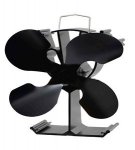
And to assist circulation without electric fan I have a heat induced (electric) fan to circulate the air. Approx £25 from Amazon. I have seen this fan operate on a Reflex heater and it works!
Heat driven fan.JPG

As regards raw wood, much depends on the actual wood as noted from my log cabin wood stove in Canada. Cedar burns like kindling, pine is better but still needs lots of wood, and beech is very hot and one lump burns all night. I think scavenging enough wood volume could be a challenge.

I see a future ideal combo of Wallas (diesel and electric/battery circulation) and the Hampshire (charcoal) for all round situations with the heat-driven(electric) fan.
 
And to assist circulation without electric fan I have a heat induced (electric) fan to circulate the air. Approx £25 from Amazon. I have seen this fan operate on a Reflex heater and it works!
View attachment 67740

I have one of these on the solid fuel stove beside me as I type. It spins very prettily, but I have never been able to detect the slightest air movement attributable to it. My crew has done experiments with smoke trails from glowing twigs and can't find anything either. Looking at some commercial thermo-electric generator module specs, I estimate the one in my fan may be good for half a watt on a good day, so it's maybe not surprising that it doesn't do much.
 
There are several choices, each with their pros and cons along with size of boat.

On a Contessa 32 in Canada, I had a paraffin/kerosene heater which was excellent. Now made by Sigmarine with such unit fuelled by propane.

http://www.sigmarine.com/SIG-CCH.html

On this Rival 32, I considered Eberspacher, Wallas etc which I may well add later using the diesel fuel. I have been advised that for such heaters it is best to start them up on paraffin/kerosene and close then down on paraffin/kerosene which burns hotter and cleans the combustion chamber.

However for no-electric reliance I am installing a Hampshire Heater burning lump charcoal. See prelim installation before flue pipe, work in progress...

http://www.hampshireheaters.co.uk/
View attachment 67738
View attachment 67739

And to assist circulation without electric fan I have a heat induced (electric) fan to circulate the air. Approx £25 from Amazon. I have seen this fan operate on a Reflex heater and it works!
View attachment 67740

As regards raw wood, much depends on the actual wood as noted from my log cabin wood stove in Canada. Cedar burns like kindling, pine is better but still needs lots of wood, and beech is very hot and one lump burns all night. I think scavenging enough wood volume could be a challenge.

I see a future ideal combo of Wallas (diesel and electric/battery circulation) and the Hampshire (charcoal) for all round situations with the heat-driven(electric) fan.

I have one of these on the solid fuel stove beside me as I type. It spins very prettily, but I have never been able to detect the slightest air movement attributable to it. My crew has done experiments with smoke trails from glowing twigs and can't find anything either. Looking at some commercial thermo-electric generator module specs, I estimate the one in my fan may be good for half a watt on a good day, so it's maybe not surprising that it doesn't do much.

These devices have only one use: If your stove in in a recess under the flue/chimney they will prevent a wasted heat build up above the stove. They can (just about) shift the lump of warm air into the room.
 
These devices have only one use: If your stove in in a recess under the flue/chimney they will prevent a wasted heat build up above the stove. They can (just about) shift the lump of warm air into the room.

I'm dubious. The stove next to me is in an alcove, the wee fan is spinning round like the very dickens and flame of a candle held in front of it (my crew's latest test) doesn't budge from the vertical. I still like it, 'cos it looks nice.
 
Top