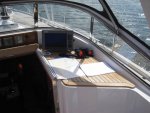
Plotters - Cockpit or Chart Table?

Ignoring the argument about paper or plotters as the primary nav aid, I find for single handing that the cockpit is the obvious place, with the radar overlaid on the CP.

It does then force me to do my passage planning down below with paper the traditional way too, so best of both worlds IMHO.

I think you might have a point there. In any case winning that Yeoman on eBay means I've got a very easy way to move data between a cockpit plotter and charts on the table now...
 
Mine is in the cockpit. Large enough and close enough to see but too far away to fiddle with when you should be using your eyes.

It's not particularly well cited though as it's either on your knees or on your bum when you want to use some of its capability.

My iwife also links it to her apple thingy. It's my early warning device that she's awake down below after an overnight passage. The screen starts to move as if by magic. My signal to get the kettle on.


DSCF0315a_zpsf9492843.jpg
 
A whole thread about chart plotters and no doom bearded prophets warning that GPS is the devil's instruments and that plotters are inhabited by the spirits of evil sirens intent on luring mariners onto the rocks! Things have changed from only a few years ago.

In terms of above/below decks.
There are two separate activities. 1. Passage planning and 2. navigating.
For the the latter, GPS functionality is the thing that makes the plotter invaluable. (Blind navigation in fog being the extreme example).
The former is usually done, at leisure, in harbour or at anchorage, so GPS position is unlikely to be required.

Plotters have a relatively primitive interface and so are not ideal for passage planning. It is much easier to carry out passage planning on a device with a big screen, keyboard, mouse, Internet access for tidal and pilot information, etc. A laptop or tablet gives all these things. It even allows you to do the passage planning at home or in the pub. They don't have a daylight visible screen or waterproofing, (which account for a significant part of the cost of a chart plotter) so they are no suitable for use on deck.

So, I would always have the plotter on the helm and have on a computer, at the chart table, for planning.
Some way of easily transferring planned routes from the PC to the plotter is highly desirable since manually transferring waypoints can be tedious and is susceptible to transcription errors.


Re - Positioning under sprayhood vs. helm.
There is an additional consideration. For those of us with reading glasses, it is easier to see the chartplotter when it is further away, under the sprayhood. However, I have also been on a boat where the rain was so foul and thick that it was hard to see the sprayhood mounted plotter. (We were navigating a narrow channel through the Farne islands at the time and the helm relied on the crew for reassurance.) So, my preference is to have the plotter (and a pair of specs) at the helming position.
As others have said, the helm's ability to use the buttons on the plotter, (to zoom in / out, etc.) can be important.
 
First boat i had with plotter was allready mounted at chart table , young family at time , found next to useless down there , sold and bought weather proof one for cockpit and set up i could use down below if needed , sh 180 i , whilst it did work below , never used it apart from occaisonal passage planning .

Sold boat as dead , kept plotter , mounted at wheel , 300 i allready inside , perfecto , the 300 links to ais radio ,to give wife something to do in fog , was going to link to to helm plotter , but suprisingly the info relayed to remote

vhf handset give plenty of useable ais info ,

Got a wandering ipad too with navionics , handy when absolutely chucking it when i can shelter in hood , using remote for autopilot .

All in all ideal west of scot set up , expensive , but bought bit by bit over years , actually a new fangled 3 d lcd plotter would prob cost more .
 
I have a plotter in the cockpit, with an AIS feed.

I also have an old monochrome plotter at the chart table which I use for Lat/Long & SOG to plot on the chart, and as a backup.
 
These posts are all interesting and give a diverse set of mounting options - but none explains WHY someone places a plotter in a particular location... could anyone give a bit more detail about why they chose to put the plotter where it is? I mean more detail than something like it being to hand - why do you need a plotter to hand? Why isn't it much use if it's installed below? What do you plan to do with it that makes a particular place more effective?

I pretty much envisage using the plotter on my Horizon to plot a course, cross checking with the paper chart and comparing the two, then use it for AIS alarms and as a feed to a GPS repeater for steering. Though a tablet will be there when I want AIS or a chart in the cockpit, mainly pilotage in busy/confined spaces.

Plotter, gps repeater, radar, radio, instruments all where they can be accessed in the cockpit and can be seen by anyone as well as from the helm. Not much use if you have to keep leaving the helm to go down below to check where you are and what obstacles are around, particularly in fog or close to the coast at night particularly if short or single handed when crew asleep and you're maybe following a channel into harbour or anchorage.
 
In terms of above/below decks.
There are two separate activities. 1. Passage planning and 2. navigating.
For the the latter, GPS functionality is the thing that makes the plotter invaluable. (Blind navigation in fog being the extreme example).
The former is usually done, at leisure, in harbour or at anchorage, so GPS position is unlikely to be required.

Plotters have a relatively primitive interface and so are not ideal for passage planning. It is much easier to carry out passage planning on a device with a big screen, keyboard, mouse, Internet access for tidal and pilot information, etc. A laptop or tablet gives all these things. It even allows you to do the passage planning at home or in the pub. They don't have a daylight visible screen or waterproofing, (which account for a significant part of the cost of a chart plotter) so they are no suitable for use on deck.

Agree with that - except that for me the non-waterproof thing with the big "screen" is a chart :).

Pete
 
I can see arguments on both sides....

At the chart table:
  • Easy to cross reference with paper.
  • Better protected
  • Reduce temptation to navigate solely by plotter.

In the cockpit:
  • Chart available without leaving the helm.
  • Alarms / AIS etc on deck.

And of course there are the hybrid solutions that try to combine the best of both by having the plotter swing between positions.

What have people chosen for their boat?


We inherited a large 10" plotter down below at the chart table in our 33' tub, now angled so it can also just be read from the companionway - not ideal as it can be a little too far away and not immediately adjustable.

IMHO.......

In a boat 30' or less, I know from previous ownership, that space becomes a premium. In an ideal world so does convenience

and safety of use. Regardless of ideals, many of us are becoming tempted to navigate primarily by chart plotter or chart plotter

alone. In that case, both cockpit and at chart table is better.

The swinging plotter is a very workable solution for some, possibly for tiller steered boats more than wheel. As long as it can be

locked in place or then quickly swung out of the way if required urgently and then repositioned without it flying about uncontrollably.

A friend used to have such a system in his 28' Twister but he gave up in the end and put a 2nd small plotter under his cockpit

hood. Two years ago I did the same and now have a second smaller plotter under the hood. It is quickly unplugged and also

reattached alongside the chart table with parallel cabling for planning purposes when comparing with paper charts etc in comfort.

Detachable plotters are not every bodies preference. In fact permanently attached on, in or near the binnacle for a wheel

steered yacht is probably preferred.
 
Last edited:
Our set-up is what we inherited from the first owner, who singlehanded a lot, even more than I do. There is the usual array of log, depth, wind over the companionway and next to that a big plotter (C120). Just inside the companionway are the VHF and the autopilot remote control. So we have all we need for navigation and pilotage together under the sprayhood. The plotter screen is large enough even for me to see from behind the wheel. It can be removed from its bracket and taken below for route planning and stowage. On the binnacle there is the radar screen, which mainly serves as a repeater for wind, depth, log etc. This set-up works very well as it is. At the chart table there is an independent GPS, and the paper chart is always ready for instant use.
Having used it now for four seasons, one of which a round Britain, if I were to specify from new, I would keep the basic layout, with a few alterations. Having all the info in the cockpit, under the sprayhood, remains the nucleus. It's where you pilot the boat from, the equivalent of the bridge, and you have a 360° view. I would of course now integrate radar and AIS on the plotter.
At the wheel I feel no need to have a plotter. Working a screen through the spokes of the wheel is not convenient., neither is a screen covered in rain. I would add a remote mic for the VHF, which is more practical than the handheld I use now.
The chart table is used in port, for planning, and en route it is where I do the hourly updates of the logbook and where I go to study pilot books etc. For difficult pilotage the books and plans are still taken into the cockpit for visual cross-reference.
Another advantage of having plotter and instruments atthe forward end of the cockpit/under the sprayhood, is that everyone in the cockpit can see them. Crew tend to become more involved in navigation and pilotage and more aware of the situation. If you have all the info at the wheel only, the helm monopolises too much.
 
Plotter in the cockpit under the sprayhood.. I single-hand a lot and the combined chart-AIS-radar is in a handy position there. I wouldn't like it at the helm as i'm on autopilot 90 percent of the time, keeping watch from a comfy dry position under the hood. Same applies when on watch with a crew.

I'm fortunate that i have space there for the paper chart too as I use both plotter and paper. In an ideal world I'd have a plotter at the helm too for pilotage in tight situations when I'm on the wheel, but it would be a waste of money most of the time and I can do pilotage into harbour with chartlets or a pilot book from the helm.Penguin plotter.jpg
 
Lots of the usual dogmatic anything-but-what-I've-got-is-useless-or-lethal stuff! Also lots of very expensive setups, and good luck to them.

Our setup is as installed when new and inherited from two previous owners: GPS display with screens to show COG, SOG, BTW, DTW, TTW, XTE and so on, plus wind, tridata and autopilot controller in the binnacle at the wheel; Navcenter 600 plotter at the chart table which supplies waypoint data to the binnacle units; standalone Raymarine radar, installed two years after the rest, under the spray hood, displaying selected waypoint and relevant data. We would love to have all the bells and whistles, but for one teeny weeny snag: MONEY. If any of the above goes titzup, we will get by without it, as we did before it was invented, and carry on sailing safely but perhaps with just a little more adrenalin when the weather turns bad or we are going somewhere unfamiliar. Having and using a boat in the first place is the point for us; the toys were no longer state of the art when we got them and we took some time to explore how we could use them.

We do have a hand held Garmin 12 and a Yeoman plotter brought from our previous boat as standbys, but we always have the relevant paper chart on the table with our intended passage pencilled in (unless we are pottering in Plymouth Sound or the Fal etc).

And for pilotage in unfamiliar waters or poor vis we always have a suitably folded chart, pilot book and my navigator's notebook to hand under the spray hood; diving down to look at the plotter is always an option with Mrs Grumpybear at the wheel.
 
Last edited:
Top