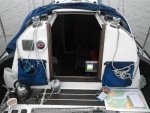
Plotters - Cockpit or Chart Table?

I'm in the "helm" camp. I do all my planning and plotting on paper at the chart table, but as I'm usually short handed and helming, the plotter saves all those quick trips below to check the chart. Having the AIS target display somewhere you can compare it with what you can actually see is enormously helpful. The big advantage I see of "helm" over the "under the spray hood" option is that you can reach the buttons. All this less applicable to those who have enough crew to leave the helming to others. I did run an ethernet cable from the plotter to the chart table in expectation of Raymarine releasing an updated version of Raytech and me buying it for use on a laptop but they never did and frankly I'm glad I saved my money: I've never felt the need for a plotter/laptop when I have paper charts.
 
I'm in the "helm" camp. I do all my planning and plotting on paper at the chart table, but as I'm usually short handed and helming, the plotter saves all those quick trips below to check the chart. Having the AIS target display somewhere you can compare it with what you can actually see is enormously helpful. The big advantage I see of "helm" over the "under the spray hood" option is that you can reach the buttons. All this less applicable to those who have enough crew to leave the helming to others. I did run an ethernet cable from the plotter to the chart table in expectation of Raymarine releasing an updated version of Raytech and me buying it for use on a laptop but they never did and frankly I'm glad I saved my money: I've never felt the need for a plotter/laptop when I have paper charts.

I do the same, Cockpit plotter and paper chart below, found it very useful coming back in fog when shorthanded.
 
These posts are all interesting and give a diverse set of mounting options - but none explains WHY someone places a plotter in a particular location... could anyone give a bit more detail about why they chose to put the plotter where it is? I mean more detail than something like it being to hand - why do you need a plotter to hand? Why isn't it much use if it's installed below? What do you plan to do with it that makes a particular place more effective?

I pretty much envisage using the plotter on my Horizon to plot a course, cross checking with the paper chart and comparing the two, then use it for AIS alarms and as a feed to a GPS repeater for steering. Though a tablet will be there when I want AIS or a chart in the cockpit, mainly pilotage in busy/confined spaces.
As the OP you really want to know why.

It’s going to come down to personal preference and how you like to navigate. Based on your experience.
From my perspective not having a plotter. I do have a GPS and RADAR both at the chart table. I find I don’t use them. I cant see them.
I like to have a folded up coffee stained old chart which goes in and out of the cockpit locker. Even my cruising guide comes out in the rain.
Even so it’s only for somewhere new. A lot of times I don’t use a chart at all.
Finding my way though an unfamiliar channel at night or into an unfamiliar anchorage or harbor. I like to make a plan based on simple visuals. Put them in a rough notebook to remember.
My GPS and RADAR are of little help.

So to my mind. A plotter by my chart table would gather dust along with the GPS. Unused. While I relied on my usual technics. Not much point in getting one.

If I put it where I could use it in the cockpit. My charts would be much less prone to coffee stains, inconvenient folds, getting soggy, footprints, and even paw prints.

By the wheel or by the hatch?
 
Definitely where you can easily see it from the wheel. It's the modern equivalent of the compass. It's no use to you if you can't see it.
 
Definitely where you can easily see it from the wheel. It's the modern equivalent of the compass. It's no use to you if you can't see it.

No one seems to have mentioned a possible downside.. if you can see it you look at it. Lots and lots. And lots.

And look around you less and less with the map in your head not really being looked at....

You could always turn it off unless it really should be on, but does anyone?
 
And look around you less and less with the map in your head not really being looked at....

Disagree, I find the plotter image helps me make more sense of what I can see, and I still look around lots! Add in other navigational info, AIS, radar, etc, and it becomes very useful indeed.
 
No one seems to have mentioned a possible downside.. if you can see it you look at it. Lots and lots. And lots.

And look around you less and less with the map in your head not really being looked at....

You could always turn it off unless it really should be on, but does anyone?

Do you wear a wristwatch? If so, are you able to cross the road without being run over?:D
 
As mentioned, I have my plotter on a swinging panel at the main hatch; on a 22' that makes it close enough to see from the helm, so I can glance:)at it under way.

Then if I swing it round inside I can refer to the paper chart on the table, and the almanac etc, while putting in waypoints before the off.

With the panel in cockpit position I have a roll of clear plastuc to keep the saloon dry in all but the worst weather, in which case it's washboards in and back to pre-plotter conditions, but I'm well used to that.

I suppose if money were no object at all - loads of things I'd get first, and my boat's pretty well equipped ! - I could fit another plotter in the cockpit bulkhead, but one's getting close to sailing a boat show display stand...
 
You could always turn it off unless it really should be on, but does anyone?

I keep my little binnacle one turned off most of the time. I've noticed that one of my regular crew tends to turn it on when he's steering - I've no objection to him doing that, but if we're at sea then I turn it off again when I take over.

I used to turn the main plotter off when crossing the Channel. Last year with a much larger battery I instead switched it into full-screen radar mode and treated it as a traditional radar display rather than a plotter, until we started to close the coast on the other side.

Pottering around the Solent I may well not bother to switch any of it on apart from the depth sounder and VHF (the latter mostly because I'm nosy :) ). Being ever so slightly anal about these things, I laid out the row of instrument circuit switches in order of increasing complexity of navigation, so for local trips I hit two switches, coastal three or four, and cross-Channel all five.

Pete
 
I use a Samsung 10" tablet running Navionics, usually set up under the sprayhood but with additional fixing position over the chart table for use down below. I used RAM bracket and ball mounts - a good system( bought over the internet from the US - half the price of buying it in the UK)
It works well and used on trips to Holland, France and the West Coast of Scotland & N Ireland. Not waterproof but with an Otterbox cover it is nearly so. On the trip in Scotland it was used in preference to the Raymarine mounted plotter as the screen was twice as large and clearer.
 
Disagree, I find the plotter image helps me make more sense of what I can see, and I still look around lots! Add in other navigational info, AIS, radar, etc, and it becomes very useful indeed.
different folks.. :)

I find the same thing driving with sat nav, my nav brain tends to turn off. If there´s a plotter to look at then Iḿ not paying so much attention to transits, or depth and all the other little bits of the real world you use to get from A to B.

Nearly all the time it just isn´t needed at the helm. That last bit of the time when it´s getting a bit exciting it´s so useful that it may well be a powerful argument in favour. Especially with ais and radar.
 
I guess my main concern is that my laziness will take over. That if I allow myself to use the plotter as my primary nav source I'll be too rusty to navigate the old way the day the electronics fails or that I'll fail to notice one day when the GPS position is less accurate than usual, hence the motivation for wanting to make the plotter a little bit harder to access so that I'm more likely to take transits and a few running fixes and pre-plan some bearings or use radar for fixing and base my planned routes on them.

I found on my old boat that having the plotter in the cockpit meant I basically just took the easy route.. worked out tides, wrote down VHF channels and made a few waypoints, but then piloted whole trips watching the plotter, and just took a GPS position every hour as my backup. It's easy, but it it proper navigation?

On the other hand, having AIS and chart data in the cockpit was really valuable - as would the planned radar install on the new boat be. So am really torn.

I've just won a Yeoman Sport on eBay which might make a difference to the equation.
 
Last edited:
In the photo you can see a GPS plotter on a swing arm, that can be seen from the helm or swung over the chart table. A chart and note pad with courses and buoy numbers on, to be ticked off as they are passed. A fresh mug of tea and some cocconut macaroons.

IMGP2930.jpg
 
I'm still in the rebuild stage on my Roberts but I'm envisioning the lap top with open cpn down below on the saloon table, and using a now defunct 13 inch 12volt tv/monitor, under the yet to be constructed spray hood. As it will be attached to laptop via data cable, I'm not sure where or how to mount it. But 1 thing I do know, at that size I will be able to see it clearly from the tiller and also not have to wear my glasses which are required to see the tiny little screen such as is on the lowrance I brought from my power boat,
 
No one seems to have mentioned a possible downside.. if you can see it you look at it. Lots and lots. And lots.

And look around you less and less with the map in your head not really being looked at....
.
You could always turn it off unless it really should be on, but does anyone?

Any aid to navigation has the same downside. Be it RADAR GPS even the humble compass. If you rely on it exclusively.
The OP mentioned “proper navigation” which comes in many forms. A plotter is just a tool. Which you may find useful.
A wise navigator will use it along with his other senses. If the two don’t add up it will clew him in to the possibility something is not right.

Place it where you find it easiest to use and see. I would be hesitant to steer by plotter. Not because it’s wrong. Rather because as skipper or navigator I am often not on the wheel.
I tend to teach the helm to steer by what they can see in front rather than by compass. An inexperienced helm often chasses the card when trying to steer by compass.
I suspect a similar issue could occur with a plotter.

Bottom line if you learn to navigate by the traditional methods this should not be an issue.
It might be for an inexperienced navigator. Who may put to much faith in the gadgets.
 
Any aid to navigation has the same downside. Be it RADAR GPS even the humble compass. If you rely on it exclusively.
The OP mentioned “proper navigation” which comes in many forms. A plotter is just a tool. Which you may find useful.
A wise navigator will use it along with his other senses.
Sound advice, but worth bearing in mind that the wisest navigator is still just a monkey with a big brain which likes patterns :)
With driving as an analogy, using satnav your internal map shrinks away and you'll just follow the little arrow. I do anyway and happily so , I see it as a sign of maturity admitting that Google will actually nearly always know a better route than me across London. :)
Same thing with boats more gadgets to look at them your brain will tend to use them and use the senses less. Which is not necessarily a bad thing, gadgets tend to be right. But well worth admitting that to a greater or lesser extent it happens. And sog/cog are simply wonderful bits of info to have :)
The rest is easy to live without, until that rare moment when it all gets a bit frantic..... :)
 
Ignoring the argument about paper or plotters as the primary nav aid, I find for single handing that the cockpit is the obvious place, with the radar overlaid on the CP.

It does then force me to do my passage planning down below with paper the traditional way too, so best of both worlds IMHO.
 
Top