
Please help me understand my engine's fuel system with electric pump

scrambledegg

Well-Known Member
Joined
2 Nov 2015
Messages
264
Location
Portsmouth
Visit site
I'm undertaking the first service on my boat's diesel inboard engine. It's a Mitsubishi Sole Mini 33.
I want to change the water-separator filter and the fine filter and then bleed the air out of the system.
I've just completed an RYA one-day diesel engine course, so I thought I knew what I was doing. However, on close examination I've discovered that the engine doesn't have a mechanical lift pump with lever for manual priming, but instead has an electric lift pump.

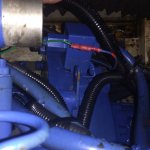
This is what it looks like, the box-like object with the wire attached:
lift pump.jpg

Does anyone know what the procedure would be for bleeding the system?
The engine manual is pretty terse on this point:

5.1.1 Bleeding air from the fuel supply system
(3) For engines equipped with electrical priming pump, operate the key to "ON" position. Do not run the starter motor for more than 20 seconds at a time.
The air bleeding from the injection pump and injectors pump is automatic


So i'm not clear if it will prime just by turning the key to "ON", or do I also have to run the starter motor?
Will the whole system self-bleed or will I have to open a bleed screw on the fine filter?
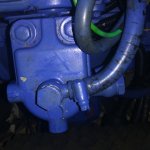
This is what the top of the fine filter looks like:
diesel fine filter.jpg

Any advice gratefully received!
Jeremy
 
If the fuel pump is running (which it has to when engine is just on , not start), you will hear it very distinctly growly-chattering.
You might find that the filters self prime and the engine does, but it takes more (battery) time. From fixing cars I always fill filter bowls before fitting to reduce priming even more.
 
If by turning the key to the ON position you can hear the fuel pump ticking then I would open the air screw on top of the filter and bleed in the normal way . ( without useing the starter motor )
 
Is the fuel level in the tank higher than both of the filters and all the supply hosing?
Do you have a fuel return hose to the tank?
If the answers to both of the above is YES then just switch on (do not start) and wait until you have a steady (bubble free) stream of fuel returning to the tank.
You may need to take the return hose off and let it run into an open container so you can see the flow is clear of bubbles. Keep the end of this hose above the level of the fuel in the tank when watching for bubbles.
As mentioned above, fill the filters with clean fuel* before fitting.
This assumes you do not currently have air in the system (IE it is running correctly before you start).
To state the obvious;
1) Close the fuel cock before removing the filter
2) Ensure the orings on the old filter come off with the filter (its possible to end up with two sets of orings which will either cause a leak or a bypass of the filter.
3) Put a little fuel on the orings before tightening
4) Be ready for a little fuel loss when removing the filters.
5) Run the engine for (a minimum) 10 minutes before you have to rely on it.


*I once saw a guy pre-fill his new filter by tipping the old filter (and all its crud) into the new filter.
New member - Posted 17h36 19th – awaiting moderation.
 
Worth noting - the presence of an electrical lift pump doesn't mean you do not also have a mechanical lift pump. It's common to have both if there is a long pipe or if the fuel tank is below the water line.
 
Thanks very much, guys, for the contributions so far.
Makes me a bit nervy doing engine jobs immediately the boat goes back in the water and then moving it to its regular summer home - but your advice has given me confidence.
 
That looks like a Facet 'cube' fuel pump, scrambledegg. If there are any markings on it a trip to the Facet website might give info about the pump itself. I appreciate that Sole's blasting blue paint all over it probably won't be helpful.

We have such a cube pump (in addition to the engine's mechanical pump). It allows fuel to flow when not powered, so presents no difficulty bleeding fuel in the normal way with the engine's primer pump.

Note that some (at least) Facet cube pumps push much more heartily than they pull, and should be sited low down and close to the fuel tank.
 
We also have a Facet cube pump in addition to the lift pump, solely for the purpose of making bleeding easy. Our fuel tank is below the engine level and the facet pump pulls the fuel up from the tank, through the primary filter, through the facet pump and then into the secondary filter via the lift pump. To bleed I simply switch the pump on and open the bleed screw on the secondary filter - simple! I suspect all you have to do is turn the ignition on (but not the starter motor) to get the pump pumping and then open your bleed screw on the filter.
 
On my old boat I had a couple of peugeot engines that had no lift pump so I fitted facet electric pumps as it had a bigger lift than in the car they came from, to bleed I would just crack the bleed screws open and turn ignition on (no starter motor required) to power the pumps, as soon as fuel showed from bleed valves close them, run engine at idle for a while afterwards to clear any small amounts of air in the system and job done, most modern injector pumps will self bleed small amounts of air anyway.
If engine does cut out you have air in the high pressure injector pipes, just crack all the nuts off slightly and spin the engine over, as fuel comes from the pipes nip them up and the engine should pick up.
 
Hi
As mentioned, generally a good idea to fill filters with fuel where possible.
If you have a electrical pump, run this and open the bleed screw on final filter right before injectors until bubbles stop (with spanner still on the banjo bolt or bleed bolt).
If this fails, have someone crank the engine with the injector fittings cracked open until she fires. A well tuned ear will be able to tell if she is firing on all cylinders.
Best to try to avoid the latter though.
 
I have a Westerbeke engine which is a marinized Mitsubishi. It also has an electric lift pump.

All you need to do is crank the engine as it is self-bleeding. Easy peasy! No faffing about looking for bubbles, getting your thumb worn out pumping an idiotically small lever and getting the engine covered in diesel.:cool:

Obviously, you may need to close the raw water intake if the cranking is excessive. When I change the fuel filters I expect the engine to catch after 10 seconds or so.
 
Last edited:
On the volvo's I have now I've replaced the bleed screws on the engine filters with brake bleed valves containing a spring loaded ball, simply crack the nipple open a bit and connect a pela oil pump till fuel enters the suction pipe, nip up nipple and let the oil sucker suck the diesel up as the pipe comes off, very easy and clean and pulls fuel through the whole system, I do shut off the vent side so it doesn't suck air back that way.
The valves were £25 each off ebay and come in different thread sizes.
 
I never like to post directly against some ones else’s advice but I think there is a risk here of a ‘one size fits all’ answer above that has the potential to cause readers real problems.

It may be that the moderators have removed the post by the time anyone reads this.

If your boat is being used in very safe closed waters, you may want to rely on the ability of a well designed system to auto-bleed.

If your boat is going to sea or there is a risk that the design (or modifications to the design) is not perfect, or perhaps the filter is not sat right or a hose has become damaged – you really should confirm you have expelled any air and that no more is being drawn in.

PROBLEM 1 – air in the low pressure system
Bubbles that get trapped can be drawn through the pump causing you a loss of power at an unpredictable time (often at high load).
Looking at the fuel being returned to the tank can be an early warning of a tiny air leak. This gives the returning fuel a cloudy appearance. The kind of hole/leak (that allows these tiny bubbles in) is initially too small to allow fuel out – so you do not have a fuel leak but you can still have air leaking into the supply.

PROBLEM 2 – air in the high pressure system
Air can be quickly cleared from the low pressure part of your fuel system. This is the part the delivers the fuel to the high pressure injection pump.
Should you fail to clear the air from the low pressure system (at low speed or better still, before starting the engine) then the air can pass into the high pressure system. Once there, it can stop the engine very quickly and may well require you to ‘crack’ the injector supply nut(s) to clear it.

ELECTRIC LIFT PUMP
It should not be necessary to crank the engine for an electric diesel lift pump to operate. There are safety systems that cut the power to some lift pumps if the engine is not running – but this is more common on a petrol setup or those with a pressure regulator. However, one size does not fit all – please check.

MANUAL LIFT PUMP
This is driven from a cam (sometimes via a push rod) in the engine. Therefore it is running whenever the engine is turning (usually one pulse per engine rev).
The same mechanism can usually also be operated by a thumb lever. This is to allow bleeding of the system when the engine is not turning.
If the engine just happens to stop with the cam pushing on the lift pump actuator, the thumb lever cannot return to the ‘un-pressed’ position. The thumb lever will feel stiff or even stuck. If this happens, just rotate the crank 90 degrees and try again.
It should not be difficult to operate the thumb lever on the lift pump and each press should generate a good healthy squirt of fuel. If it does not, then you may well have a serious problem that needs checking before the system is relied upon.
It’s possible, your installation will run with a failed lift pump providing the fuel level (in the tank) is above the injection pump and the hoses are not too restrictive.
If this is the case, when your tank fuel lever drops below the injection pump - the engine may stop.
A boat normally operating with plenty in the tank could find its self ‘running out’ of fuel when the tank is still 75% full.

If you find the thumb lever on your manual lift pump difficult or ineffective – please get it checked.

CONTINUOUS OPERATION OF STARTER MOTOR
Starter motors are designed for very short operation times – you should not crank the engine for prolonged periods (at least, not unless you have a decompressor). As the starter motor heats up, the brushes are consumed at a much escalated rate. If someone has been running your starter motor hard without starting the engine – get the brushes checked before you need to rely on it.

RAW SEA WATER IMPLLERS
Raw water impellers are not designed to run dry. If you need to crank an engine without starting it (and have closed the seacock to avoid water building up in the exhaust) – either remove the impeller or grease it.

RELIABILITY
If you need to rely on a system that you may not (yet) fully understand – it’s much better to visually confirm the return fuel is clear of bubbles than faff around trying to clear trapped air that has decided to release its self into your injection pump when you are really relying on your engine.

***************
I do like Snowbirds idea of using the vac pump to draw fuel through. A transparent hose to draw the fuel could let you check for air bubbles (the thinner hose the better). There is one proviso – if the fuel is being drawn from the end of the return pipe, its still possible air could be trapped in a high point of the system (top of the filter perhaps?)

After all that, what's the betting I'll leave a hose off or a bolt out of my fuel system!
 
To add to prior comments, although the electric pump will make the bleeding easy it is unlikely fuel will flow to the injection pump until it too is operating, hence why you need to spin the engine over for short periods to get any air out. If it doesn't start after say 20 seconds I would vent the lines at the injection pump and injector by loosening the connections until fuel flows out freely when operating the starter.
 
I never like to post directly against some ones else’s advice but I think there is a risk here of a ‘one size fits all’ answer above that has the potential to cause readers real problems.

It may be that the moderators have removed the post by the time anyone reads this.

If your boat is being used in very safe closed waters, you may want to rely on the ability of a well designed system to auto-bleed.

If your boat is going to sea or there is a risk that the design (or modifications to the design) is not perfect, or perhaps the filter is not sat right or a hose has become damaged – you really should confirm you have expelled any air and that no more is being drawn in.

PROBLEM 1 – air in the low pressure system
Bubbles that get trapped can be drawn through the pump causing you a loss of power at an unpredictable time (often at high load).
Looking at the fuel being returned to the tank can be an early warning of a tiny air leak. This gives the returning fuel a cloudy appearance. The kind of hole/leak (that allows these tiny bubbles in) is initially too small to allow fuel out – so you do not have a fuel leak but you can still have air leaking into the supply.

PROBLEM 2 – air in the high pressure system
Air can be quickly cleared from the low pressure part of your fuel system. This is the part the delivers the fuel to the high pressure injection pump.
Should you fail to clear the air from the low pressure system (at low speed or better still, before starting the engine) then the air can pass into the high pressure system. Once there, it can stop the engine very quickly and may well require you to ‘crack’ the injector supply nut(s) to clear it.

ELECTRIC LIFT PUMP
It should not be necessary to crank the engine for an electric diesel lift pump to operate. There are safety systems that cut the power to some lift pumps if the engine is not running – but this is more common on a petrol setup or those with a pressure regulator. However, one size does not fit all – please check.

MANUAL LIFT PUMP
This is driven from a cam (sometimes via a push rod) in the engine. Therefore it is running whenever the engine is turning (usually one pulse per engine rev).
The same mechanism can usually also be operated by a thumb lever. This is to allow bleeding of the system when the engine is not turning.
If the engine just happens to stop with the cam pushing on the lift pump actuator, the thumb lever cannot return to the ‘un-pressed’ position. The thumb lever will feel stiff or even stuck. If this happens, just rotate the crank 90 degrees and try again.
It should not be difficult to operate the thumb lever on the lift pump and each press should generate a good healthy squirt of fuel. If it does not, then you may well have a serious problem that needs checking before the system is relied upon.
It’s possible, your installation will run with a failed lift pump providing the fuel level (in the tank) is above the injection pump and the hoses are not too restrictive.
If this is the case, when your tank fuel lever drops below the injection pump - the engine may stop.
A boat normally operating with plenty in the tank could find its self ‘running out’ of fuel when the tank is still 75% full.

If you find the thumb lever on your manual lift pump difficult or ineffective – please get it checked.

CONTINUOUS OPERATION OF STARTER MOTOR
Starter motors are designed for very short operation times – you should not crank the engine for prolonged periods (at least, not unless you have a decompressor). As the starter motor heats up, the brushes are consumed at a much escalated rate. If someone has been running your starter motor hard without starting the engine – get the brushes checked before you need to rely on it.

RAW SEA WATER IMPLLERS
Raw water impellers are not designed to run dry. If you need to crank an engine without starting it (and have closed the seacock to avoid water building up in the exhaust) – either remove the impeller or grease it.

RELIABILITY
If you need to rely on a system that you may not (yet) fully understand – it’s much better to visually confirm the return fuel is clear of bubbles than faff around trying to clear trapped air that has decided to release its self into your injection pump when you are really relying on your engine.

***************
I do like Snowbirds idea of using the vac pump to draw fuel through. A transparent hose to draw the fuel could let you check for air bubbles (the thinner hose the better). There is one proviso – if the fuel is being drawn from the end of the return pipe, its still possible air could be trapped in a high point of the system (top of the filter perhaps?)

After all that, what's the betting I'll leave a hose off or a bolt out of my fuel system!

You have just done a one size fits all!
The advice about a starter motor is .?! A bit of overcranking and then you have to check the brushes? Uh?
Stu
 
Thanks all for your very well considered replies.
I can now provide a bit of feedback on what actually happened when I replaced filters and bled the system over the weekend.
First was the primary (Water separating filter), which is Volvo Penta type with glass bowl. After replacing the filter I fitted it all back together dry, ie without filling the bowl with diesel. Then opened the bleed screw on the secondary, fine filter and turned ignition to "ON". The electric pump clicked into life and was amazingly effective at drawing diesel into the primary, taking less than 20 seconds to completely fill and for diesel to ooze out of the bleed screw. I was expecting some bubbles, but no, just clear diesel.
The whole difficulty with the primary was re-assembling it with the rubber 'O' rings apparently a bit too large, so that fitting one of them was like trying to get toothpaste back in its tube (this explains why I didn't attempt to pre-fill the bowl with diesel)
Then the secondary filter, screw-on cartridge type. No troubles fitting that. Exactly the same bleed sequence applied. Same result with diesel oozing out of the bleed point in seconds.
The final acid test: did the engine start? Yes, first time and never missed a beat. One happy boat owner.

To add a few more points of info which I see I didn't respond to from earlier posts.
* There is a fuel return pipe to main tank
*The tank and filters are pretty much all at the same level, no obvious change of height ( I guess that helps speed up the priming)
 
Last edited:
I don't understand why the mods would remove any of the posts in this interesting thread. :confused:

Richard

Perhaps because it was suggested that verifying an engine has been bled properly is just messy faffing??
Certainly could be taken as meaning its unnecessary if you were lacking understanding.
 
...ie without filling the bowl with diese, ...'O' rings apparently a bit too large....

I've had those 'delphi' types - no way of reasonable filling the filter before assembly and yes, the orings are just a little oversize.
But I nearly used one again due to the ability to view water/fuel in the glass bowl - this is a great bonus.
I didn't as I could see me breaking the glass bowl by dropping it halfway through a filter change.

Glad its all sorted
 
Top