Planning for DIY LiFePO4

It's going to be fine.... for me :)

My batteries have a kind of BMS and are connected to a little laptop such that I can see individual cell voltages and differences, along with cell temperatures, (about 8 temperatures in each battery). It doesn't provide any cut off protection in any way... merely information. The BMS does balance the cells given time.

This does mean that, if I plan to charge to a voltage above the upper knee, I need to keep an eye on the laptop to see whats happening. If I charge to above about 14.2V, (roughly 90%), then I need to be careful and keep an eye open. Below that, I can charge and discharge between about 90% and 20% without too much concern.

Sounds like you've got it covered!
 
A question re Lithium batteries. Most of the pictures show 4 cells which equates to 16.4 volts fully charged and 14.8 volts near discharged. Or you could go 3 cells giving 12.3 volts charged and 11.1 volts at discharged. How do these voltages suit our systems designed for 12 to 14v operation. Do people just operate at the higher voltage or lower voltage or do they use a converter /regulator to get the desired voltage. ol'will
 
A question re Lithium batteries. Most of the pictures show 4 cells which equates to 16.4 volts fully charged and 14.8 volts near discharged. Or you could go 3 cells giving 12.3 volts charged and 11.1 volts at discharged. How do these voltages suit our systems designed for 12 to 14v operation. Do people just operate at the higher voltage or lower voltage or do they use a converter /regulator to get the desired voltage. ol'will

Each cell is a nominal 3.2V, (12.8V in a block of 4). Max charge voltage is generally 3.65V, (14.6V), and, when the charge is removed, they settle to 13.4V when full.

Thus, in use, they tend to be somewhere between about 13.4V fully charged, and 12.8V at about 20% SOC.

Given that our lead acids charge at 14.4V to 15V or so, there is no additional danger with the voltages of Lithium.

I find a benefit of the higher voltage when discharging is that voltage drops due to distance are from a higher starting voltage.
 
I'm waiting for prices to drop.
I think there is a lot of scope for that.
And for the charging/battery management stuff to mature a little.
I sometimes work with someone who has an industrial interest in these things.
Boat wise, I'm taking a long hard look at the demand side of the equation.
For us, storing power is the technically easy bit (if heavy on the credit card!) between not generating enough and using too much...
I just did a quick calculation and lithium is still expensive in my book. Nothing fancy, I wanted a battery for my electric outboard. Lead variant: 110Ah Ultramax AGM (ebay, £153), Lithium: 40pcs 32650 cells (aliexpress $300+add case & balancer). Considering I'll hardly deplete deep and I don't expect much higher typical loads than 0.2C (20A), the lithium is still about 2x the price for the same thing. 500cycles will likely take me 10years as I like paddling and unfortunatly I can't spend too much time on the boat anyway.

Anyway, I don't want to discourage any projects, I might join the lithium club in the coming years!
 
I’ve had them for 7 years now. No BMS, just Winston cells and bog standard Mastervolt chargers adjusted to suit them. No problems, but they do require daily monitoring, no complacency and TLC. But lead batteries do too, maybe differently a bit.
 
I just did a quick calculation and lithium is still expensive in my book. Nothing fancy, I wanted a battery for my electric outboard. Lead variant: 110Ah Ultramax AGM (ebay, £153), Lithium: 40pcs 32650 cells (aliexpress $300+add case & balancer). Considering I'll hardly deplete deep and I don't expect much higher typical loads than 0.2C (20A), the lithium is still about 2x the price for the same thing. 500cycles will likely take me 10years as I like paddling and unfortunatly I can't spend too much time on the boat anyway.

Anyway, I don't want to discourage any projects, I might join the lithium club in the coming years!
Personally I would think a 110Ah lead acid battery weighing 3x my petrol outboard detracts from the value of the proposition.
 
I don't have the link to hand but I saw a reference on the web that said that Sinoply for one state that the maximum capacity cells suitable for marine or other use where motion will be experienced in use is 200Ah with 100Ah being safer.

Boo2

Yes, I've read something like that too. As you say it is the size of individual cells rather than the size of battery that imposes limits. As I'm planning on using 8 smaller cells (2P4S) rather 4 larger ones (4S) for my 200ah then I'm not concerned.
 
Last edited:
I’ve had them for 7 years now. No BMS, just Winston cells and bog standard Mastervolt chargers adjusted to suit them. No problems, but they do require daily monitoring, no complacency and TLC. But lead batteries do too, maybe differently a bit.

How much capacity do you reckon you've lost over the seven years?
 
So .. anyone hatching plans or has an installation?
Certainly hatching plans :)
Though I suspect if some do appear on the boat it will be in addition to the 2 x T105's which still have a lot of life in them. Guessing LiFePo4 could be very useful on the hook when the sun don't shine much for a while, high current acceptance so the engine alternator can push lots power in quickly, then drip feed into the trojans to get them all the way full and use the lithium as they aren't so suicidal living at PSOC. Could be nicer than running the gennie for hours and hours trying to get the lead acid full every few days.
Also might be able to put the excess solar into lithium in the afternoon when it is sunny and the trojans are slowly getting back to full. Could be handy on long passages as well when it's harder to get lead acid all the way back to full.
 
A question re Lithium batteries. Most of the pictures show 4 cells which equates to 16.4 volts fully charged and 14.8 volts near discharged. Or you could go 3 cells giving 12.3 volts charged and 11.1 volts at discharged. How do these voltages suit our systems designed for 12 to 14v operation. Do people just operate at the higher voltage or lower voltage or do they use a converter /regulator to get the desired voltage. ol'will


Do not mix up LiPo cells and LiFe ...

Lipo are 4.2v full charged per cell ....

LiFe are 3.6V
 
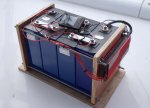
I installed a 271ah LFP bank before my Atlantic crossing. The cells were from RJ Energy.

I use a relatively cheap Daily 200a BMS (though I plan to upgrade in future) and a IDST BattGo balancer to monitor the cell levels. I've got an old Mastervolt BattMon battery monitor, and charging is via 3 Victron MPPT controllers (850w solar), and an 80a alternator via a Sterling Battery to Battery charger (the weakest link in the whole system).

I did not opt for separate high and low voltage disconnects instead letting the BMS handle it for now. I do plan to add a cell level high voltage disconnect in the future. Low voltage disconnect can be handled by the battery monitor or BMS. This doesn't need to be cell level as even in a worse case scenario if you disconnect at 12.6v pack voltage you are completely covered.

The main reason I went for an LFP bank was voltage sag from heavy load items, a more contistant voltage for my water maker, and weight. This system replaced 220kg of FLA 6xT105 an engine start and windlass battery, and weighs less than 30kg. Add another 20 for an AGM battery i bought to be the alternator dump.

3,500nm on it so far, the only issue has been a slighly loose terminal screw, which was causing the BattGo to read incorrect voltages. The right screwdriver and 15 seconds later and all was fixed.

Image added below. Been told it looks like an IED.

This setup was about 30% more expensive than installing similar capacity Rolls batteries.
 

Attachments

  • 54433E08-4762-4DB9-9143-DBA3E4C3EB20.JPG
    54433E08-4762-4DB9-9143-DBA3E4C3EB20.JPG
    300.1 KB · Views: 26
Last edited:
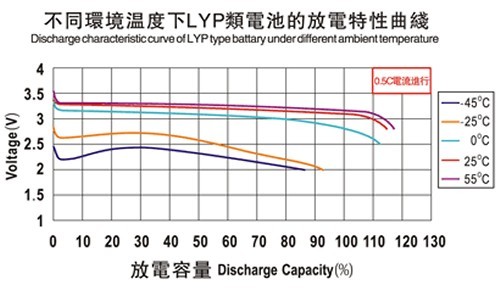
I'm a little confused by the data on Winston LiFeYPO4 cells (link in the OP). I thought that one big advantage of these cells was the ability to use most of their capacity, ie to discharge them quite deeply - so that a given Ah capacity LiFeYPO4 battery would be much more usable than the same Ah capacity lead acid battery.

However, the Winston data says that the cells must not be discharged below 2.5v (below which the cell will be damaged). And a discharge curve shows that, at 25°C (not an unusual ambient temperature in boat use), the cell voltage drops to 2.5v after only 55% discharge. Doesn't this negate one of the main reasons for choosing these expensive cells?

tumblr_p6em9nL1ZR1qa2swjo1_500.jpg
 
I'm a little confused by the data on Winston LiFeYPO4 cells (link in the OP). I thought that one big advantage of these cells was the ability to use most of their capacity, ie to discharge them quite deeply - so that a given Ah capacity LiFeYPO4 battery would be much more usable than the same Ah capacity lead acid battery.

However, the Winston data says that the cells must not be discharged below 2.5v (below which the cell will be damaged). And a discharge curve shows that, at 25°C (not an unusual ambient temperature in boat use), the cell voltage drops to 2.5v after only 55% discharge. Doesn't this negate one of the main reasons for choosing these expensive cells?

tumblr_p6em9nL1ZR1qa2swjo1_500.jpg
The key is not very intuitive as it shows the negative values above the positive. I think there's a tiny minus sign before the uppermost 25 degrees.
 
I'm a little confused by the data on Winston LiFeYPO4 cells (link in the OP). I thought that one big advantage of these cells was the ability to use most of their capacity, ie to discharge them quite deeply - so that a given Ah capacity LiFeYPO4 battery would be much more usable than the same Ah capacity lead acid battery.

However, the Winston data says that the cells must not be discharged below 2.5v (below which the cell will be damaged). And a discharge curve shows that, at 25°C (not an unusual ambient temperature in boat use), the cell voltage drops to 2.5v after only 55% discharge. Doesn't this negate one of the main reasons for choosing these expensive cells?

tumblr_p6em9nL1ZR1qa2swjo1_500.jpg

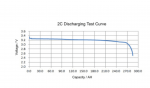
That looks poor and can't be right. Here is the curve for my cells at a 2C discharge rate, so 542a.

As you can see, it doesn't get near 2.5v until the bitter end of capacity. I believe this at 20-25c.

Currently my bank is sitting at 32c ambient is 28c.
 

Attachments

  • RJEnergy-discharge-curve.png
    RJEnergy-discharge-curve.png
    109.9 KB · Views: 6
I installed a 271ah LFP bank before my Atlantic crossing. The cells were from RJ Energy.

I use a relatively cheap Daily 200a BMS (though I plan to upgrade in future) and a IDST BattGo balancer to monitor the cell levels. I've got an old Mastervolt BattMon battery monitor, and charging is via 3 Victron MPPT controllers (850w solar), and an 80a alternator via a Sterling Battery to Battery charger (the weakest link in the whole system).

I did not opt for separate high and low voltage disconnects instead letting the BMS handle it for now. I do plan to add a cell level high voltage disconnect in the future. Low voltage disconnect can be handled by the battery monitor or BMS. This doesn't need to be cell level as even in a worse case scenario if you disconnect at 12.6v pack voltage you are completely covered.

The main reason I went for an LFP bank was voltage sag from heavy load items, a more contistant voltage for my water maker, and weight. This system replaced 220kg of FLA 6xT105 an engine start and windlass battery, and weighs less than 30kg. Add another 20 for an AGM battery i bought to be the alternator dump.

3,500nm on it so far, the only issue has been a slighly loose terminal screw, which was causing the BattGo to read incorrect voltages. The right screwdriver and 15 seconds later and all was fixed.

Image added below. Been told it looks like an IED.

This setup was about 30% more expensive than installing similar capacity Rolls batteries.

Sounds great! Can you expand on why the Sterling B2B was the weakest link? Did your alternator charge your lead acid start battery and the B2B charge the LFP?
 
Top