Graham_Wright
Well-Known Member
...................and do all dosing pumps give the same fuel for each pulse?

The Chinese heaters usully come with 0.022ml.pumps both the smaller 2kw and 5kw although its not unknown for the 2kw to be supplied with a0.016 ml pump....................and do all dosing pumps give the same fuel for each pulse?

As a general point I agree absolutely about insulating the pipework. I did this when I bought the boat and couldnt believe the difference. Dont insulate the first part of the run where it leaves the heater, it can cause overheatingOur 2kw Planar (supplied by Owen) on a 32 foot Sadler has been faultless for 3 seasons. If anything it runs too hot at the lowest setting! But I lagged every inch of the ducting and set it up to recirculate from the cabin. We don't seem to suffer from excessive condensation but we always have some flow of fresh air in the cabin. Without doubt it has been an excellent purchase.
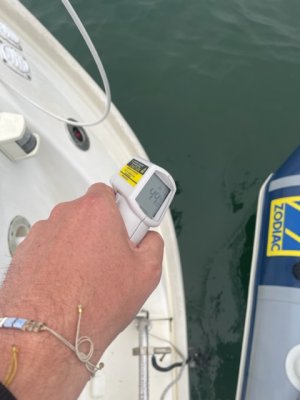

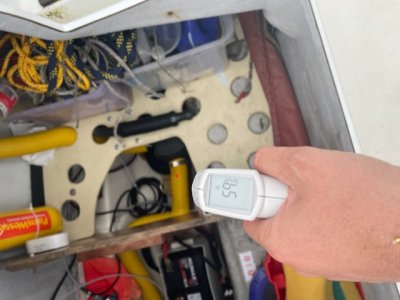
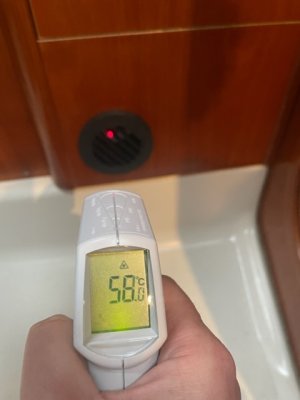
If you still have a problem, contact Owen. He monitors queries constantly and typically advises within minutes.I promised an update to this thread once I had managed to visit the boat. I ran the system from a fresh tank of diesel and removed a small loop in the fuel pipe as suggested earlier in this thread. There was a small Improvement and with the help of a laser temp reader, the temperature was 59 degrees immediately at the outlet of the heater, 58 degrees at the vent and 50 degrees at the exhaust. Air temp must have been around 10 degrees.
This would suggest not much loss of heat in the ducting itself (it’s only a 2m) but interested if the 58 degrees at outlet is reasonable. Earlier threads suggest this should be around 80-90 degrees?
View attachment 155750

I have a 8kw planar heater, installed in the engine room. When run after the engines have been on, the heat output is much reduced, even from the start, so my point is ventilation round the unit is very important for full output.I had Planar's agent Sub Zero install a 4Kw unit to replace a dead 5Kw eber. Before I make any comment I want to say the service level has been superb and I am now very happy with the install but it took a while to get my head round it. Firstly the unit is much fussier about intake air volume than the eber. The old unit ran forever (till it died at about 18 years old) in a closed lazarette drawing air from inside the boat via a duct under the bed into the lazarette. When I do this with the Planar it runs at full chat for about 10 mins and then goes to tickover. Experimentation showed that it is necessary to crack open the lazarette by a couple of inches and with the increased air flow it runs like a bird and will heat my 36 foot Moody to an extent where I have to turn the temp control down - as a scientist I suppose I should say that this is a reproducible finding, the extra air is definitely necessary. It may be the case also that this allows the unit to run cooler and therefore take longer to reach a temperature where it drops back to tickover. As far as settings go I select the top option on the menu (from memory - control by the temperature of the unit), I also set the power to max and initially at least set the cut off temperature (the last menu item) to max as well (30 I think). The unit takes a few minutes to do its run up and then should sound like a rocket taking off for about 30 seconds followed by settling to high output. It does sound to me that your unit for some reason might be dropping back to tickover early and so not putting out much heat. I can just about hold my hand over the main outlet but wouldn't want to leave it there when the unit is going flat out. Hope that helps