Pilotage Done Properly

Thanks for following this up with the link (I missed the issue). Seems he doesn't really advocate 3d modelling but does approve of trying to use some kind of hand-eye effect on memory. I do that, if I've drawn it I'm going to recall it. (usually when trying to concentrate on something unrelated and numbingly mundane, but nm - I'd rather be in the Western Solent than the supermarket queue anyway). Where I disagree is in the value of tracing. I think what's valuable to me is my schematic of what I understood, not a rote tracing. My tracing would be an inferior copy of the chart, my crude sketch is a reflection of what I actually held in my head... if I were good, no doubt my sketches would be better.

But if it works for him, good for him...
 
. . .
There is a fascinating map I spotted in a class room I work in from time to time. It is based on Australia so naturally south is to the 'top'. Clearly there is a teacher who is uncomfortable with that and has turned it round so that the North Pole is in the north; it looks silly.

You can take that a lot further.

For teaching purposes, a few decades ago -
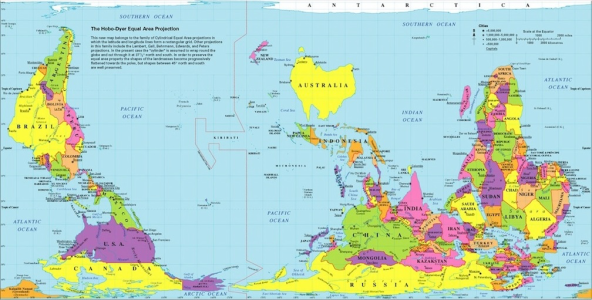
- I got hold of a Gall-Peters Projection World Map (shows something akin to 'equal size' relative to reality, unlike the Mercator projection we are so accustomed to which e.g. exaggerates the relative size of Europe & USA, and grossly diminishes the relative size of Africa and S.America),
- turned it upside down (North up is just a convention, but affects how we view the world),
- then cut it in two, and rejoined it so that it was centred on the Pacific.
This then showed Europe (and especially the British Isles) as a relatively tiny far corner of the world, rather than a huge lump in its centre.

Similar to this -
1738099759034.png

Not to be used for pilotage navigation, though! :D
 
Thanks for following this up with the link (I missed the issue). Seems he doesn't really advocate 3d modelling but does approve of trying to use some kind of hand-eye effect on memory.
Yes, some people who perhaps need to put more effort into understanding the message before shooting it down!

I agree about how you visualise the plan being key. I’ve taught some land based navigation over the years and getting people to be able to look at a map and imagine what it looks like on the ground is the hard part. Contours confuse a lot of people and we sometimes do excercises with playdoh or make them cut out multiple copies of a an are and stack them up like decoupage to help them understand. I usually find that if someone has verbally describe the plan to someone else they end up with a far better memory of what to expect than in they simply scribble down some bearings and grid refs.

Or perhaps, there will be Apps that will create a passage plan for you from digital information.
Orca and Savvy Navy? Will already do a big chunk of that for you (in trial period with both I’ve been rather unimpressed). On a simple trip it is likely time saving, if you make a mistake it could be catastrophic and go unnoticed, but I think the very issue this article was alluding to is a bigger issue - when it’s YOUR plan, you’ve put in the mental effort, you’ve rehearsed it in your head, you’ve seen how close the dodgy bits are, etc. THEN when something goes wrong you are far better prepared, more in control and for any crew get reassuring confidence which is important.
 
You can take that a lot further.

For teaching purposes, a few decades ago -
- I got hold of a Gall-Peters Projection World Map (shows something akin to 'equal size' relative to reality, unlike the Mercator projection we are so accustomed to which e.g. exaggerates the relative size of Europe & USA, and grossly diminishes the relative size of Africa and S.America),
- turned it upside down (North up is just a convention, but affects how we view the world),
- then cut it in two, and rejoined it so that it was centred on the Pacific.
This then showed Europe (and especially the British Isles) as a relatively tiny far corner of the world, rather than a huge lump in its centre.

Similar to this -
View attachment 188808

Not to be used for pilotage navigation, though! :D
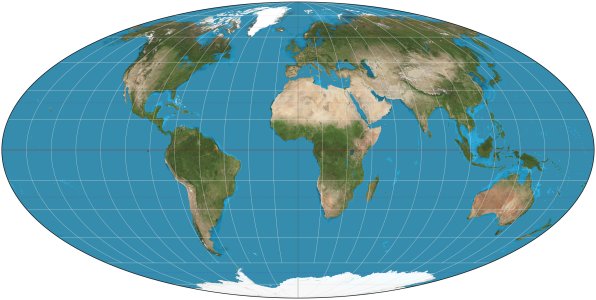
A cartographic aside - the Peters Projection is almost universally abhorred by map-makers, and as it is merely a specific example of the Gall Projection, even associating Peters name with it is annoying. There are many other better projections with the same equal area property (e.g. my favourite, the Mollweide). The South up orientation is a common gimmick from Australia and New Zealand, but it's not really taken seriously!
Mollweide_projection_SW.jpeg
 
You can take that a lot further.

For teaching purposes, a few decades ago -
- I got hold of a Gall-Peters Projection World Map (shows something akin to 'equal size' relative to reality, unlike the Mercator projection we are so accustomed to which e.g. exaggerates the relative size of Europe & USA, and grossly diminishes the relative size of Africa and S.America),
- turned it upside down (North up is just a convention, but affects how we view the world),
- then cut it in two, and rejoined it so that it was centred on the Pacific.
This then showed Europe (and especially the British Isles) as a relatively tiny far corner of the world, rather than a huge lump in its centre.

Similar to this -
View attachment 188808

Not to be used for pilotage navigation, though! :D
When I first got here and started my gin-sodden-expatriate development I was very irritated by the way local maps (for tourists and such) failed to obey the N at top (or any) orientation convention, and suspected it was related to the astonishing Taiwanese ability to get lost driving around the block. Universal pocket GPS has pretty much made the maps, at least, go away now though.
 
I'd think perhaps a bucket and spade, and the sandbank that my poor pilotage put me on. Then I could video my approach by "flying in " my smartphone, while humming the 633 squadron theme. Endless fun until the tide comes back in.

But as someone has already pointed out, the article doesn't actually advocate routine model building, just considers its worthwhile if you hope to blow up a dry dock in occupied St Nazaire
 
Almost no knowledge or experience, but my impression is that this procedure is largely based on electronic sources and may assume the abscence of paper charts, so, although its mostly aimed at building "situational awareness", a potential important secondary objective is a backup in case of electronic failure.

If thats correct, this aspect might be of increasing importance as paper charts get scarcer.
 
... Savvy Navy? Will already do a big chunk of that for you (in trial period with both I’ve been rather unimpressed). On a simple trip it is likely time saving, if you make a mistake it could be catastrophic and go unnoticed, but I think the very issue this article was alluding to is a bigger issue - when it’s YOUR plan, you’ve put in the mental effort, you’ve rehearsed it in your head, you’ve seen how close the dodgy bits are, etc. THEN when something goes wrong you are far better prepared, more in control and for any crew get reassuring confidence which is important.

Indeed. Savvy Navy charts are unreliable and quite frankly dangerous: Loch Spelve chart has no indication of mussel farms outlines or annotated and an automatic passage plan, even if checked, would lead a boat into danger. Loch Long Coulport restricted area is not delineated correctly. I cancelled my subscription to Savy Navy as their charts are unreliable. They do have updates as certain other features have been amended, so not sure what is going on. However, this level of missing data means that it's not a product I would use. I checked Lighthouse, Navionics and both missing features are displayed one these charts.
 
When I first got here and started my gin-sodden-expatriate development I was very irritated by the way local maps (for tourists and such) failed to obey the N at top (or any) orientation convention, and suspected it was related to the astonishing Taiwanese ability to get lost driving around the block. Universal pocket GPS has pretty much made the maps, at least, go away now though.
Not just Taiwan - Hong Kongers also struggle with directions. I think it's the excellent public transport - you get on at one place, change as necessary and get off at your destination. You don't need to know the real geography, and the transport network is as misleading in that regard as the Tube Map in London.
 
. . . The South up orientation is a common gimmick from Australia and New Zealand, but it's not really taken seriously!

The North up orientation is an even more common gimmick! ;)

And taken all too seriously (along with the typical Eurocentric, er, centring of world maps) in the sense that its ubiquity shapes, without us being conscious of it, our perception of the world.

There is no neutral map. Every map is a distorting interpretation of the world (which is also its value), and it is useful to remind ourselves of our very partial perspectives.

We should be wary of cartographers, because it is they, surely, who are to blame for the prevalence of Flat Earth Conspiracy Theorists! 😁 ;)
 
The North up orientation is an even more common gimmick! ;)

And taken all too seriously (along with the typical Eurocentric, er, centring of world maps) in the sense that its ubiquity shapes, without us being conscious of it, our perception of the world.

There is no neutral map. Every map is a distorting interpretation of the world (which is also its value), and it is useful to remind ourselves of our very partial perspectives.

We should be wary of cartographers, because it is they, surely, who are to blame for the prevalence of Flat Earth Conspiracy Theorists! 😁 ;)
You have a point when you say there is no such thing as a neutral map - indeed it is doubtful that there can be. It is noteworthy that an excellent introductory cartographic textbook is "How to Lie with Maps" by Monmonnier! However, there is such a thing as common cartographic conventions. and north up is one of them. Applying conventions means that viewers more readily understand maps and the relationships they portray. Other orientations are normal in some parts of the world - most of my mapping was either north up OR Greenwich Meridian up, north up making little sense for a map with the south pole in its centre. The Greenwich up orientation was a) logical and b) agreed by the relevant bodies (including representatives from southern nations). But in the Arctic we applied the opposite convention of Greenwich DOWN.
 
You have a point when you say there is no such thing as a neutral map - indeed it is doubtful that there can be. It is noteworthy that an excellent introductory cartographic textbook is "How to Lie with Maps" by Monmonnier! However, there is such a thing as common cartographic conventions. and north up is one of them. Applying conventions means that viewers more readily understand maps and the relationships they portray. Other orientations are normal in some parts of the world - most of my mapping was either north up OR Greenwich Meridian up, north up making little sense for a map with the south pole in its centre. The Greenwich up orientation was a) logical and b) agreed by the relevant bodies (including representatives from southern nations). But in the Arctic we applied the opposite convention of Greenwich DOWN.

Just to be clear, I am not at all opposed to cartographic conventions, whether north up, the ubiquity of the Mercator projection or anything else.

I am just very interested in how they, and cartography more generally, inform and shape our perceptions of the world without our usually being aware of how partial they are.

Yes, I've read Monmonier's book (albeit long ago now), and even after successive culls still have a small library of books and learned articles on the history of cartography and its role in society. I'd also recommend David Turnbull's 'Maps Are Territories: Science Is An Atlas' as a very accessible, entertaining and informative introduction to cartography as a social phenomenon. It has, among many other illustrations and explanations, some great examples of 'maps' from other cultures that we would struggle to even recognise as such. (We forget how culturally specific modern cartography is).

I'm amused, but not at all surprised, that even in the wastes of the Antarctic in the 21st century, your advanced cartographic endeavours were still reinforcing the Greenwich Meridian (presumably actually the IRM?), with its origins in the imperial and scientific eminence of Britain in the 17th century. If I'd only know about it earlier I might have included it as a passing example in my draft PhD thesis, alongside, for example, Ransome's map of 'Secret Water' (aka Walton Backwaters). :D
 
Thank you - looks fascinating so just ordered a copy.

Years back I was recommended by Uni professor - How to Lie With Statistics. The techniques in there still seem to be applied by default.
Truncated axes, inappropriate scaling, comparing n thousand with m million and suchlike? And not making it clear that the difference between two numbers is within the error bounds, and so not significant?
The XKCD web comic often has exaggerated examples!
 
I guessed you were an XKCD fan, Antarctic... I nearly posted the "what your chosen map projection says about you" comic in this thread already, now I know it belongs!
Map Projections
Not fair on Mercator though....
Well, I personally dislike Mercator intensely, and warned polar scientists off it! But its one good point (straight lines are rhumb lines, a property no other projection has) makes it indispensable for navigation. But it has no other good points; it is conformal, but at the expense of extreme and non-linear scale distortion, the mathematics for the ellipsoidal case is horrible and, for the transverse form, intractable. Of course, the fact that Mercator can't depict the poles may also colour my judgement! And before you suggest transverse Mercator, the distortion far from the central meridian puts it out of consideration.
 
Yes, I was only thinking of the navigation use at comfortable latitudes. It must be considerably less use than a chocolate teapot at the poles!

Fortunately we are blessed with plenty of projections to choose from...
 
Not just Taiwan - Hong Kongers also struggle with directions. I think it's the excellent public transport - you get on at one place, change as necessary and get off at your destination. You don't need to know the real geography, and the transport network is as misleading in that regard as the Tube Map in London.
Not much local public transport outside Taipei, everyone uses scooters.

My best guess is its a group-think-thang. Boldly going where no one (or at least oneself) has gone before is perhaps more consistent with individualist cultures, and they are generally reluctant to do it, so they dont get the practice.

First taxi I got here I wanted to get to the sea, that big wet blue thing, quite hard to miss on an island. Showed the driver my map and he didn't seem to understand what it was. Had to navigate every intersection for him, and this subsequently proved to be quite usual, though eventually most of them got the hang of satnav/
 
Not much local public transport outside Taipei, everyone uses scooters.

My best guess is its a group-think-thang. Boldly going where no one (or at least oneself) has gone before is perhaps more consistent with individualist cultures, and they are generally reluctant to do it, so they dont get the practice.

First taxi I got here I wanted to get to the sea, that big wet blue thing, quite hard to miss on an island. Showed the driver my map and he didn't seem to understand what it was. Had to navigate every intersection for him, and this subsequently proved to be quite usual, though eventually most of them got the hang of satnav/
Could be. That's a general Asian thing, I think.
 
Top