Pile Mooring -- Single Handed

So I'm on my new mooring. A forumite most kindly came along and helped, without which there's no way I would have managed it.

After the experience, I know less than I knew before, or let's say, I know more about what I don't know.

It was especially difficult because the light line connecting the two strops was too short, so we had to untie it to get both strops on board. Whilst the boat was not really tied to anything. There was 5 knots of cross wind and zero current (high tide stand) so almost ideal conditions, and still it was difficult.

We did try a leader line through a bow cleat and that helps somewhat.

Some way to stabilize the boat at least temporarily whilst getting the strops on would really be helpful. I thought about a static line, but how would you rig it? The range of tide here is more than 3 meters, so depending on state of tide it can be high overhead or underwater (which would be dangerous).

I'm going to go down the river this afternoon in the dinghy and try to see how others have done it.
A line with floats on it originally suggested that one in the middle but if that's not sufficient then a couple of others along the length of the static line. It sounds as though there are no iron risers that will help the line to rise and fall so rather than fixing the line to the pile some form of buoyant collar needs to be improvised so that there is not too much slack in the static line.

Edit
A quick thought for the floating collars: If they are still available the cork or whatever inshore net fishermen use on their nets threaded onto the line which is then made into a loop which can be done when moored or if it's possible to get the collar over the top of the pile then done ashore or again on board but the loop can be formed with a splice.
Alternatively use a largish diameter tube 3" in place of the floats filled with closed cell foam.

Three fenders threaded onto the line before making the last collar should ensure that it floats and is visible without much slack in it.
 
Last edited:
A line with floats on it originally suggested that one in the middle but if that's not sufficient then a couple of others along the length of the static line. It sounds as though there are no iron risers that will help the line to rise and fall so rather than fixing the line to the pile some form of buoyant collar needs to be improvised so that there is not too much slack in the static line.

Edit
A quick thought for the floating collars: If they are still available the cork or whatever inshore net fishermen use on their nets threaded onto the line which is then made into a loop which can be done when moored or if it's possible to get the collar over the top of the pile then done ashore or again on board but the loop can be formed with a splice.
Alternatively use a largish diameter tube 3" in place of the floats filled with closed cell foam.

Three fenders threaded onto the line before making the last collar should ensure that it floats and is visible without much slack in it.
Thanks for this.

There are big iron rings on a vertical rail which allows the strops to move up and down with the tide. But the rings are underwater at high tide, at least on a spring tide like yesterday.

One consideration with the static line is that it will be extremely dangerous if it's just underwater. I guess it would need floats along the whole length to prevent that, or maybe a floating polyprop line.

Or maybe mounted high enough to never be underwater, to be usable only at high tide.

I will also consult with the HM today to see if he has any insight.
 
Thanks for this.

There are big iron rings on a vertical rail which allows the strops to move up and down with the tide. But the rings are underwater at high tide, at least on a spring tide like yesterday.

One consideration with the static line is that it will be extremely dangerous if it's just underwater. I guess it would need floats along the whole length to prevent that, or maybe a floating polyprop line.

Or maybe mounted high enough to never be underwater, to be usable only at high tide.

I will also consult with the HM today to see if he has any insight.
Usually there is a line attached to each sliding ring by which you can pull it up.
 
An interesting thread.

Its a technique that has been used in various forms for generations yet there does not appear to have satisfactory answer.

There are 2 immovable poles, each has a set of lines, to suit the berth holders (and for public moorings a variety of berth holders) and a connecting line secured to vertical rails - to accomodate tide changes.

All a bit like mooring to a pontoon.

Yet after 103 posts still no acceptable answer.


My wife and I had never seen a pile mooring, up close and personal and were without access to the wisdom of YBW.

We sat off the pile mooring that we had been allocated for the night and simply discussed what was possible. Ignore the available kit, take an over sized carabiner and attach to the 'up wind/current' verttical rail snd have other handy for the down wind rail. Motor into the current snd Josephine attaches one carabiner and takes in as much slack as possible, increase revs to take in more slack. Use boat hook to bring down current/wind vertical rail close enough to clip on second carabiner. Ignore line between poles (its visible and above the water level).

Easy with 2 people - single handed have all kit ready,, nudge 'up pile' and use engine to hold against pile. clip on larger carabiner - the rest as per a crew of 2 or a large crew.

Its little different to mooring to a pontoon in a marina with a flow through the marina or an adverse wind.

But maybe its easier with a multihull (with the nimbleness of 2 engines) and/or a yacht that only weighs 7t (not ignoring holding 2 oversized carabiners) (or shackles) as mooring kit.

No anguish.

I confess I became a bit blasé about mooring as suggested single handed. I regularly would sail back to the marina entrance single handed under full sail, and in light winds under spinnaker. I'd entered the marina dropped the spinaker and main I'd laid out the lines so that I could access a bow and stern line easily, nudge the Pontoon under gentle revs leap of the stern and walked confidently forward to attach bow line - to find I had not secured the neatly laid out lines had not secured them to JoXepehine (too busy showing off) and she had drifted too far way that a younger me could not leap back on board.

I did consider leaping and swimming - but then reason prevailed and I realised I could walk round and catch the errant yacht on the next pontoon. The assembled audience never knew I'd cocked it up :)

Jonathan
 
An interesting thread.

Its a technique that has been used in various forms for generations yet there does not appear to have satisfactory answer.

There are 2 immovable poles, each has a set of lines, to suit the berth holders (and for public moorings a variety of berth holders) and a connecting line secured to vertical rails - to accomodate tide changes.

All a bit like mooring to a pontoon.

Yet after 103 posts still no acceptable answer.


My wife and I had never seen a pile mooring, up close and personal and were without access to the wisdom of YBW.

We sat off the pile mooring that we had been allocated for the night and simply discussed what was possible. Ignore the available kit, take an over sized carabiner and attach to the 'up wind/current' verttical rail snd have other handy for the down wind rail. Motor into the current snd Josephine attaches one carabiner and takes in as much slack as possible, increase revs to take in more slack. Use boat hook to bring down current/wind vertical rail close enough to clip on second carabiner. Ignore line between poles (its visible and above the water level).

Easy with 2 people - single handed have all kit ready,, nudge 'up pile' and use engine to hold against pile. clip on larger carabiner - the rest as per a crew of 2 or a large crew.

Its little different to mooring to a pontoon in a marina with a flow through the marina or an adverse wind.

But maybe its easier with a multihull (with the nimbleness of 2 engines) and/or a yacht that only weighs 7t (not ignoring holding 2 oversized carabiners) (or shackles) as mooring kit.

No anguish.

I confess I became a bit blasé about mooring as suggested single handed. I regularly would sail back to the marina entrance single handed under full sail, and in light winds under spinnaker. I'd entered the marina dropped the spinaker and main I'd laid out the lines so that I could access a bow and stern line easily, nudge the Pontoon under gentle revs leap of the stern and walked confidently forward to attach bow line - to find I had not secured the neatly laid out lines had not secured them to JoXepehine (too busy showing off) and she had drifted too far way that a younger me could not leap back on board.

I did consider leaping and swimming - but then reason prevailed and I realised I could walk round and catch the errant yacht on the next pontoon. The assembled audience never knew I'd cocked it up :)
That's a good story.

I NEVER leap off my boat when mooring single handed. For one thing, the freeboard is too much. I am extremely grateful to fate that I still have very well functioning knees, unlike many of my friends, and want to keep it that way. But mainly it's to avoid this very situation you describe. I have developed my lassoing skills (I was born in Texas, so maybe some of it is genetic), and that's my go-to method with regular docking cleats or bollards. With those cursed rings in the Baltic, I use a special Baltic mooring hook, but you have to be closer to the ring, than when you are lassoing cleats.

Yes, displacement of the yacht matters. Below a certainly level (10 tonnes? 15 tonnes?) you can push and pull the yacht around with main force. In my childhood, on my father's boat, my own arms provided the main force, as he got the boat somewhere vaguely near something which could be grabbed. And if you had a line on something, you could pull on that to move the boat. That was a Pearson 365, about 10 tonnes.

Your arm strength cannot be used above a certain displacement; you have to rely on main engine, thruster, vectored force against angled lines, wind, sails, etc. So I would never want to be on the quay with nothing but lines attached to my boat in my hand. Recipe for disaster in my case.

The appropriate use of main force is a key item on the new crew briefing, on my boat.
 
Such is the windage on our 3 hulls that we regularly resort to attaching the stern and threading a long bow line through the bow cleat and onto the pontoon cleat, then winching the free end to bring the bow in. More than 20kn of wind blowing us off our mooring and this becomes the standard method. It's not only displacement that negates the crew's brute force. 2 grown men could possibly manage to pull her in, but there lies an assortment of ways to rupture yourself or be dragged into the water, or both. No, finding a way, on any boat, where brute force is not required is always best.
 
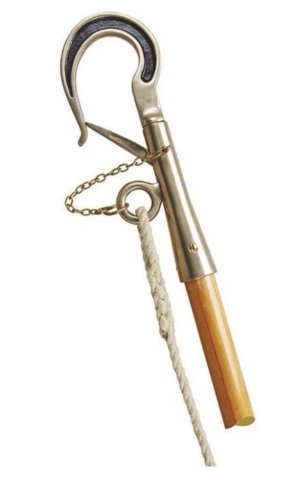
I have found one of these

Ye Olde Grabit Boathook.
I have devices similar to that on board -- a Swedish "Hook 'N Moor", a Baltic mooring hook.

I don't think this would help much in this case -- I could get a line on the pickup buoy but I'm not sure that helps. As it is I can reach the pickup buoy with a normal boat hook and pull it up to get at the intermediate line.

I did try looping the pickup line over a midships cleat, which somewhat stabilized the boat, but it's still a reach to get at the actual mooring strops, and hard to connect a leader line. I think the issue is that the intermediate line is too short. Maybe if it's longer I can not loop but tie it to a midships cleat, then pull up the strop, get the leader line on that, without having to untie the intermediate line.

That's one of two improvements I'm considering.
 
I put the Grabit hook on the vertical iron bar and replaced it later. The line on the Grabit led through the bow or the stern fairlead. One end of the boat “secured for the moment” leaving me to sort out the other end.

I found I could “grab” the “aft” pile’s iron bar from the cockpit; the line went through a fairlead on the counter and was made off on a cleat on the side deck near the cockpit.
 
Last edited:
Top