
UK-WOOZY
Well-Known Member
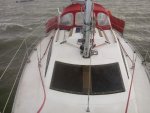
the front window on my Jeanneau Sundream is 12mm and sides are 6mm.


Hi,
Looking at buying new perspex windows and struggling to find any recommendations about desired thickness.
I'm assuming that some clever person has worked out the minimum thickness of perspex required per maximum height or width of the window span???
Cheers,
Ian
You could employ beam theory for a simply supported beam. Work out the second moment of inertia and the load for forces derived from a body of water under X meters head.
Or you could just state that 8mm polycarbonate will be perfectly sufficient for anything short of a mortar round
Whats the thickness of the old windows?
e 6mm thick, long but only about 7" tall. I did in fact try and break the J27 windows which were badly crazed but it was very difficult and had to resort to a club hammer with the Perspex clamped in a heavy vice and it took about 3 blows before it broke. .
Lloyds 100A5 rated portlight thickness of 10mm. Height of portlights is 140mm, maximum portlight length is 670mm. Portlights are situated in CE Area A2.
NormanS;6772048ook the trouble to give at least some idea of the size of his windows? Without that information said:I'm looking for an equation or predictive model that i can calculate myself. I'm trying to avoid anecdotal responses.
Average yacht, Small to medium windows 6mm. Large windows 8mm. Huge windows 10mm.
With the greatest respect, you’ve given those who might help virtually no contextual information at all.
Whats the point? You havent metioned the size of your windows.

Disagree. I'm looking for a scientifically reproducible method of calculating the appropriate thickness of perspex required for a given span. I'm not asking anybody to do that calculation for me.
I'm trying to avoid anecdotal responses.
Stating that in your OP might have been a helpful step that would it not?


I think you calculation needs more thought process 1 mm of perspex will do , but what forces will
a/ push it in
b/ shatter it
so in theory you really would need to work out your A/ sailing areas B/ What weather would you expect to see
This then leads you into forces
The formula for force says force is equal to mass (m) multiplied by acceleration (a). If you have any two of the three variables, you can solve for the third. Force is measured in Newtons (N), mass in kilograms (kg), and acceleration in meters per second squared ( m/s2 )
But this would be difficult because you would need to know the Acceleration of the wave or the Mass to work out the force against the perspex
Then you would need to understand the perspex and how it was made
I have a link to a great Plastic shop with a PDF with a lot of technical dat for you to browse and maybe come up wih a formula for two objects colliding which would be Pressure and force I think
Pressure and force are related, and so you can calculate one if you know the other by using the physics equation, P = F/A. Because pressure is force divided by area, its meter-kilogram-second (MKS) units are newtons per square meter, or N/m2.
But as you can imagine this is a boaty forum and you are asking the impossible question without being either a Maths or physics Genius
https://www.theplasticshop.co.uk/plastic_technical_data_sheets/perspex-design-guide.pdf
Page 5 is good
Page 24 also for wind speeds

Then add in grade of Perspex, exposure to sunlight, amount of curvature the material is exposed to, allowance for age. I am sure you could go on. Or just tell formites the intended cruising area, type of boat and size of windows and some decent chap will say you boat sounds pretty similar to mine, this has worked for me for the last twenty years......


Disagree. I'm looking for a scientifically reproducible method of calculating the appropriate thickness of perspex required for a given span. I'm not asking anybody to do that calculation for me.
I'm trying to avoid anecdotal responses.
Insert eye roll here...
I'm looking for a scientifically reproducible method of calculating the appropriate thickness of perspex required for a given span. I'm not asking anybody to do that calculation for me.
I'm trying to avoid anecdotal responses.
Because I don't want the answer, I want the method of calculating it. I'm trying to avoid anecdotal responses.