Permanent Mooring Lines

Hu Hum ..... now I understand .... that the term Cow Hitch is being misused ...

The use of a spliced or bowline loop in end of rope to create is actually a BALE HITCH or its full name : BALE SLING HITCH.

as in :

Bale Sling Hitch
Fair enough, but news to me. Although it is not something I would use, a simple cow hitch with two half hitches ought to be as stable as a similar round turn, though perhaps making a bowline as illustrated might be better. I always use a loop with a cow hitch when tying to a mooring overnight, at least for the primary line. (I also attach a light line to the loop which enables recovery from the foredeck).
 
According to Wikipedia, a bale sling hitch is a type of cow hitch, where there is a loop/soft eye spliced into the warp, so technically, if wiki is to be believed it is a bale sling hitch when a loop is choked onto a bar/tube. But when using a bridged cleat, I thread the soft eye through the bridge on the cleat and then pass the loop over both horns. Which isn’t any kind of knot because there is rope to rope contact.
 
I’ve just renewed my insurance and the following clause has been added to my policy;

Due to increasing amounts of Storm claims, the following new Condition will apply : Your Craft must be secured to the mooring using a substantial backup mooring line or chain in addition to the normal method of attachment between 01 November to 31 March.

I suspect that all marine insurance companies will adopt a similar policy.

Mike
 
I attach the eye splices on the ends of the mooring lines to the buoys using cow hitches.

See my post ..... because you are using the spliced loop - it is a secure and good method. But if the true cow hitch was used - where its meant to have tension applied to BOTH rope ends exiting separately - you would be at risk as using only one end without any locking hitches - it is unstable.
Its why its used for chain stoppers when making fast ships wires of a capstan ... once wire is made fast to bits - the chain stopper is easily removed as the Cow Hitch does not lock up.
 
According to Wikipedia, a bale sling hitch is a type of cow hitch, where there is a loop/soft eye spliced into the warp, so technically, if wiki is to be believed it is a bale sling hitch when a loop is choked onto a bar/tube. But when using a bridged cleat, I thread the soft eye through the bridge on the cleat and then pass the loop over both horns. Which isn’t any kind of knot because there is rope to rope contact.

Yes the pass through ad over is common and a good way to secure a line .... but again - its a closed loop and not just a bight of rope.
 
Due to increasing amounts of Storm claims, the following new Condition will apply : Your Craft must be secured to the mooring using a substantial backup mooring line or chain in addition to the normal method of attachment between 01 November to 31 March.
Given the usual practice of mooring using a bit of 'wet string' ,and the resulting carnage in marinas, I wonder how owners will interperpate this?
 
As a habit, photographing one's mooring lines ' arrangements before leaving the boat is a quick, cheap way - using mobophone camera - of avoiding lengthy arguments with one's insurer. You'd have proof of 'best practice' in event of a challenged claim. It also encourages you to use 'best practice'....
 
Over winter I generally double up the mooring lines anyway. Like Sandy says, it’s amazing the bits of string that some tie up their £££££ floaty thing with.
 
In my experience unless your mooring is exposed to strong winds or wave action your plans are probably an over-reach. Exposed situations are well catered for by springs or rubber tensioners. 3 strand Nylon line has the stretch and flexibility and is easily spliced. A loop through the pontoon cleat is fine. 14mm will hold fast for several seasons. Thimbles are not required to avoid chafe. Fixed length lines are especially useful
 
I had my mooring overhauled a couple of months ago. I asked the guy how it was and he plled a face and said, "Let's just say you've had your money's worth out of that chain." :eek:

In my defence, I had been nagging him to do it for months, but...

At Tudor SC and also at Farlington Yard ... we used to get our chain from the Gravel / Dredger guys next door ... bit oversized but best ground chain I've ever used. They had to replace their working chains at set life regardless of condition.
 
At Tudor SC and also at Farlington Yard ... we used to get our chain from the Gravel / Dredger guys next door ... bit oversized but best ground chain I've ever used. They had to replace their working chains at set life regardless of condition.
Ground chain?

Chain abrading on the sea bed will wear based on its hardness and size, thicker chain takes longer to wear through. Harder chain also takes longer to wear through but harder chain is of a higher tensile strength, so G40 or G70 instead of the more common, and cheaper, G30. Transport chain might be a G70, lifting chain would normally be a G100 or exceptionally and very expensive, a G120. Most other chain is a G30 or G40 (and given the other variables, sea bed, weather - I doubt you would tell the difference over the life of a mooring G30 vs G40). The galvanising on ground chain wears off very quickly - basically its a waste of time (and money).

Chain makers usually work on a simple 10% loss - beyond which chain is retired. Normally standard for chain is to physically test it for strength, or loss of strength. Ground chain usually abrades. Chain subject to the sea surface environment will not be subject to much abrasion but may degrade through corrosion.

In locations with mud acid corrosion is a major issue, think old docks, very slow moving rivers - where the mud has a bad egg smell.

Most mooring chains will all be a G30 quality.

In Australia there is much retired mining chain which tends to wear along the length of the chain, not the crown. In moorings its the crown that wears - so good use of a chain retired for wear in a different part of the chain.


Moorings are a safety device, as well as being a convenience. I always attend the replacement of our mooring tackle - but then I have a fetish :)

This is a chain that had a delayed, very, servicing - in fact it failed and the yacht finished up on the beach. The chain was a G30 and the shackle a G80 (you can see the different in the effects of abrasion on the 2 different steels - not in reality that much). The seabed is silica sand. This is the yacht end of the ground chain, the sinker end enjoys less abrasion.
IMGP1634.jpeg

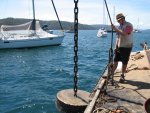
Our moorings are very heavy ground chains, see in the picture below 1.5" chain, attached to a sweep chain (around 15mm), the chain in the above image and then a rope riser (the operator is holding the riser)

40wandeen yachts mooring screen 027.jpeg

In terms of the OP. Our moorings use over sized strops from the mooring buoy, on the surface, and the yacht. The mooring strops have simply hosepipe where there might be wear on the strop as it rubs on the yacht (fairlead) and for the full length of the splice (to protect is from abrasion from the horn cleat.). The splice to the chain at the seabed is also protected by hose pipe. You can see, above (ist picture), the hosepipe is not the point of failure, the hose pipe rubs on the shackle and seabed. The snatch load is accepted by the chain on the seabed, both the sweep chain and the really heavy chain attached to the sinker - not the elasticity of the rope. The rope is well oversized - it simply connects yacht to chain on the seabed - and in reality offers no elasticity. However mooring designs vary - either you need elasticity or weight (chain) on the seabed. I suspect our mooring configuration is different to yours.

None of our splices have thimbles

There are many ways to skin a cat :

Jonathan
 
Last edited:
"Neeves" ...... those chains from the Dredger boats outlasted any other ... so much so in fact that when anyone was looking to lay or change old laid trots - club and even HM mentioned using it.

Do you think we were just taking any old chain from them ? Don't forget also that my background is as a Deck Officer who had to know about such matters ...

My post anyway was in response to Stemar ...
 
Top