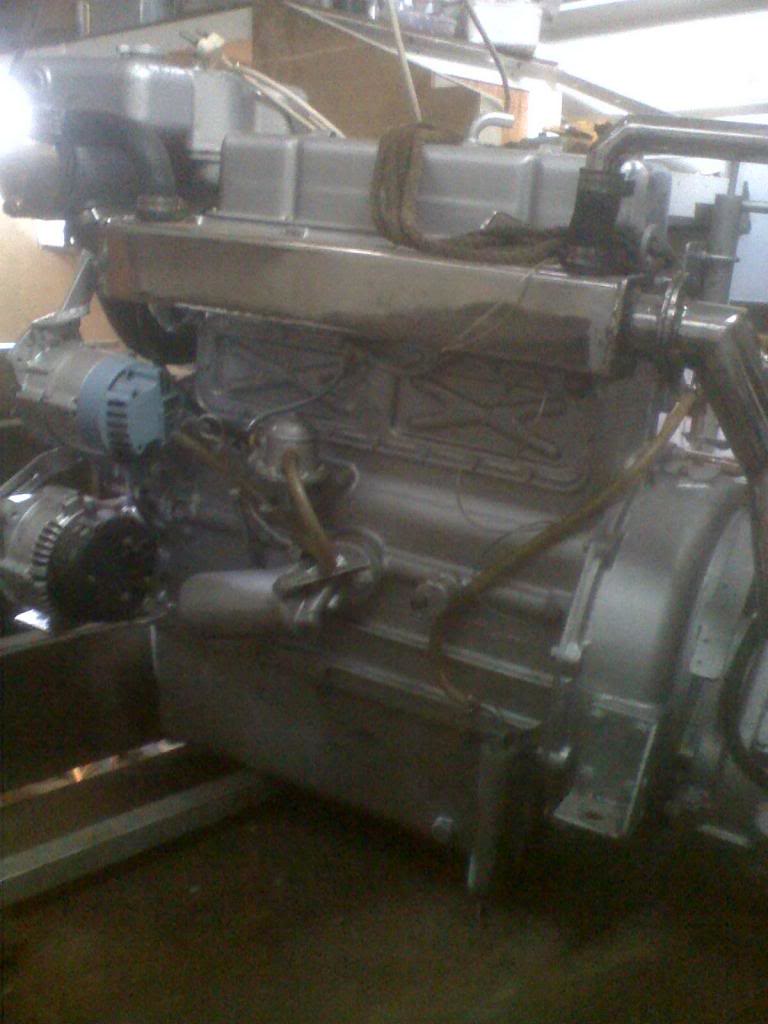
Perkins 4.108 second alternator

djstefan

New Member
Joined
4 Dec 2004
Messages
13
Visit site
Dear all,

Does anyone have experience of adding a second alternator to a Perkins 4.108? Is there a mounting kit available and what are the likely costs?

I already have a new 90 amp alternator so would use that for the domestic batteries and add a smaller alternator to charge the engine battery.

I'm looking a the various split charging systems that are available (series regulators, VSR's etc) and think that a seprate alternator for house and engine batteries is the way to go - particularly as I plan to live on board in the near future.
 
I have a Perkins 6354 with two alternators, the original for the engine batteries, and the newer larger one for the domestic and bowthruster banks. There is a Chargemaster monitoring system on the domestic side.

I recently installed a Sterling charger to replace the old Constavolt system and fitted a three-way switch to allow the Bowthruster bank to be used to supplement either engine or domestic banks. The system works well.

Somewhere there are the layout drawings I did when we set the system up. P.m. me if of use. Can't help re any fixing kits.
 
Thanks for the info - your set up sounds similar to what I have in mind. Just need to figure out how I go about installing a second alternator.
 
In my 4108 the second alternator is installed this way, maybe it may give you some ideas

P1020074.jpg
 
Starting the engine uses so little battery power (less than 1Ah) that it's hardly worth adding a dedicated alternator to charge the starting battery. Much better to spend the money on a "smart" regulator for your 90A alternator, and use a VSR to keep the starting battery charged. Unless you have a huge domestic battery bank, you'll rarely be able to push 90A into it, so there'll be plenty to spare for charging the starting battery.
 
Thanks for your thoughts and pictures.

I still think that 2 alternators is the best way to go as I intend to live on board and like the idea of redundancy in the charging system. However I do accept that a good split charging system with a smart regulator, VSR or (preferably) a series regulator would certainly do the job pretty well. I'll have a look at costs and decide from there.
 
Hey Roberto I saw you posting of a Perkins alternator with a squarel fan on the front. Where did you getthat? It's awesome.
Uh very old thread:)
I have found that when I bought the boat, I do not know where it came from nor where it could be sourced.
Useful though, it acts as an engine bay blower, the outlet has a duct leading to an opening at the passageway where warm air can be felt blowing out.
 
Thanks for your thoughts and pictures.

I still think that 2 alternators is the best way to go as I intend to live on board and like the idea of redundancy in the charging system. However I do accept that a good split charging system with a smart regulator, VSR or (preferably) a series regulator would certainly do the job pretty well. I'll have a look at costs and decide from there.
Re living aboard: We, pre Covid, would spend min 3-4 months each year cruising and living aboard. Running a large diesel just to charge the batteries makes no sense what so ever and if done without load is bad for the engine to boot. We have used a small suitcase gen for that purpose when off-grid, but having the beast screaming away on the foredeck is not conducive to one's mental health or neighbourly relations for that matter.
3 years ago, we installed 300W of solar on the wheelhouse roof and we haven't looked back since or run any engine to just charge batteries. This is cruising in the Baltic, Holland, UK and Britanny, summer to late fall.
Solar, these days, is by far the cheapest and most convenient way of keeping those batteries charged.
Wind generators need a surprising amount of wind to produce anything of value and downwind their output is pretty useless. Some are very noisy.

Our old BMC used to have a second alternator run off the same belt. This is a terrible solution, as it regularly chewed up the drive belts in no time. The previous owner managed to fry the engine trying to make port in adverse conditions when the belt failed on him.
 
Our old BMC used to have a second alternator run off the same belt. This is a terrible solution, as it regularly chewed up the drive belts in no time. The previous owner managed to fry the engine trying to make port in adverse conditions when the belt failed on him.


That's why I have a separate belt for each alternator and the water pump.
 
I know that but I changes it to to make my setup more bulletproof.

Did I do something wrong then ?

Are you a bit touchy today?

The reason water pumps are usually driven by the primary alternator's belt is that it makes tensioning easier. If you want a dedicated belt for the water pump, you have to add a tensioner pulley, which starts to get complicated for many people. Anyway, as the load imposed by the water pump is minimal, it works OK for most people on the primary alternator's belt.
 
Ancient thread revived, no point posting, so deleted.
 
Are you a bit touchy today?

The reason water pumps are usually driven by the primary alternator's belt is that it makes tensioning easier. If you want a dedicated belt for the water pump, you have to add a tensioner pulley, which starts to get complicated for many people. Anyway, as the load imposed by the water pump is minimal, it works OK for most people on the primary alternator's belt.

Yes as you do tend to be very sarcastic at times when all I am trying to do is to help the OP.

My history does back to me growing up in South Birmingham where I lived was over looking the Austin factory tuning mini for fun.

BTW you can see my water pump tensioner pulley just left of the upper alternator.
 
Top