Partial? holding tank system - is that a thing?

samfieldhouse

Well-Known Member
Joined
18 Sep 2016
Messages
192
Visit site
I crew on a 2000s Dufour 38 that has various quirks.
There appears to be a holding tank that doesn’t function like any I’ve seen before.
It would appear that the heads outlet goes into the top of the tank.
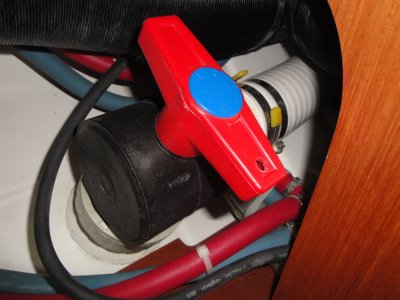
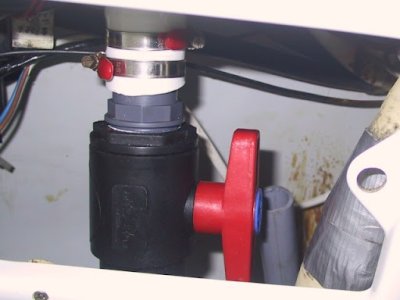
At the bottom of the tank is an outlet straight to the seacock.
At the top of the tank there’s a small diameter breather/overflow (I assume) and a large diameter pipe to a pump out fitting on deck.
My assumption is that one can empty the toilet with the seacock closed, filling the tank, with pressure expelled via the breather.
With the seacock open I assume it then empties via the seacock as normal, with the pressure from the heads forcing the contents of the tank out via the seacock.
Currently the tank appears full, with water being expelled from the breather when the toilet is pumped and, when unscrewed, black water coming out of the inspection hatch.
I’m assuming there’s a blockage at the bottom of the tank, preventing egress via the seacock.
I’ve never seen a system like this, has anyone else?
There are no additional valves or plumbing. And yes, I also question what happens with the boat healed and the tank dipping below the waterline.
And how do we pump it out, I’ve never used a pump out station to empty this type of tank, do we just suck and hope?
 
Hmmm replying to my own thread, but having done some searching on this excellent forum it would appear to be a “through flow” holding tank and the solution being to get it emptied then rod it through via the inspection hatch.

Any clues on how to empty it, can we use a normal pump out station?
 
I have just installed a similar system in Musketeer. The pump-out connection to the tank includes a syphon pipe to the bottom of the tank, so that the marina pump extracts from the bottom not the top. My understanding is that this is the normal arrangement, certainly all the stock tanks that I've seen have this pump-out tube. The other arrangement is to tee the pump-out from the gravity drain (before the seacock, of course).
 
How low below the surface is the seacock? If you can I’d just rod it from under the water [important bit!] whilst the person doing the rodding is in a tender.
 
You can definitely pump it out. I’ve owned two boats with this system of gravity discharge to sea, never had a blocked one though. In my own experience, open the seacock to discharge resulted in the tank contents draining in a few seconds. The seacock diameter of c. 1.5” seems unlikely to be blocked unless you have had a visitor flush eg baby wipes.
 
If you're lucky the deck fitting is directly above the drain and you can rod it without taking the top off the tank.
 
It would appear that the deck access p, as well as being only about 6” above the tank, is almost above the seacock exit so that’s a good sign.
We’ll get it pumped and go from there. Thank you!
 
This is a fairly standard design on Bavarias and it sounds like other production boats. One source of blockages in the plastic tank gets covered in sheets of crystalline material which as the tank flexes breaks off in big sheets/lumps and then blocks the outlet.

If you search this site you’ll find various tips and tricks for trying to rod it from above or below. People may also suggest using dinghy pump to blow it through. Ultimately you may need some very long marigolds and a nose clip and some way of bailing via the inspection hatch!!! If you can get a lot of the slurry out then we took two very large bottles of the cheapest own brand Diet Coke (full fat stuff is sticky) you can get (about 50p/L) and pour into the tank and leave it for a while (we left it a week) and it drained easily. Vinegar and other acids will do the same but getting large quantities of coke is easy and perhaps the fizz helps!

If I couldn’t pump out but the overflow was working I’d be tempted to try flushing coke through the pump out fitting (which goes to bottom of tank) and the toilet which feeds the top of the tank.
 
Yes, bog standard installation if you pardon the pun. Exactly as on my Jeanneau. Works exactly as you describe. I'd be surprised if you can't push a flexible rod straight down from deck access to the exit at the bottom of the tank. Mine is laid out that way with one big wrinkle. There's a 90 deg. elbow that prevents rodding right through. It could be blocked with wads of paper or other items and they'd need to be pushed through. I'd suggest a flexible rod from the deck if there's no elbow at the skin fitting. Pushing from below will be difficult and less likely to get stuff out.

Calcified material is fairly likely and rodding would help. Hydrochloric acid would work if the tank was fairly empty. Getting it to the blockage would be difficult with a full tank. I'd do that by pushing a long wide tube down from the deck and filling it with acid. If you leave a couple of feet above deck and keep pouring the head of liquid will take the acid down. Displaced water will exit via the hull overflow.

You could also do the same with strong caustic if the blockage is organic in nature. Problem with either acid or alkali is knowing which is needed and also making further work more dangerous if it doesn't work.

Rodding is probably the best bet at a first step, especially if you can get a lot pumped out first.

BTW the fizz in Coke won't help and Hydrochloric acid would be much more effective than either Coke or vinegar.
 
I've sailed modern Jeanneau and Beneteau boats (own included) and the holding tank system is set up as you describe.

Are you sure you're opening the correct seacock? The holding tank outlet is large and will usually be plastic like the image below.

On my boat, the outlet pipe runs across into the bottom of the starboard aft cabin and is accessed under a panel in the wardrobe floor.

I have experienced a tank blocking where someone accidentally tried to fill the tank via the deck outlet using a hose. When they realised their mistake, they pulled the hose out but the "Hoselock" connector on the end pulled off, fell into the tank and jammed at the seacock. A big stinky job to fix.

AD1E0876-CE1F-4353-9154-FC59B044386A.jpegunnamed.jpg
 
Maybe after pumping out the addition of a generous dose of white vinegar followed by a long wait will help dissolve the whatever is blocking the outlet.
I believe from past discussions flushing with fresh water instead of sea water may be less likely to generate a precipitate via a chemical reaction so that may be considered for future use . Lets hope nothing that has not been passed through a human body (and water) has been flushed.
 
I assume that you have tried going to sea and when well away from land opening the seacock?
By the way, it is also common to have a diverter valve in the outlet from the toilet at a high point near the tank. One branch goes to the seacock via a Y-junction. The drain from the tank goes to the other branch of the Y. It doesn't matter which way the diverter is set when the seacock is opened, the tank will empty.
 
It would appear that the deck access p, as well as being only about 6” above the tank, is almost above the seacock exit so that’s a good sign.
We’ll get it pumped and go from there. Thank you!
You should be able to rod it . The outlet to the seacock will be bunged up because the owner has failed to use it properly. Waste should not be left for any time in the tank - just use the tank when you need say at anchor, then empty it at sea or pump out as soon as possible. always flush through when leaving the boat and leave the valve open so the tank is empty. Really simple trouble free system, almost universal with modern production boats if you use it properly - I have had 3 boats with such a system and only had trouble with one when unknown to me it was left full by somebody else who failed to have it pumped out before leaving the boat.
 
Thank you for all the info and the replies. It’s tricky when it’s not your own boat! I operate a “if you haven’t eaten it, don’t flush it” policy, with a bin - but this boat is all flush, which I don’t really approve of, especially as it’s “bog” standard loo roll, not biodegradable as far as I know.
The seacock is always open and the tank has never been pumped.
So are the learnings here:
Leave the seacock closed until off shore (or pump).
Flush through with clean or fresh water before leaving the boat.
Suggest a bin?
 
BTW the fizz in Coke won't help and Hydrochloric acid would be much more effective than either Coke or vinegar.
Hydrochloric acid a stronger acid but you can’t walk into virtually any shop and buy it - so coke has a distinct advantage. Vinegar isn’t too hard to find but is more expensive for the sort of quantity needed The consequences of spilling Diet Coke whilst doing this are minimal. HCl needs a bit more care, and depending on the concentration potentially safety precautions. If it does turn out you picked the wrong agent then you have a bigger problem!

As for the fizz - people use the dinghy pump to build up pressure - I agree it’s probably not the no 1 effect but I am impressed by your certainty. In fact I’m not even sure the fizz didn’t help “churn up” contents of the tank / pipe.
By the way, it is also common to have a diverter valve in the outlet from the toilet at a high point near the tank.
I suspect that’s exactly the sort of arrangement the OP is more familiar with - but what his friend has is definitely not odd or unusual on modern production boats. I’m not convinced a diverter valve actually brings a real benefit and just adds another thing to jam/block/fail.
So are the learnings here:
Leave the seacock closed until off shore (or pump).
Yes they should be doing that anyway.
Flush through with clean or fresh water before leaving the boat.
If they have no tank level sensor this may give them a false sense of security - they could just be adding more water to a blocked tank - without a level sensor the first you become aware of the issue is when it starts coming out the vent - and the smell hits you!

It may be worth adding some way of checking the status of the tank.
 
You should be able to get Hydrochloric acid in many places at reasonable strength, probably 7-10%. I just bought a few 500ml bottles here in Greece for 60 cents each. Many supermarkets stock it. I bought it in Spain as agua fuerte. In UK you'll find it in Toolstation or similar as brick c!eaner. Something like Cementone would be mainly Hydrochloric acid as the active ingredient. Check the datasheet first as patio cleaners will often be based on quaternary ammonium salts rather than acid.

Forget the fizz in Cola. The hydrochloric acid will generate a large amount of gas and much more "fizz". Much cheaper than Cola for given amount of acid in many places. UK brick cleaner will probably be more expensive. Whether or not it's a sensible option is another thing. I'd only expect Cola to contain around 0.25 - 0.5% phosphoric acid, not really a lot and really only likely to remove very small levels of calcification.

I still have a modest understanding of basic chemistry from my time in research many, many years ago. Almost alchemy then with terms like corrosive sublimate, calomel, etc.(kidding).
 
Last edited:
Our holding tank blocked whilst we were docked at Kilmore Quay, where the pump out station was out of action.
We then set off to Spain and assumed that five days of very lumpy weather in Biscay would do the trick and dislodge whatever was causing the blockage. It didn't do a thing!
Whatever bright spark fitted our system used a tank with an inspection hatch half way to the side, so I wasn't keen to open that up with a brimming tank.
I was able to empty it out by weighting the end of a length of hose and putting this over the side, with the other end in the tank via the pump out fitting. Under sail, it created enough of a venturi effect to start a syphon, and it got the tank down below the level of the hatch. I was actually quite surprised that it worked because these sort of ideas rarely do...
 
Unless people are shitting carbonate bricks I fail to see what hydrochloric acid / vinegar ( acetic acid) or Diet Coke will do in any meaningful time frame to a blockage of solidified excrement and paper. Mechanical agitation either by a compressed air ( dinghy pump hose) or rodding is the way to clear blockages then as other people have pointed out use it properly by emptying at every opportunity and flushing when the boat is not going to be in use.
 
Indeed I’m more familiar with diverter valve setups.
I’ll feed all this back, thank you!

And to confirm, when the seacock is opened at sea the tank will drain, I assume through physics and not black magic?

Or use a pump out facility.
 
Top