Panope Vid No 138

Neeves

Well-Known Member
Joined
20 Nov 2011
Messages
14,073
Location
Sydney, Australia.
Visit site
For those who keep up with the videos No 138 has been released. Sadly the Kobra, as it is topical, does not appear - its not easily available (if at all) in Seatle.

Enjoy - or otherwise.

And if you don't like anchor threads - simply don't watch - and then you will not need to complain. :)

Jonathan

 
For those who keep up with the videos No 138 has been released. Sadly the Kobra, as it is topical, does not appear - its not easily available (if at all) in Seatle.

Enjoy - or otherwise.

And if you don't like anchor threads - simply don't watch - and then you will not need to complain. :)

Jonathan


I think what can be determined by Steves videos is that more than one anchor design needs to be carried if not 3 designs! Interesting how the bruce performed quite well in soft mud.
 
I think what can be determined by Steves videos is that more than one anchor design needs to be carried if not 3 designs!
As probably 99% of real world cruisers who anchor a lot use for 99% of the time a single allround anchor they trust (with possibly a second one for very specific cases), I wonder what practical advice can be detemined from those tests. :)
 
As probably 99% of real world cruisers who anchor a lot use for 99% of the time a single allround anchor they trust (with possibly a second one for very specific cases), I wonder what practical advice can be detemined from those tests. :)

Many worship and wait in anticipation for the next video. Some are so committed, they sponsor the work. Many are very sceptical of the tests. There are 2 camps. On some forum they have a healthy debate on anchors (and the Panope tests) - like YBW. In other venues criticism of the Panope tests is simply not tolerated by the assembled devotees - be warned.

A worry that I saw, on one video - that I did not take note of and then forgot which video - he remarks at the end of vids the financial support he receives - very sensible and nothing wrong. However in one video he thanked those who had sent donations and then said 'thank you for the large amount submitted by one source'. (or words to that effect). The donation was sufficiently large to merit special mention and thanks and I later wondered who would have made a sufficiently generous amount to be specifically thanked - though anonymously. I immediately thought Bill Gates et al.......?

The issue with his tests are that the videos are long, and frankly, boring on top of which is a blanket of scepticism. The summary spreadsheets give you most of the salient details, they tend to be at the end of each vid - so quick forward till you find the spreadsheet.

Anchor testing is laboriously tedious, expensive and often dirty - magazines have difficulty in funding the work - the only guaranteed advertiser are the anchor makers that do well - and many of them are small and impecunious.

The Panope tests throw up, basically, a negative for Rocna - which makes little sense as it is one of the most popular anchors on bow rollers.

The big question is - how can the buying public, who have Rocna on their bow roller, have got it so wrong - or what is wrong with the test protocols? The question is obvious and unanswered.

Fortress in their tests clearly define an environment in which Fortress excels:

Anchoring in Squishy Bottoms - Practical Sailor

The tests were paid for by Fortress - so the expected result is obvious. But strip out Fortress (and if you like Danforth) and look at the other results. It is impossible for Fortress to have engineered good or bad results for every single other anchor - its not that easy.

The results demonstrate that in soupy mud most anchors simply do not offer any certainty - because most anchors do not develop sufficient hold. Reasons are probably many but most anchors rely on sitting on a hard substrate to allow them to roll over to the correct and designed (setting) orientation. Roll bar and ballasted anchors have the same issues and can sink into the seabed upside down, so the fluke sits upside down and simply skates over the mud - a bit like a sledge in snow. I have watched this and the anchor will drag until it reaches harder seabed, or not. Fortress and Danforth have no top and bottom, they simply need patient coaxing . Some anchors are hydro dynamic and will arrive at the seabed 'right way round' and as long as you set to ensure this happens with your anchor - it may develop hold - but hold is then contingent on surface area and Fortress wins hands down with a big fluke and no extra weight. Consequently the idea that you choose an anchor for its strengths is well known and there is nothing new there. I think Fortress have some articles on their tests - which explains in more detail. Roll bar anchors can clog in weed - we all know this. Pebbles can clog or jamb a Fortress and Danforth . We have flogged it to death - and weed is not really an ideal seabed in which to anchor (it may harbour seahorses :) ).

The odd thing about the tests is the rejection, used in every other test, of holding capacity. Holding capacity has been used as THE measure of performance for decades and in every test I can think of - it curries no favour with these tests. This is really odd as hold has stood the buying public well over the last 20, 50, 70 years - why is it now rejected. Development of good hold usually appears to result in good veering characteristics etc etc .....? Price is another issue - relative prices in N American will be different to Europe - so care needs to be taken. I also wonder how you can determine engineering excellence and galvanising quality simply by looking at an anchor - you can reject obvious flaws - but a good, looking, galvanising finish does not guarantee longevity.

We carry and use an aluminium Excel as our primary and also carry an aluminium Spade (neither of which are rated highly) we also carry a FX16 and FX 37, the latter for soupy mud. We carry, effectively, 3 primaries, the Excel, Spade and FX16 in case we need to anchor in a fork or "v" or in case we lose one (and still want to anchor in a 'V'.

If we could accept a roll bar we would retire the Spade in favour of a 10kg Viking (which we have tested for hold - it has the same hold as the No 4, alloy or steel Excel or A80 Spade). Our conclusion is the Panope vids - or spreadsheets are right - but this is cherry picking (If Rocna is wrong then the protocols are all wrong - you cannot cherry pick :( )

Take care, stay safe

Jonathan
 
Last edited:
The condemnation of Rocna in his tests is difficult to understand. I understand its down-marking by Morgan's Cloud but it seems to me that this results from mud clogging in somewhat specific seabeds in northern Canada: heavy deep mud.

Although most of my free anchoring is on relatively light sandy mud in Greece this is not true of harbours where heavy mud is common. But of course here there is no requirement to reset as we are berthed on anchor stern-to a wall. We certainly pick up some large clods of mud but I doubt that any would prevent resetting if that were necessary.

Having bought one of the first Rocnas to reach UK, NZ made and bought from Ireland before there was a UK importer, I can honestly say that in 13(?) years of frequent use for nearly 6 months of almost every year we have never dragged once set properly. Setting almost always occurs immediately but a few failures have been problematic due to weed and various forms of debris. Resets on wind shifts have been countless and always drag free.

One wonders whether there is an underlying secret agenda for this anchor, particularly when the so-similar Manson Supreme seems to be satisfactory.
 
One wonders whether there is an underlying secret agenda for this anchor, particularly when the so-similar Manson Supreme seems to be satisfactory.

There's clearly something odd about the difference between Panope's testing of Rocnas and the wealth of real-world experience. I find it hard to believe that there is a hidden agenda, at least one that effects results - that would be quite an elaborate con. I noticed in one video that a Rocna was improved in his tests by drilling some holes in the flukes to allow suction to be released. This is quite a small change and it makes me wonder if his mud testbeds have a narrowly specific stickiness not commonly found elsewhere. The error then being to generalise from those results.
 
The condemnation of Rocna in his tests is difficult to understand.
I am puzzled by the amount of credit given to these tests, they do not reflect very wide sample serious real life experiences. If widely repeated real facts do not conform to tests or theory, then tests must be made in a different way, or theories revised if their aim is to explain something.
Re Morgan Cloud: ok a handful of very experienced sailors... may I stress "a handful", with a lot of internet resonance? Widen the anchor user panel to other countries "very experienced sailors" which do not write on the internet, the sample is multiplied by 00s or 000s and there is basically no one complaining about their specific anchors, whatever they are; these include Antarctica anchoring, NW passage, NE passage (the one above Russia), anchors holding 180° reversals in tropical rivers with bus-size chunks of floating forest blocked against the chain, Patagonian kelp, etc
Ex. we often experience 4 x 180° reversals a day (ok lunar month, say 3.9 :) ), it's about 100-120 a month: I wonder how come I have not lost my boat at least several hundred times, not even once; the tester tries two three times and the final verdict is out...
Anyway, each one to believe what they like to believe :)
 
Anyway, each one to believe what they like to believe :)

It is interesting - many people use a Rocna without issue (or many other anchors) and looking at their anchor, recalling their experience they say there is something wrong with the Panope tests - and then worship at the alter of the results despite finding the results for their anchor invalid. Either the results or conclusions are ALL wrong (and the public's experience with Rocna are correct). OR the tests are very valid and should be accepted without argument and thus owners with a Rocna are a disaster waiting to happen.

You cannot have it both ways - you cannot cherry pick - or you can but it lacks any logic.

The issue I dislike is that if the results are invalid then then some manufacturers are being hammered unfairly (who would have thought I might feel for Rocna. :) ). Arguably it is upto the manufacturer to dispute the results. It does show the power of video and the internet as a marketing tool (accidental or otherwise).

I have this niggle at the back of my mind, expressed also by Vyv - is there an underlying agenda (or agendas) of which we are unaware. If I were an anchor manufacturer I would be trying to influence these results (in the nicest possible way) - they are unhealthily powerful. I am not suggesting making one's anchor looking better, though that is one option - but a bit obvious - but denigrating the market leaders is another option. And if you want to 'nip an anchor in the bud'....? like Epsilon - do so before it gains any momentum.

Classification testing (CS), for example of Rocna, has been invaluable in the past. I remain puzzled as to why Epsilon similar in performance as rated by CS to Rocna, Excel, Ultra, Supreme are not rated more similarly and why independent tests like the 2006 West Marine tests or the more frequent Voile et Voileur tests are suddenly found totally invalid. These tests are as independent as you can get - yet Rocna and Epsilon (and possibly others) are now singularly damned and found inadequate.

I have queried the inconsistency and not received an answer.

Now one can be banned for expressing such views and apparently attacking the integrity of an individual or organisation, been there, done that - so I am sticking my neck out....

There is nothing like a good mystery (which may be a simple fabrication in my mind) to freshen up an anchor thread.

As you say - people believe what they want to believe.

Jonathan
 
Interesting that Skip Novak, widely admired as the doyen of anchorers in wild and difficult places, apparently uses a Rocna, having used a CQR for many years.

Mind you - having relied on a CQR I am sure he noticed the difference .... and never looked back.

I'm not a great fan of Rocna, tinged by their issues, and I think there are better anchors (and a greater range of better anchors) now. So Mr Novak might not be keeping upto date on what's fashionable today. But he is in good company, not far from Pelagic's home port, Port Stanley,
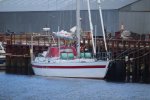
IMG_6597.jpeg

unrecognised heroes would agree with Sip Novak's choice. This is a Maltese registered yacht in Ushuaia
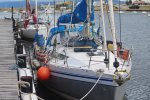
IMG_6374.jpeg
The blue laundry basket in the cockpit contains, some, of the shore lines the rest are in the sail bags secured to the mast.

Why do I get the idea when the chips are down - shore lines are the go to answer :)

But they do reinforce the question - why if they appear to be well accepted are they poorly rated .......

You don't use a questionable anchor in Patagonia (or anywhere else).

Jonathan
 
his is a Maltese registered yacht in Ushuaia
View attachment 139859
The blue laundry basket in the cockpit contains, some, of the shore lines the rest are in the sail bags secured to the mast.
Lookie lookie, Stranizza :)
Angelo and Antonella a couple of very good friends, they spent a fzew years spanning from Pacific Chile to Falklands, now they are in Gijon preparing for the North.
ovni345.blogspot.com
their blog for friends/family, no loud "withdrawing their endorsement" for anything, may I say there are tens or hundreds others with similar silent allround experiences, not even internet existence, just use what works, and if an anchor is doubtful it will not last long on the bow. Spade, Rocnas, etc you name it, there are perfectly satisfying anchors for 99% of hard work, the 1% being possibly a Coke can on the tip, a flat rock bottom, etc etc.
 
The condemnation of Rocna in his tests is difficult to understand. I understand its down-marking by Morgan's Cloud but it seems to me that this results from mud clogging in somewhat specific seabeds in northern Canada: heavy deep mud.

Although most of my free anchoring is on relatively light sandy mud in Greece this is not true of harbours where heavy mud is common. But of course here there is no requirement to reset as we are berthed on anchor stern-to a wall. We certainly pick up some large clods of mud but I doubt that any would prevent resetting if that were necessary.

Having bought one of the first Rocnas to reach UK, NZ made and bought from Ireland before there was a UK importer, I can honestly say that in 13(?) years of frequent use for nearly 6 months of almost every year we have never dragged once set properly. Setting almost always occurs immediately but a few failures have been problematic due to weed and various forms of debris. Resets on wind shifts have been countless and always drag free.

One wonders whether there is an underlying secret agenda for this anchor, particularly when the so-similar Manson Supreme seems to be satisfactory.
WelI second that , we actually anchor far much longer each year then Vyv does or should I say did till this year and had the same result, since we left Greece 5 years ago all our anchoring is free swinging we very rarely tie back .
Just to add on our latest boat , Bene 36 came with a Manson 15 kg ,
We been using this mostly every day and it's been no problem, set fast, hold well the biggest blow we had 28 kts , lots less then we been use to.
But so far it's all in muddy waters , so I would expect good holding
 
Last edited:
I am puzzled by the amount of credit given to these tests, they do not reflect very wide sample serious real life experiences. If widely repeated real facts do not conform to tests or theory, then tests must be made in a different way, or theories revised if their aim is to explain something.
Re Morgan Cloud: ok a handful of very experienced sailors... may I stress "a handful", with a lot of internet resonance? Widen the anchor user panel to other countries "very experienced sailors" which do not write on the internet, the sample is multiplied by 00s or 000s and there is basically no one complaining about their specific anchors, whatever they are; these include Antarctica anchoring, NW passage, NE passage (the one above Russia), anchors holding 180° reversals in tropical rivers with bus-size chunks of floating forest blocked against the chain, Patagonian kelp, etc
Ex. we often experience 4 x 180° reversals a day (ok lunar month, say 3.9 :) ), it's about 100-120 a month: I wonder how come I have not lost my boat at least several hundred times, not even once; the tester tries two three times and the final verdict is out...
Anyway, each one to believe what they like to believe :)

It's not a handful, they just don't all post about it.

I have had both Rocna (once), Manson Supreme (once), and all pivoting fluke-type anchors (several times) clog with sticky mud and fail to reset during routine overnight anchoring (not anchor torture tests). I have not seen this with other anchors, and I have tested Mantus, Delta, Excel, Bruce, Spade, and Claw. Obviously, if you do not anchor in a sticky mud area this is not something you will notice or be aware of.

It is not super common, but in the right mud it is not rare either. I would say one night per 30 when there is a good shift is a fare estimate in some places. Far, far less if there is some sand in the mix., or if the mud is very soft. It has to be sticky, clay-based mud. This is more fact than opinion.
 
I think the only test really matter is the one you do yourself ou own anchor.

That sounds rather like the people that accept the religion of the fathers, never have researched it or any other. The assumption being father knows best, and his father, and his father before him.... Which is unsettlingly common. It is easy, though.

Unless you have used many anchors, and investigated the statements of many others, then you only know one thing. Once upon a time I though Danforth was pretty good. I was told Delta was good, and I used that for a few years. And then I looked around and found other anchors. Progress is based on curiosity and testing. This is true of all sailing gear. There is a lot of traditional stuff we use because we like the idea of it and it is good enough, not because it is best or even very good for the sailing we do.
 
That sounds rather like the people that accept the religion of the fathers, never have researched it or any other. The assumption being father knows best, and his father, and his father before him.... Which is unsettlingly common. It is easy, though.

Unless you have used many anchors, and investigated the statements of many others, then you only know one thing. Once upon a time I though Danforth was pretty good. I was told Delta was good, and I used that for a few years. And then I looked around and found other anchors. Progress is based on curiosity and testing. This is true of all sailing gear. There is a lot of traditional stuff we use because we like the idea of it and it is good enough, not because it is best or even very good for the sailing we do.
Well keep watching video of test and keep buying ,
Maybe people just need to lean how to anchor in the first place.
Most NG anchor work well , as we all know or should know there not one anochor that will work on all sea bed .
I used an delta for many years beforeI brought a Rocha it worked fine , I brought the rocna when we had a new to us boat and it had a CQR which I also had in the pass that worked well in east coast muddy river but cruising it was useless .
The Rocna always worked other then the odd time in weed .
We now have another boat that came with a Manson , I didn't go out to buy a Rocna because of the last experance I had or because of some video I seen on you tube , I throught I give the Manson a go and so far it working very well ,
We have enough experience in anchoring in all weather , seas bed and non shelter coast to know it's won't be our technic if the anchor doesn't hold , it be the ground we are in or the anchor it self ,
At them moment other then sand and some light stones, it's been mud , some soft some hard , and it's done it job ,
So for now I hang on to my hard earn cash and stick to the Manson no matter what some guy on you tube says or how low down it's on his chart ,
 
At the end of the day, all anchors are a compromise. Where as in the profession (big) anchoring world, a sea bed survey followed by anchor pattern design, they will hire a set of anchors appropriate to that site. We want one anchor to work in any site we choose based on it beauty, convenience or shoreside attributes, not on its seabed substrate.
Clearly some anchors are better all rounders than others. But I think we all realise that there are some instances where the bower is not suited to what lurks beneath and we either have suitable alternative or range of anchors or accept that we need to find somewhere else to lunch/spend the night.
The current ‘arms race’ of anchors is rather conveniently fed by us forumites and YouTubers who spend lots of time and money discussing and upgrading their hooks
 
Top